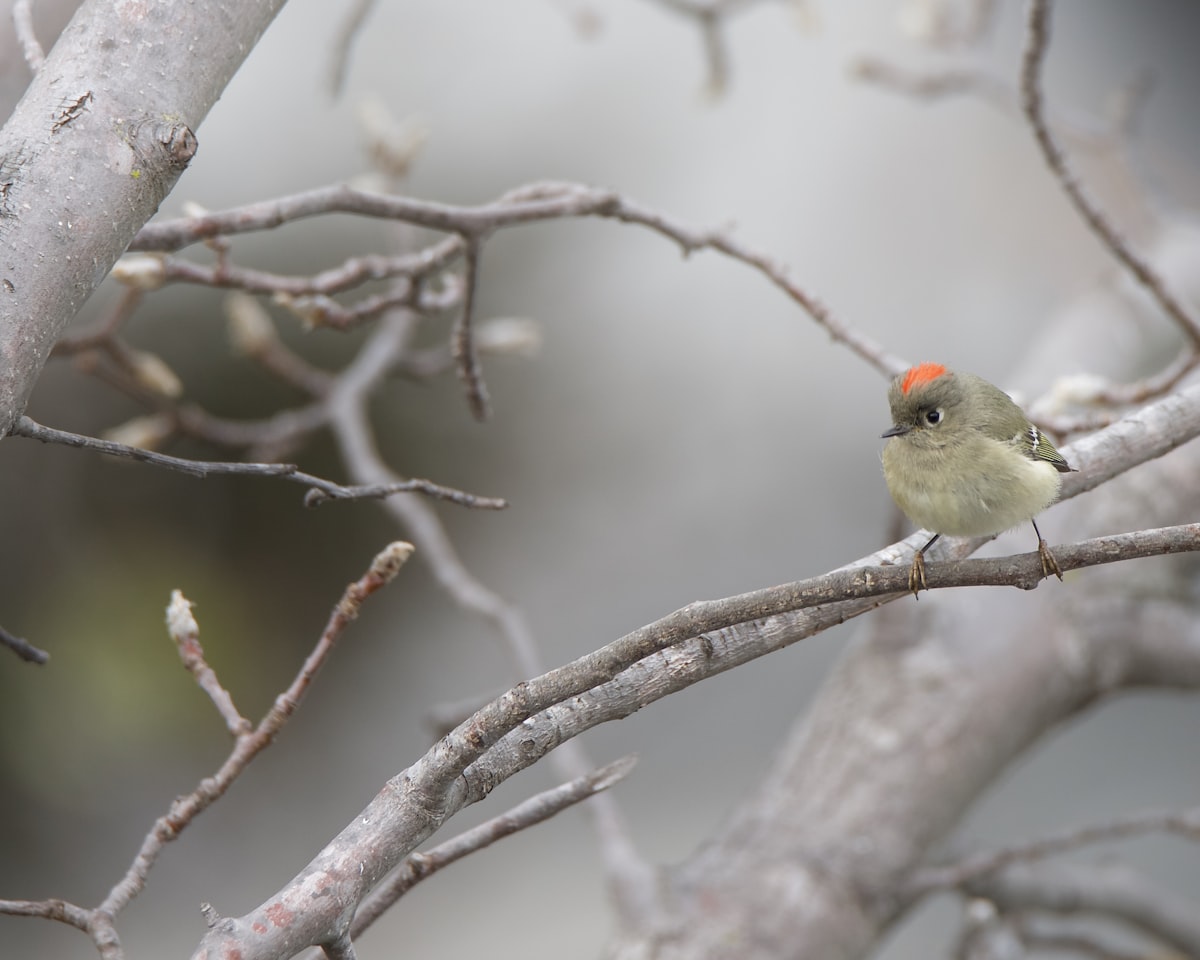
The Ruby-crowned Kinglet weighs about as much as two paper clips — roughly 6 grams — making it one of the smallest songbirds in North America, barely larger than some hummingbirds. And yet the male carries a small patch of brilliant red feathers on the crown of its head that’s almost never visible, hidden beneath the surrounding feathers unless the bird is excited or agitated enough to raise it.
Identification
Overall impression: A tiny, plump, olive-gray bird in constant motion, with a short tail, thin bill, and a habit of flicking its wings nervously while foraging — a behavior that’s often the first clue to the bird’s identity before any plumage detail is visible.
Key field marks:
- Bold white eye-ring, broken at the top — Creates a distinctive “surprised” facial expression, one of the most useful field marks since the ruby crown itself is usually hidden
- Ruby-red crown patch (males only) — Normally concealed, only visible when the bird raises the feathers during territorial displays or agitation. Females lack this patch entirely.
- Olive-gray upperparts — Plain, unmarked gray-green above
- Two white wing bars — With a dark bar behind the lower wing bar, a useful confirming detail at close range
- Constant wing-flicking — A nervous, rapid flicking of the wings while foraging, distinctive enough that the behavior alone can identify the species before plumage is clearly seen
Size: 3.5–4.3 inches long, wingspan 6.3–7.1 inches, weight 0.2–0.3 oz (5–10g). One of the smallest songbirds regularly encountered in North America.
Basic Facts
| Feature | Detail |
|---|---|
| Scientific name | Regulus calendula |
| Family | Regulidae (kinglets) |
| Length | 3.5–4.3 inches |
| Weight | 0.2–0.3 oz (5–10g) |
| Wingspan | 6.3–7.1 inches |
| Lifespan | Up to 4 years on record |
| Eggs per clutch | 5–12, cream to white with brown speckling |
| Incubation | 12–14 days |
| Conservation status | Least concern |
The Hidden Ruby Crown
The species’ defining feature is also its most elusive. The male’s namesake ruby-red crown patch remains flattened and hidden under the surrounding olive feathers during normal, calm behavior — most encounters with a Ruby-crowned Kinglet never reveal the crown at all, leaving observers looking at what appears to be a plain gray-olive bird with no red visible anywhere.
The crown becomes visible only when the male raises the feathers, typically during territorial disputes, courtship displays, or moments of high excitement or agitation. When fully raised, the patch is a small but vivid red crest that briefly transforms the bird’s appearance — a genuinely striking difference from its usual understated look.
This means confirming a male Ruby-crowned Kinglet by the crown alone requires either luck or patience watching an agitated bird — the white broken eye-ring is a far more reliable field mark for routine identification.
Surviving Extreme Cold at a Tiny Size
Ruby-crowned Kinglets are remarkable for their ability to survive genuinely cold winter temperatures despite their extremely small body size — a physiological challenge because smaller animals lose heat faster relative to their body mass than larger ones. Some populations winter as far north as the mid-Atlantic and Pacific Northwest, enduring freezing nights on a body barely larger than a hummingbird.
The species compensates through nearly constant foraging activity to maintain the metabolic rate needed for heat production, along with roosting behavior that minimizes heat loss overnight — huddling in dense conifer foliage that provides insulation against wind and cold. The energy demands are intense enough that a kinglet’s entire waking day is essentially dedicated to finding enough food to survive the following night.
Diet
Almost entirely insectivorous — Ruby-crowned Kinglets glean small insects, spiders, and insect eggs from foliage, twigs, and bark, foraging with rapid, restless movement through branches, often hovering briefly to pick prey from the underside of leaves (a technique called “hover-gleaning”). In winter, when insect availability drops, the diet shifts to include more spider eggs, small berries, and tree sap where available.
They are not feeder visitors given their tiny size and specialized insect-focused diet — most people who see a Ruby-crowned Kinglet encounter it while it’s actively foraging in shrubs or low tree branches rather than at a feeder.
Song: Surprisingly Loud for the Size
Similar to the Carolina Wren, the Ruby-crowned Kinglet’s song is disproportionately loud and complex for such a tiny bird — a cascading series that typically starts with high, thin notes before dropping into a louder, more musical warbling phrase, often rendered as “tee tee tee, tew tew tew, look-at-me, look-at-me.” The volume and complexity relative to the bird’s size surprises most people the first time they trace the sound to its source.
Range and Migration
Breeds primarily in coniferous forest across Canada and the western mountains of the US, migrating through and wintering across most of the continental United States and into Mexico. Because breeding habitat is largely remote boreal and montane forest, most people encounter Ruby-crowned Kinglets during migration or winter, when the birds pass through or settle in a much broader range of habitats including suburban yards, parks, and mixed woodland.
Golden-crowned Kinglet: The Close Relative
The Golden-crowned Kinglet is a closely related species found in similar habitat, distinguished by a bold black-and-white striped face pattern and an orange-yellow (rather than ruby-red) crown patch that, unlike the Ruby-crowned Kinglet’s hidden crown, is visible at all times rather than concealed. Golden-crowned Kinglets also tend to tolerate colder temperatures even further north in winter, being slightly more cold-hardy than their ruby-crowned relative.
FAQ: Ruby-Crowned Kinglet
Why can’t I see the red crown on a Ruby-crowned Kinglet?
The crown patch is normally kept flattened and hidden under surrounding feathers, only becoming visible when the male raises it during territorial disputes or high excitement. Most sightings never reveal it.
How small is a Ruby-crowned Kinglet?
About 6 grams on average — roughly the weight of two paper clips, making it one of the smallest songbirds in North America.
How does such a small bird survive cold winters?
Through nearly constant foraging to maintain metabolic heat production, plus roosting in dense conifer cover overnight to minimize heat loss.
What is the difference between a Ruby-crowned and Golden-crowned Kinglet?
Golden-crowned Kinglets have a bold black-and-white striped face and a crown that’s visible at all times (orange-yellow rather than hidden ruby-red). Ruby-crowned Kinglets have a plainer face with a broken white eye-ring and a crown that’s usually concealed.
For more on small backyard songbirds, see our guides on Black-capped Chickadee and Tufted Titmouse.

MD Imdadul Haque is the founder of BirdzFly, a research-backed resource on North American backyard birds. Drawing on years of independent study into bird identification, behavior, and migration patterns, he writes in-depth guides designed to help US birders understand the species in their own backyards — from common feeder visitors to seasonal migrants passing through.