
Approach a Killdeer nest too closely and the adult won’t fly away in alarm — it will drop to the ground, drag one wing as though it’s broken, and stumble away from the nest in what looks like an easy, injured target. It’s not injured at all. This is one of the most convincing predator-distraction displays in North American birdlife, and the Killdeer performs it with startling consistency whenever a nest is threatened.
Identification
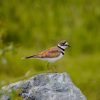
Overall impression: A medium-sized plover with a notably long tail for the group, brown above and white below, marked with two bold black breast bands that are the species’ most distinctive and useful field mark.
Key field marks:
- Two black breast bands — Unlike most plovers, which show a single band, the Killdeer has two distinct black bands across the white breast — the single most reliable identification feature and the source of the species’ scientific name (Charadrius vociferus, though the double-banding is a visual rather than vocal trait)
- Brown upperparts, white underparts — Simple, clean contrast typical of plovers
- Orange-red eye-ring — Visible at close range, adding a subtle but distinctive detail to the face
- Long tail — Proportionally longer than most other plover species, visible both perched and in flight
- Orange rump patch — Visible in flight, particularly during the broken-wing display when the tail is fanned
Size: 7.9–11.0 inches long, wingspan 18.1–18.9 inches. Larger than most common backyard songbirds, closer in size to a robin but with the distinctive upright, long-legged plover posture.
Basic Facts
| Feature | Detail |
|---|---|
| Scientific name | Charadrius vociferus |
| Family | Charadriidae (plovers) |
| Length | 7.9–11.0 inches |
| Weight | 2.6–4.5 oz (75–128g) |
| Wingspan | 18.1–18.9 inches |
| Lifespan | Up to 11 years on record |
| Eggs per clutch | 4, buff with dark speckling |
| Incubation | 24–28 days |
| Conservation status | Least concern |
The Broken-Wing Display
When a predator or perceived threat — including humans — approaches too close to a nest or chicks, the adult Killdeer performs a distraction display of remarkable consistency and effectiveness. The bird drops one wing as though injured, drags it across the ground while stumbling and calling in apparent distress, and leads the threat away from the nest before suddenly “recovering” and flying off once a safe distance has been achieved.
This behavior — technically called a “distraction display” or “injury-feigning display” — is instinctive rather than learned, and it works because it exploits a predator’s preference for easy, vulnerable prey over the difficulty of locating a well-camouflaged nest directly. The display is so convincing that people unfamiliar with the behavior frequently believe they’ve encountered a genuinely injured bird and attempt to help, only to watch it fly away perfectly fine once they’ve been led a safe distance from the nest site.
Killdeer will also perform a different, more aggressive defense against larger threats like grazing livestock — running directly at the animal with wings spread and tail fanned, attempting to startle it into changing direction away from the nest rather than luring it away.
Nesting: No Nest at All
Killdeer are ground-nesters in the most minimal sense possible — they typically lay eggs directly on bare ground, gravel, or rocky substrate with little to no nest material added, relying entirely on the eggs’ camouflage pattern to avoid detection. This minimalist nesting strategy means Killdeer regularly nest in unusual and conspicuous locations: gravel rooftops, parking lots, driveways, railroad beds, and gravel road shoulders are all commonly used, sometimes placing the nest directly in areas with significant human foot or vehicle traffic.
The eggs’ camouflage is genuinely effective — buff-colored with dark speckling closely matching gravel and bare soil, they can be extremely difficult to spot even when someone knows roughly where to look, which is a significant part of why the broken-wing display evolved as a backup defense against threats that get too close despite the camouflage.
Precocial Chicks: Ready to Run at Hatching
Unlike many songbirds whose young are born naked, blind, and entirely dependent on parents, Killdeer chicks are precocial — they hatch covered in down, with eyes open, and are capable of walking and even feeding themselves within hours of hatching. Parents still guard and lead the chicks to feeding areas, and continue performing distraction displays to protect them, but the chicks themselves are mobile and largely self-sufficient for feeding almost immediately, a significant contrast to altricial songbird development.
Diet
Primarily insectivorous, foraging by sight in open ground — running short distances, stopping abruptly, and picking up prey. Diet includes beetles, grasshoppers, earthworms, snails, and other invertebrates found in open fields, lawns, gravel areas, and mudflats. Unlike many shorebirds, Killdeer are commonly found well away from actual water, foraging readily on dry open ground including lawns, sports fields, and parking lots.
The Call: Where the Name Comes From
The species’ common name comes directly from its loud, distinctive call — a repeated, piercing “kill-deer, kill-deer” or a rapid, urgent “dee-dee-dee” when alarmed. The scientific species name, vociferus, translates to “vociferous” or “noisy,” reflecting how frequently and loudly the bird calls, particularly when disturbed near a nest.
Range and Habitat
One of the most widely distributed shorebirds in North America, found across virtually the entire continent in open habitat — fields, lawns, gravel areas, parking lots, athletic fields, and shorelines. Unlike most plovers, which are strongly tied to actual shoreline and mudflat habitat, Killdeer thrive in human-modified open landscapes far from water, making them one of the more commonly encountered “shorebirds” for people who don’t live anywhere near actual shore habitat.
FAQ: Killdeer
Why does a Killdeer pretend to have a broken wing?
To lure predators and other threats away from a nest or chicks by appearing to be easy, vulnerable prey. Once the threat is led a safe distance away, the bird “recovers” and flies off normally.
Where do Killdeer build nests?
Directly on bare ground, gravel, or rocky substrate with minimal or no nest material — often in unusual locations including gravel rooftops, parking lots, and driveways, relying on egg camouflage for protection.
Are Killdeer chicks able to walk right after hatching?
Yes — Killdeer chicks are precocial, hatching with open eyes, down feathers, and the ability to walk and feed themselves within hours, unlike most songbirds.
Why is it called a “Killdeer”?
From its loud, repeated call, which sounds like “kill-deer, kill-deer.” The scientific species name, vociferus, reflects how noisy and vocal the bird is.
For more on ground-nesting and distinctive backyard birds, see our guide on the American Goldfinch vs Yellow Warbler.

MD Imdadul Haque is the founder of BirdzFly, a research-backed resource on North American backyard birds. Drawing on years of independent study into bird identification, behavior, and migration patterns, he writes in-depth guides designed to help US birders understand the species in their own backyards — from common feeder visitors to seasonal migrants passing through.