A Rufous Hummingbird weighs about as much as a penny, and yet at a feeder it will chase off, dive-bomb, and physically drive away hummingbirds twice its size — including species that could, in theory, simply overpower it. This isn’t occasional territorial behavior; it’s a defining trait, and Rufous Hummingbirds are consistently described by researchers and birders alike as the most aggressive hummingbird species in North America.
Identification
Overall impression: A small, compact hummingbird with males showing extensive rich orange-rufous coloring across the body — distinctive enough to separate from most other North American hummingbird species at a glance, though females and immatures require more careful attention.
Key field marks:
- Orange-rufous body (males) — Bright cinnamon-orange coloring across the back, flanks, and tail, with an iridescent orange-red throat (gorget) — one of the most extensively orange-colored hummingbirds in North America
- Iridescent orange-red gorget — Can appear nearly black in poor light, flashing brilliant fiery orange-red in direct sun
- Females and immatures — Green above with rufous coloring limited mainly to the flanks and base of the tail, plus some orange-red spotting on an otherwise white throat — considerably harder to distinguish from similar species like Allen’s Hummingbird without very close observation
Size: 3.5 inches long, wingspan 4.3 inches — genuinely tiny, among the smallest North American hummingbird species.
Basic Facts
| Feature | Detail |
|---|---|
| Scientific name | Selasphorus rufus |
| Family | Trochilidae (hummingbirds) |
| Length | 3.5 inches |
| Weight | 0.1 oz (2–5g) |
| Wingspan | 4.3 inches |
| Lifespan | Up to 8 years on record |
| Eggs per clutch | 2, white |
| Incubation | 15–17 days |
| Conservation status | Near threatened — declining significantly |
Why Rufous Hummingbirds Are So Aggressive
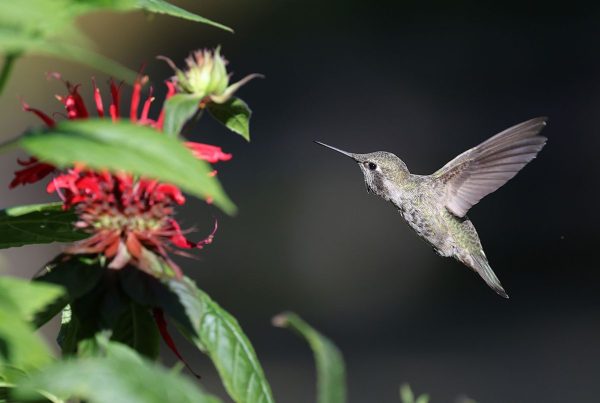
The species’ intense territorial aggression is well documented in ornithological research, and Rufous Hummingbirds will regularly dominate and displace other hummingbird species at shared feeding territories, including larger species like Anna’s Hummingbird, despite the significant size difference. This behavior extends beyond simple feeder competition — during migration, individual Rufous Hummingbirds will establish and defend temporary feeding territories along the route, aggressively excluding other hummingbirds (including other Rufous Hummingbirds) from a productive patch of flowers for as long as they remain in the area.
The likely explanation ties back to the species’ extraordinarily long migration relative to its tiny size — covering a route that can exceed 3,000 miles one way for a bird weighing just a few grams demands maximizing energy intake at every stop, and aggressive exclusion of competitors from limited nectar resources along the way directly supports that survival strategy. In effect, the aggression that makes Rufous Hummingbirds difficult feeder guests is likely the same trait that makes their extreme migration possible at all.
One of the Longest Migrations Relative to Body Size
Rufous Hummingbirds breed as far north as southern Alaska — the northernmost breeding range of any North American hummingbird — and migrate to winter in Mexico, a round-trip distance that can exceed 3,000 miles for a bird only 3.5 inches long. Relative to body size, this is considered one of the longest migrations of any bird in the world.
The migration route follows a distinctive elliptical pattern rather than a simple straight line: birds generally travel north along the Pacific coast in spring, then follow a more inland route through the Rocky Mountains southward in fall, taking advantage of different flowering seasons along each leg of the journey. This “loop migration” pattern, confirmed through banding studies, allows the species to track peak nectar availability across an enormous geographic range through the year.
Diet
Nectar from a wide range of wildflowers along the migration route, supplemented significantly by small insects for protein. Rufous Hummingbirds are considered important pollinators for many wildflower species across their extensive range, particularly in mountain meadow habitat during the northbound spring migration, when the timing of the birds’ arrival often closely tracks specific wildflower bloom periods.
Conservation Concern
Unlike several other North American hummingbird species with stable or expanding populations, Rufous Hummingbirds have experienced a significant population decline — estimated at more than 60% over recent decades according to long-term monitoring data — leading to a “Near Threatened” conservation designation. The causes are thought to include habitat loss and degradation along both breeding grounds and the extensive migration route, along with potential climate-driven mismatches between migration timing and flower bloom periods.
This decline has made Rufous Hummingbird a genuine conservation priority, with the species increasingly used as an indicator of overall wildflower meadow health across its western North American range.
Range and Migration Timing
Breeds from northern California and the Pacific Northwest north through British Columbia into southern Alaska, migrating to winter primarily in central Mexico. Spring migration follows the Pacific coast; fall migration shifts inland through the Rocky Mountain corridor, tracking high-elevation wildflower blooms.
FAQ: Rufous Hummingbird
Why is the Rufous Hummingbird so aggressive?
Likely tied to its extreme migration distance relative to body size — aggressively defending feeding territories maximizes the energy intake needed to fuel a 3,000+ mile journey for such a tiny bird.
How far does a Rufous Hummingbird migrate?
Up to 3,000+ miles one way between Alaska breeding grounds and Mexican wintering areas — one of the longest migrations relative to body size of any bird in the world.
Are Rufous Hummingbirds endangered?
They’re classified as Near Threatened, with population declines exceeding 60% over recent decades, making them a genuine conservation concern despite still being commonly encountered across their range.
How do you identify a Rufous Hummingbird?
Males show extensive bright orange-rufous coloring across the body with an iridescent orange-red throat. Females are trickier, showing rufous mainly on the flanks and tail base.
For more on hummingbirds, see our guides on Anna’s Hummingbird and Black-chinned Hummingbird.

MD Imdadul Haque is the founder of BirdzFly, a research-backed resource on North American backyard birds. Drawing on years of independent study into bird identification, behavior, and migration patterns, he writes in-depth guides designed to help US birders understand the species in their own backyards — from common feeder visitors to seasonal migrants passing through.