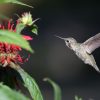
Almost every hummingbird species in North America follows the same basic pattern: arrive in spring, breed, leave by fall. Anna’s Hummingbird breaks that pattern entirely. Across most of its range along the Pacific coast, this species doesn’t migrate south for winter at all — it stays put year-round, even through freezing nighttime temperatures that would seem to demand the same escape response every other hummingbird relies on.
Identification
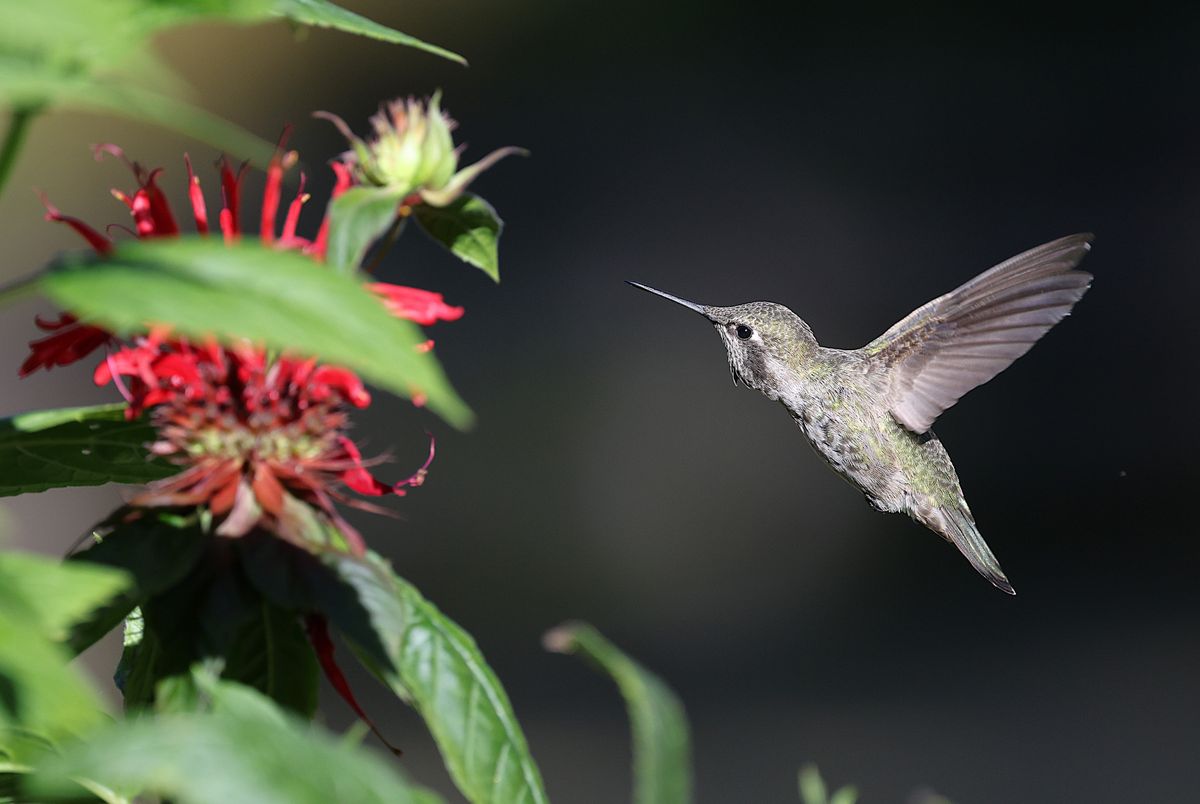
Overall impression: A medium-sized hummingbird, males with an iridescent rose-pink to magenta crown and throat that can look nearly black in poor light and flash brilliant color in direct sun — one of the few North American hummingbirds where the male’s iridescent color extends up over the entire head rather than just the throat.
Key field marks:
- Rose-pink/magenta crown and gorget (males) — Unlike most North American hummingbirds, where iridescent color is limited to the throat (gorget), Anna’s Hummingbird males show this same brilliant color extending up over the crown as well — a genuinely distinctive feature among common US hummingbird species
- Gray-green body — Grayish underparts with a bronze-green back, relatively plain compared to the head coloring
- Females duller — Gray-green overall with limited red spotting on the throat, considerably less flashy than males but still identifiable by range, size, and structure
- Larger than Rufous or Black-chinned Hummingbirds — A noticeably bigger, stockier hummingbird than several other western species it might be confused with
Size: 3.9–4.3 inches long, wingspan 4.7 inches.
Basic Facts
| Feature | Detail |
|---|---|
| Scientific name | Calypte anna |
| Family | Trochilidae (hummingbirds) |
| Length | 3.9–4.3 inches |
| Weight | 0.1–0.2 oz (3–6g) |
| Wingspan | 4.7 inches |
| Lifespan | Up to 8.5 years on record |
| Eggs per clutch | 2, white |
| Incubation | 14–19 days |
| Conservation status | Least concern, expanding range |
Why Anna’s Hummingbird Doesn’t Migrate South
Most hummingbird species evolved to migrate because their breeding range experiences winters too cold and too poor in flowering plants to sustain them. Anna’s Hummingbird’s original range — coastal California — has a mild enough climate, with enough winter-blooming native plants (particularly various manzanita and currant species), that year-round residency became a viable strategy rather than a risky one.
The species’ range has also expanded significantly over the past century, moving north into Oregon, Washington, and even parts of British Columbia — a shift closely linked to the increasing availability of winter-blooming ornamental plants and, critically, backyard hummingbird feeders maintained year-round by homeowners. This human-assisted expansion is well documented in banding and range-mapping data, and it represents one of the more direct examples of feeder maintenance genuinely changing a wild bird species’ range over time.
Surviving Freezing Nights: Torpor
Remaining active through cold winter nights at extreme latitudes for a hummingbird requires the same adaptation nearly all hummingbird species rely on to some degree: torpor, a controlled, dramatic drop in metabolic rate and body temperature that conserves energy overnight. Anna’s Hummingbirds enter torpor readily during cold nights, dropping body temperature and heart rate substantially below normal active levels, conserving enough energy reserves to survive until they can resume feeding the following morning.
This ability is what makes year-round residency in a temperate (rather than tropical) climate possible at all — without torpor, the energy demands of maintaining a normal hummingbird metabolism through a cold night would be unsustainable for a bird this small.
The Male’s Dramatic Courtship Dive
Anna’s Hummingbird males perform one of the most extreme courtship displays of any North American bird — a high-speed diving display that has been measured at speeds exceeding 60 mph relative to the ground, among the fastest recorded flight speeds relative to body length of any vertebrate on Earth.
The display begins with the male climbing to significant height (sometimes 100 feet or more) above a perched female, then diving directly toward her before pulling up sharply at the bottom of the dive. At the pull-up point, the tail feathers produce a loud, distinctive chirp — not a vocalization, but a mechanical sound created by air rushing through the outer tail feathers at extreme speed, a phenomenon confirmed through high-speed video and acoustic research.
Diet
Nectar from a wide range of native and ornamental flowering plants makes up the bulk of the diet, supplemented significantly by small insects and spiders, which provide essential protein — particularly important during breeding season and for the added energy demands of maintaining activity through winter in a non-migratory population. Anna’s Hummingbirds are notably willing to feed on non-native ornamental plants, which has likely supported the species’ range expansion into suburban and urban areas well beyond its historic native range.
Range and Population Expansion
Originally native to coastal California and northern Baja California, Anna’s Hummingbird’s range has expanded dramatically over the past 70+ years, now extending north through Oregon and Washington into southern British Columbia, and east into Arizona and parts of Texas. This expansion stands in contrast to many bird species facing range contraction, and is widely attributed to the combination of climate patterns, spread of exotic flowering plants, and reliable winter feeder maintenance by backyard birders.
FAQ: Anna’s Hummingbird
Does Anna’s Hummingbird migrate?
No, not across most of its range — it’s one of the only North American hummingbird species that remains resident year-round rather than migrating south for winter.
How does Anna’s Hummingbird survive freezing nights?
Through torpor — a controlled drop in metabolic rate and body temperature overnight that conserves enough energy to survive until the bird can resume feeding the next morning.
How fast is the male’s courtship dive?
Measured at over 60 mph relative to the ground — among the fastest flight speeds relative to body length recorded for any vertebrate.
Why has Anna’s Hummingbird’s range expanded so much?
A combination of exotic flowering plant spread and year-round backyard feeder maintenance by homeowners has supported the species moving well beyond its historic coastal California range.
For more on hummingbirds, see our guides on Black-chinned Hummingbird and how fast hummingbirds fly.

MD Imdadul Haque is the founder of BirdzFly, a research-backed resource on North American backyard birds. Drawing on years of independent study into bird identification, behavior, and migration patterns, he writes in-depth guides designed to help US birders understand the species in their own backyards — from common feeder visitors to seasonal migrants passing through.