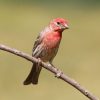

Every House Finch east of the Mississippi is descended from a small number of birds set loose on Long Island in 1940 — released not out of kindness, but because a New York pet store was about to get caught running an illegal wildlife smuggling operation. It’s one of the stranger origin stories of any common North American backyard bird, and it involves an Audubon undercover sting operation.
Identification
Overall impression: A small, streaky brown finch, with males showing a rosy-red wash across the head, throat, and rump that varies noticeably in intensity from bird to bird — one of the most common and recognizable backyard feeder birds across nearly the entire continent today.
Key field marks:
- Red coloring on males — Concentrated on the forehead, eyebrow, throat, and rump, with brown streaking on the back, wings, and flanks. The red intensity ranges from pale orange to deep red depending on diet during molt.
- Brown-streaked females — No red at all; overall grayish-brown with blurry streaking below, lacking the bold facial pattern of a similar-looking sparrow
- Slightly curved bill — A conical seed-cracking bill with a subtle downward curve on the upper mandible, a useful distinguishing feature from the very similar Purple Finch
- Squared tail — Notably less notched than many other finches
Size: 5.1–5.5 inches long, wingspan 7.9–9.8 inches.
Basic Facts
| Feature | Detail |
|---|---|
| Scientific name | Haemorhous mexicanus |
| Family | Fringillidae (finches) |
| Length | 5.1–5.5 inches |
| Weight | 0.6–0.9 oz (16–27g) |
| Wingspan | 7.9–9.8 inches |
| Lifespan | Up to 11+ years on record |
| Eggs per clutch | 2–6, pale blue with fine speckling |
| Incubation | 12–14 days |
| Conservation status | Least concern |
The “Hollywood Finch” Smuggling Operation
In the early 1940s, the illegal caged-bird trade in New York City was booming, and dealers found a marketable product in wild House Finches captured around Los Angeles — sold under the name “Hollywood Finches” to unsuspecting buyers who had no idea they were purchasing a federally protected native species. Roughly 100,000 House Finches were captured in California and shipped east for this trade, with males making up more than 90% of the birds taken (likely because their red coloring made them more visually appealing as caged pets).
Federal authorities eventually caught wind of the operation, and Audubon investigators ran an undercover sting — arranging fake purchases of birds (documented at $35 for a lot of 100) to build a case against the dealers. As word spread that a crackdown was coming, panicked shop owners in the New York area released their illegal inventory rather than be caught holding it — opening cage doors and letting the finches fly free rather than face prosecution.
From a Handful of Birds to Half a Continent
The first documented sighting of a wild House Finch on the East Coast came in April 1941, at Jones Beach on Long Island — a single bird that disappeared after a few days. The following spring, a small flock of seven was found nearby in Babylon, Long Island, and this time the birds stayed. By 1944, small breeding colonies had been documented in the surrounding area.
From that founding population, House Finches spread with extraordinary speed. Within about 50 years, the species had colonized nearly the entire eastern United States and southern Canada, eventually meeting up with the native western population on the Great Plains — reuniting a single species across a continent it had been artificially split across by human intervention.
A Genetic Bottleneck With Real Consequences
Because the entire eastern population descended from such a small number of founding birds, eastern House Finches have notably low genetic diversity compared to their western counterparts — a textbook case of what population geneticists call a founder effect. This genetic narrowness is believed to be part of why the species proved unusually vulnerable when a bacterial eye disease, mycoplasmal conjunctivitis, first appeared in eastern House Finch populations in the 1990s.
The disease, which causes swollen, crusty eyes that can leave birds unable to see well enough to find food or detect predators, killed roughly half of the eastern House Finch population in its early years of spread. Rates have declined significantly since — down to an estimated 5-10% of the population in recent surveys — but the disease remains present and is closely monitored through long-running citizen science programs like Project FeederWatch.
Why the Red Color Varies So Much
Unlike some birds whose color comes from a fixed genetic trait, a male House Finch’s red intensity is directly tied to diet during molt. The red, orange, and yellow pigments (carotenoids) that produce the coloring come entirely from food, not from anything the bird’s body manufactures on its own — meaning a male eating a diet richer in these pigments during molt will grow more vividly red feathers than one with a poorer diet, and this is why some backyard House Finches appear pale orange or even yellowish rather than red.
Diet
Almost entirely vegetarian — seeds, buds, and fruit make up the vast majority of the diet, with very little insect consumption even during breeding season (unusual among songbirds, most of which rely heavily on insects to feed nestlings). This strictly plant-based diet made House Finches easy to keep in captivity, which is part of why they became a target for the caged-bird trade in the first place.
At feeders, House Finches strongly favor black oil sunflower seed and nyjer, and they’re notably social — a single bird discovering a feeder often leads to a flock of dozens arriving within days.
Range Today
Found across virtually all of the continental United States, southern Canada, and Mexico — one of the most widely distributed and commonly encountered songbirds on the continent, present in suburban yards, city parks, farmland, and desert habitat alike.
FAQ: House Finch
Why are House Finches found in the eastern US if they’re a western species?
Illegally caged “Hollywood Finches” were released on Long Island in 1940 by pet dealers trying to avoid prosecution. The released birds established a wild population that spread across the entire eastern half of the continent within about 50 years.
Why do some male House Finches look orange or yellow instead of red?
The red coloring comes entirely from pigments in the diet during molt — a male eating fewer of these pigments will grow paler orange or yellow feathers instead of red.
Are House Finches invasive?
Not formally classified as invasive — they’re native to the western US and an introduced species in the East, but they generally coexist with native birds without significant ecological harm, unlike species such as European Starlings.
For more on finches, see our guide on the House Finch vs Purple Finch identification.

MD Imdadul Haque is the founder of BirdzFly, a research-backed resource on North American backyard birds. Drawing on years of independent study into bird identification, behavior, and migration patterns, he writes in-depth guides designed to help US birders understand the species in their own backyards — from common feeder visitors to seasonal migrants passing through.