


Pileated Woodpecker
Hearing a Pileated Woodpecker before you see it is normal. The call is loud, wild, and carries through forest — a series of irregular cuk-cuk-cuk notes that sounds more tropical than temperate. When you finally locate the bird hammering into a dead trunk, the scale of what it’s doing becomes clear. The holes are rectangular, sometimes a foot long, gouged out to reach carpenter ant colonies deep in the wood.
This is the largest woodpecker in North America, and it behaves at a scale that matches its size.
Identification
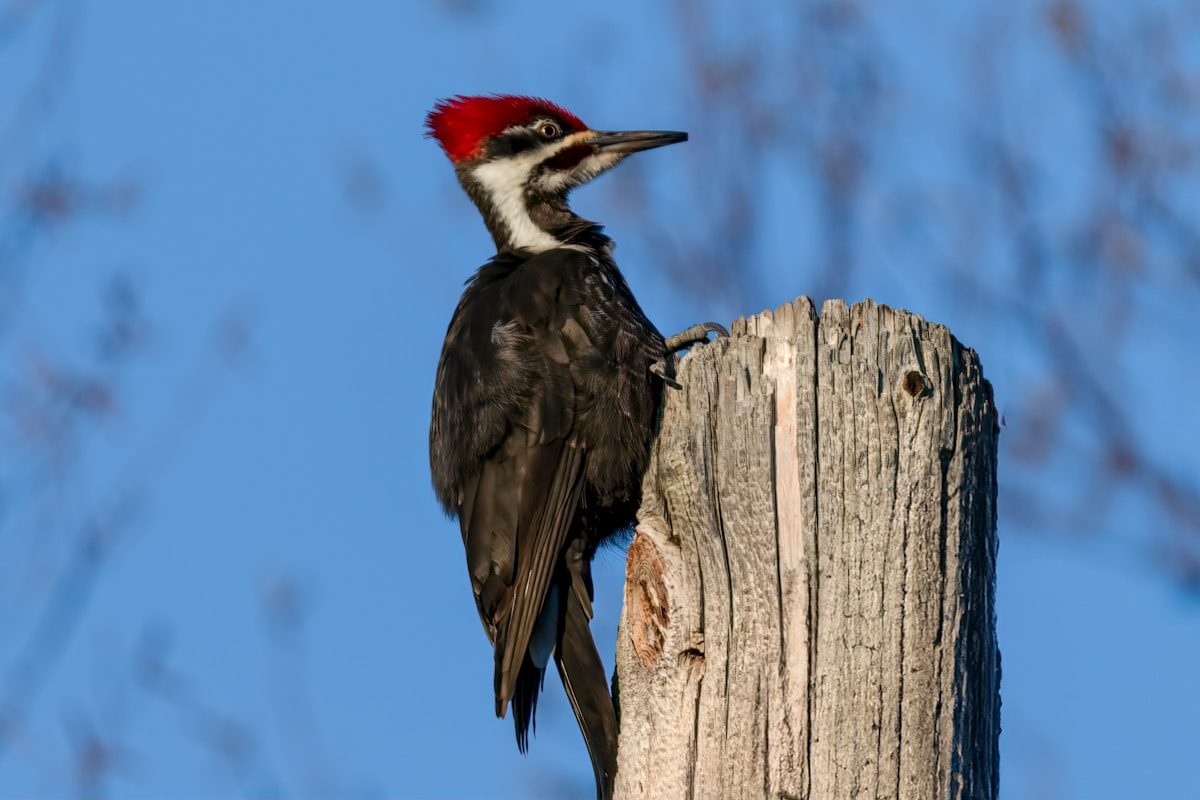
Overall impression: Crow-sized, black and white, with a flaming red crest. Unmistakable. No other woodpecker in North America approaches its size.
Key field marks:
- Red crest — Prominent, triangular, extends from the bill to the back of the head. Males have a red forehead; females have a black forehead with the red starting further back.
- Black body — Mostly black above and below, with white stripes on the neck and white underwings visible in flight.
- White underwings — The white wing lining flashes conspicuously in flight — a field mark visible at distance.
- Long neck — The bird has a notably long neck compared to other woodpeckers, giving it a distinctive silhouette in flight.
- Rectangular excavations — The holes Pileated Woodpeckers make are diagnostic. Rectangular, sometimes a foot or more long, with clean edges. No other woodpecker makes holes this shape.
Size: 15.8–19.3 inches. Crow-sized. Wingspan 26–29.5 inches. Weight about 8.8–12.3 oz — substantially heavier than a crow.
Basic Facts
| Feature | Detail |
|---|---|
| Scientific name | Dryocopus pileatus |
| Family | Picidae (woodpeckers) |
| Length | 15.8–19.3 inches |
| Weight | 8.8–12.3 oz (250–350g) |
| Wingspan | 26–29.5 inches |
| Lifespan | Up to 12 years on record |
| Eggs per clutch | 3–5, white |
| Incubation | 15–18 days |
| Broods per year | 1 |
| Conservation status | Least concern |
Diet: Built Around Carpenter Ants
Carpenter ants make up roughly 60% of the Pileated Woodpecker’s diet. The rest comes from other wood-boring beetle larvae, termites, wild berries, and occasionally nuts. The bird’s entire physiology is built around extracting carpenter ants from deep within dead and dying trees.
The tongue is extraordinarily long — it wraps around the back of the skull when retracted, similar to a hummingbird’s tongue. The tip is barbed and coated in sticky saliva. The bird excavates a large opening to reach the ant gallery, then extends the tongue to extract ants from the tunnels beyond the excavation.
The rectangular excavation is a byproduct of this process. The bird chisels along the ant gallery, following the trail of ants through the wood, which produces the characteristic elongated shape. Fresh excavations are one of the most reliable ways to confirm Pileated Woodpecker presence in an area even when the bird isn’t visible.
Ecological Role: Keystone Species
The Pileated Woodpecker is considered a keystone species in mature forest ecosystems because the large cavities it excavates for nesting and roosting are subsequently used by a long list of other species.
Secondary cavity users that depend on Pileated-sized holes include Wood Duck, Common Goldeneye, Bufflehead, Hooded Merganser, American Kestrel, Eastern Screech-Owl, Barred Owl, flying squirrels, and several other woodpecker species that enlarge existing cavities. Without the Pileated Woodpecker excavating, none of these species can create their own suitable nesting sites in mature forest.
The holes in dead trees also accelerate decomposition, releasing nutrients back into the forest floor more quickly than natural decay alone.
Habitat
Mature forest with large dead trees — that’s the essential requirement. Pileated Woodpeckers need trees large enough to contain substantial carpenter ant colonies and provide excavation sites big enough for nesting cavities (roughly 3.5 inches in diameter, 10–24 inches deep).
They are present in mature deciduous and mixed forests across the eastern US, the Pacific Northwest, and a band through the boreal forest of Canada. They have expanded into suburban and even some urban areas in regions where mature street trees and park trees provide enough habitat.
The bird’s expansion into suburban areas since the mid-20th century — as previously logged forest regrew to maturity — is one of the genuine wildlife success stories of the last 80 years. Areas that had no Pileated Woodpeckers in 1950 routinely have them now.
Behavior and Territory
Pileated Woodpecker
Pileated Woodpeckers maintain large territories — typically 150–200 acres per pair. Both the male and female defend the territory year-round, and both roost within it in separate cavities. Territory defense involves loud calling and drumming rather than physical confrontation.
The drumming is powerful and sustained — a series of 11–30 strikes per second that carries significantly further than smaller woodpeckers. It serves both territorial advertisement and communication between mates.
Pairs are monogamous and maintain long-term pair bonds, reusing the same territory for years. If one member of a pair dies, the survivor typically attracts a new mate to the same territory within one breeding season.
How to Find and Attract Pileated Woodpeckers
Where to look: Mature forest with standing dead trees (snags). Listen for the loud, irregular call — once learned, it’s unmistakable. Look for fresh rectangular excavations on dead trunks, then watch the area.
At feeders: Pileated Woodpeckers visit suet feeders less often than Downy or Hairy Woodpeckers, but they do come — particularly to large suet blocks or log feeders filled with suet. They need a substantial surface to land on; standard small suet cage feeders are too small.
Leave dead trees: The single most effective thing for Pileated Woodpeckers is leaving standing dead trees on your property. A dead snag of 18+ inches diameter is prime habitat. If the tree is not a safety hazard, leave it.
FAQ: Pileated Woodpecker
Is the Pileated Woodpecker the largest woodpecker in North America?
Yes. It is the largest surviving woodpecker in North America at 15.8–19.3 inches. The Ivory-billed Woodpecker was larger but is almost certainly extinct.
What does a Pileated Woodpecker sound like?
A loud, irregular series of cuk-cuk-cuk notes, often compared to a jungle bird. Also produces powerful sustained drumming on resonant dead wood.
What are the rectangular holes in trees?
Pileated Woodpecker excavations. The rectangular shape is the result of following carpenter ant galleries through the wood. No other North American bird makes holes this shape.
Is the Pileated Woodpecker the Woody Woodpecker bird?
The character’s call is based on the Pileated Woodpecker’s call. The visual design has elements of both the Pileated and the Acorn Woodpecker. The Pileated is the primary inspiration.
For more on woodpeckers, see our guide on Hairy vs Downy Woodpecker. For other large forest birds, see our guides on Barn Owl and Bald Eagle.

MD Imdadul Haque is the founder of BirdzFly, a research-backed resource on North American backyard birds. Drawing on years of independent study into bird identification, behavior, and migration patterns, he writes in-depth guides designed to help US birders understand the species in their own backyards — from common feeder visitors to seasonal migrants passing through.

