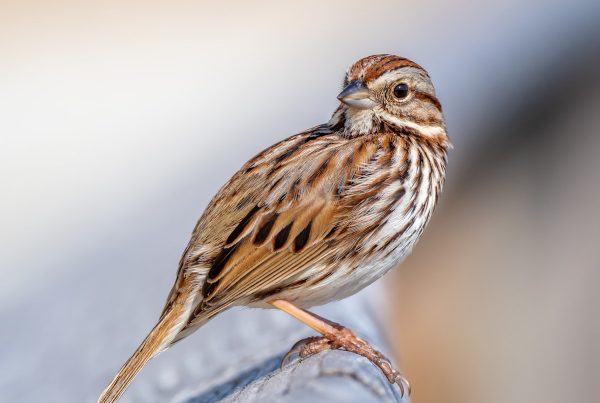

The old mnemonic for the Eastern Towhee’s song is almost too perfect: “drink-your-teeeeea,” with the last note trilling out. The bird’s name itself comes from its call note — an emphatic “tow-hee” or “chewink” that gave the species its common name centuries before formal ornithology existed. Few North American birds are as directly named after their own vocalizations.
Identification
Overall impression: A striking, ground-dwelling sparrow relative with bold black, white, and rufous coloring — one of the more visually distinctive birds in eastern woodland edges and thickets, though often heard well before it’s seen.
Key field marks (male):
- Black hood and upperparts — Solid black head, throat, back, and tail in adult males, providing sharp contrast with the rest of the pattern
- Rufous (reddish-orange) flanks — Bold orange-rust coloring along the sides, one of the most distinctive marks on the species
- White belly — Clean white center of the underparts, sharply demarcated from the rufous flanks
- Red eyes — Bright red iris, visible at close range and a useful confirming mark (though a southern subspecies has white or pale eyes instead)
- White wing patches and tail corners — Flash visible in flight, useful for confirming ID on a fast-moving bird
Females show the same pattern but with warm brown replacing the male’s solid black — otherwise identical in structure and behavior.
Size: 6.8–8.2 inches long, wingspan 7.9–11.0 inches. Larger and chunkier than most sparrows, closer in size to a small robin.
Basic Facts
| Feature | Detail |
|---|---|
| Scientific name | Pipilo erythrophthalmus |
| Family | Passerellidae (New World sparrows) |
| Length | 6.8–8.2 inches |
| Weight | 1.1–1.8 oz (32–52g) |
| Wingspan | 7.9–11.0 inches |
| Lifespan | Up to 12 years on record |
| Eggs per clutch | 2–6, whitish with reddish-brown speckling |
| Incubation | 12–13 days |
| Conservation status | Least concern, though declining in parts of range |
The Song and Call
The song is commonly rendered with the mnemonic “drink-your-teeeeea” — two short introductory notes followed by an extended trilling note. This song is distinctive enough that it’s one of the more reliable ways to confirm a Towhee’s presence in dense brush where the bird itself may stay hidden.
The call note — separate from the full song — is an emphatic “tow-hee” or in some regional dialects a nasal “chewink,” which is where both the common name and an older alternate name (Chewink) for the species originated. Unlike many bird names that come from appearance or a naturalist’s name, the Eastern Towhee is named almost entirely for the sound it makes.
Ground-Foraging Behavior: The “Double-Scratch”
Eastern Towhees forage almost exclusively on the ground in dense understory and leaf litter, using a distinctive technique called the “double-scratch” — hopping backward with both feet simultaneously to kick leaf litter aside, revealing insects and seeds underneath. This two-footed backward hop is loud enough that a foraging Towhee in dry leaves is often heard before it’s seen, and the sound can be surprisingly large for a bird this size — people sometimes initially assume a much larger animal is moving through the brush.
This ground-foraging habit means Towhees are strongly associated with dense shrubby habitat — forest edges, overgrown fields, and thickets with substantial leaf litter — rather than open lawns or mature forest interior.
Diet
The diet shifts seasonally, similar to many sparrows:
- Summer — Insects dominate: beetles, caterpillars, ants, spiders, and other invertebrates found in leaf litter
- Fall and winter — Seeds and fruit become the primary food: various grass and weed seeds, acorns, and berries including blackberry, blueberry, and sumac
At feeders, Towhees will take mixed seed and cracked corn scattered on the ground beneath a feeder, though they rarely use elevated feeders directly — their ground-foraging instinct is strong enough that food needs to be at ground level to attract them reliably.
Range and Habitat
Found across the eastern United States, from southern Canada to Florida, with year-round residents in the South and migratory populations in the North that move to the southeastern states for winter. Strongly tied to habitat with dense understory: forest edges, overgrown fields, power line cuts, and suburban areas with unmanicured shrub borders.
The species has declined somewhat in areas where dense shrubby habitat has been lost to development or intensive land management — a pattern shared by several shrub-dependent bird species across North America.
Spotted Towhee: The Western Counterpart
West of the Great Plains, the Eastern Towhee is replaced by the closely related Spotted Towhee — nearly identical in overall pattern but with distinct white spotting on the back and wings that the Eastern Towhee lacks. The two species were once considered a single species (Rufous-sided Towhee) before being split based on differences in range, plumage, and vocalizations. Where their ranges approach each other in the central Great Plains, some hybridization occurs.
FAQ: Eastern Towhee
What does an Eastern Towhee sound like?
The song is commonly described with the mnemonic “drink-your-teeeeea” — two short notes followed by a trill. The call note is an emphatic “tow-hee,” which gave the species its name.
Why does an Eastern Towhee hop backward?
It’s using the “double-scratch” foraging technique — hopping backward with both feet at once to kick aside leaf litter and expose insects and seeds hidden underneath. This is a defining foraging behavior for the species.
Where do Eastern Towhees live?
Dense shrubby habitat across the eastern US — forest edges, overgrown fields, and thickets with substantial leaf litter. They’re strongly ground-associated and rarely seen in open lawns or mature forest interior.
What is the difference between an Eastern Towhee and a Spotted Towhee?
Spotted Towhees have white spotting on the back and wings that Eastern Towhees lack. Eastern Towhees live in the eastern US; Spotted Towhees replace them west of the Great Plains.
For more on sparrow-family birds and backyard identification, see our guides on House Finch vs Purple Finch and American Goldfinch vs Yellow Warbler.

MD Imdadul Haque is the founder of BirdzFly, a research-backed resource on North American backyard birds. Drawing on years of independent study into bird identification, behavior, and migration patterns, he writes in-depth guides designed to help US birders understand the species in their own backyards — from common feeder visitors to seasonal migrants passing through.