

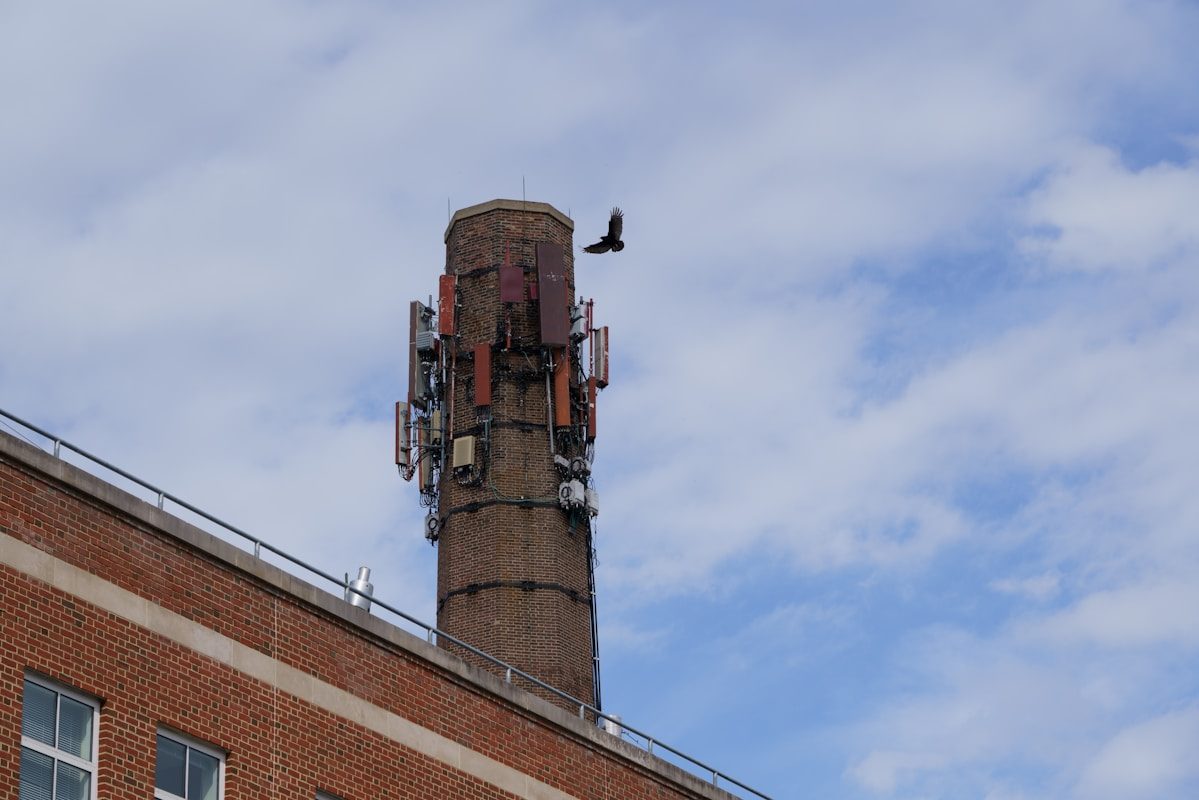
Chimney Swift
A Chimney Swift cannot perch on a branch. Its feet are so reduced and specialized that the bird is physically incapable of the grip-and-balance posture every other backyard bird uses. It cannot stand on a wire, sit on a fence rail, or land on the ground without serious difficulty. Almost everything in its life — feeding, drinking, even mating in some documented cases — happens in the air.
This is one of the most genuinely unusual birds in North America, and most people who see one flying overhead at dusk have no idea what they’re looking at.
Identification
Overall impression: A small, dark, cigar-shaped silhouette flying with stiff, fluttering wingbeats, often in groups, at dusk. Frequently mistaken for a bat because of the erratic flight and twilight timing.
Key field marks:
- Body shape — Compact, cylindrical, no visible neck or tail extension. The whole bird looks like a flying cigar with curved wings attached.
- Wings — Long, narrow, stiffly curved, held in a bow shape. Distinct from swallows, which have a more relaxed, fluid wingbeat.
- Color — Uniform sooty brown-gray throughout, slightly paler on the throat. No bold markings.
- Flight — Rapid, fluttery, erratic changes of direction, often described as “a cigar with wings.” Frequently seen in loose flocks circling at dusk.
Size: 4.7–5.9 inches. Wingspan 11–12 inches. Easily confused with swallows at a distance, but the stiffer wingbeat and cigar shape are diagnostic once learned.
Basic Facts
| Feature | Detail |
|---|---|
| Scientific name | Chaetura pelagica |
| Family | Apodidae (swifts) — the name means “without feet” |
| Length | 4.7–5.9 inches |
| Weight | 0.6–1 oz (17–30g) |
| Wingspan | 11–12 inches |
| Lifespan | Up to 14 years on record |
| Eggs per clutch | 4–5, white |
| Incubation | 19–21 days |
| Conservation status | Near threatened — declining significantly |
A Life Spent Almost Entirely in Flight
Chimney Swifts feed exclusively on flying insects caught in midair — they cannot land to forage. They drink by skimming low over water and scooping it up without landing. Even nest-building material is gathered in flight: small twigs are snapped off trees while flying past, never collected from the ground.
The feet, while functional, are specialized for clinging to vertical surfaces rather than perching horizontally. All four toes point forward, and sharp curved claws allow the bird to cling to rough vertical walls — inside a chimney, a hollow tree, or a cave — but this same adaptation makes perching on a branch like a typical songbird essentially impossible.
Some research suggests Chimney Swifts may even sleep while in slow gliding flight at high altitude, similar to behavior documented in their close relatives, the Common Swifts of Europe — though this is harder to confirm directly in Chimney Swifts specifically.
Why “Chimney” Swift: A Species That Adapted to Buildings
Before European settlement, Chimney Swifts nested almost exclusively in large hollow trees — old-growth forest cavities big enough to house their colonial roosting and nesting behavior. As old-growth forests were cleared across the eastern US, the species shifted dramatically toward an artificial substitute: masonry chimneys, which provide the same vertical, dark, rough-surfaced cavity.
This adaptation was so successful that by the 20th century, the species’ name and identity had become tied to chimneys rather than the dwindling hollow trees that were its original habitat. The irony of the current population decline is that the same human structures that allowed the species to thrive for over a century are now disappearing — capped, removed, or rebuilt with smooth metal liners that swifts cannot cling to.
Why Chimney Swifts Are Declining
Chimney Swift populations have declined by an estimated 67% since 1970, driven by loss of nesting and roosting habitat:
- Chimney capping — Modern homeowners cap chimneys for safety and energy efficiency, eliminating nest sites
- Chimney removal — Many newer homes are built without traditional masonry chimneys at all
- Metal liners — Even chimneys that remain often get smooth metal liner installations that swifts cannot grip
- Insect decline — As an obligate insectivore, the species is directly affected by the broader decline in flying insect populations across North America
The Spectacular Communal Roost
Chimney Swift
One of the great underrated wildlife spectacles in North America happens during fall migration, when Chimney Swifts gather in massive communal roosts before heading to South America for winter. At dusk, hundreds to thousands of swifts circle above a large chimney in a funnel-shaped vortex before pouring inside to roost together for the night. Several cities run organized “Swift Night Out” viewing events during peak migration in September.
These roost sites — often old industrial chimneys, school buildings, or church towers — can be genuinely massive. Some historic roost sites in the eastern US have hosted tens of thousands of birds on a single night during peak migration.
How to Help Chimney Swifts
- Leave your chimney uncapped during the breeding season (April through October) if you’re not actively using it, and check for nests before any chimney work
- Install a Chimney Swift tower — a purpose-built freestanding structure that mimics a chimney’s interior. Plans are available from conservation groups specifically for this purpose
- Avoid pesticide use — supports the flying insect populations swifts depend on entirely
- Attend a “Swift Night Out” event if one happens near you in September — most are free, organized by local Audubon chapters
FAQ: Chimney Swift
Can a Chimney Swift land on the ground or a branch?
Not effectively. Its feet are adapted for clinging to vertical surfaces, not perching or walking. It spends nearly its entire life in flight, landing only to cling inside a chimney or hollow tree.
Why are Chimney Swifts called that?
They adapted to nesting and roosting in masonry chimneys after old-growth forests with hollow trees — their original habitat — were cleared across the eastern US.
Are Chimney Swifts endangered?
Listed as Near Threatened, with population declines of roughly 67% since 1970, primarily due to loss of chimney nesting sites and declining insect populations.
What do Chimney Swifts eat?
Exclusively flying insects caught in midair — mosquitoes, flies, beetles, and other small flying insects. They cannot forage on the ground.
For more on unusual bird behavior, see our guides on Barn Owl hunting in darkness and Purple Martin migration.

MD Imdadul Haque is the founder of BirdzFly, a research-backed resource on North American backyard birds. Drawing on years of independent study into bird identification, behavior, and migration patterns, he writes in-depth guides designed to help US birders understand the species in their own backyards — from common feeder visitors to seasonal migrants passing through.

