

At a distance — gliding over a lake, a silhouette against the sky — an Osprey and a Bald Eagle can look surprisingly similar. Both are large, both hunt over water, both have a hooked bill built for tearing flesh. But once you know the three field marks that separate them, the confusion stops permanently.
The Fast Separator
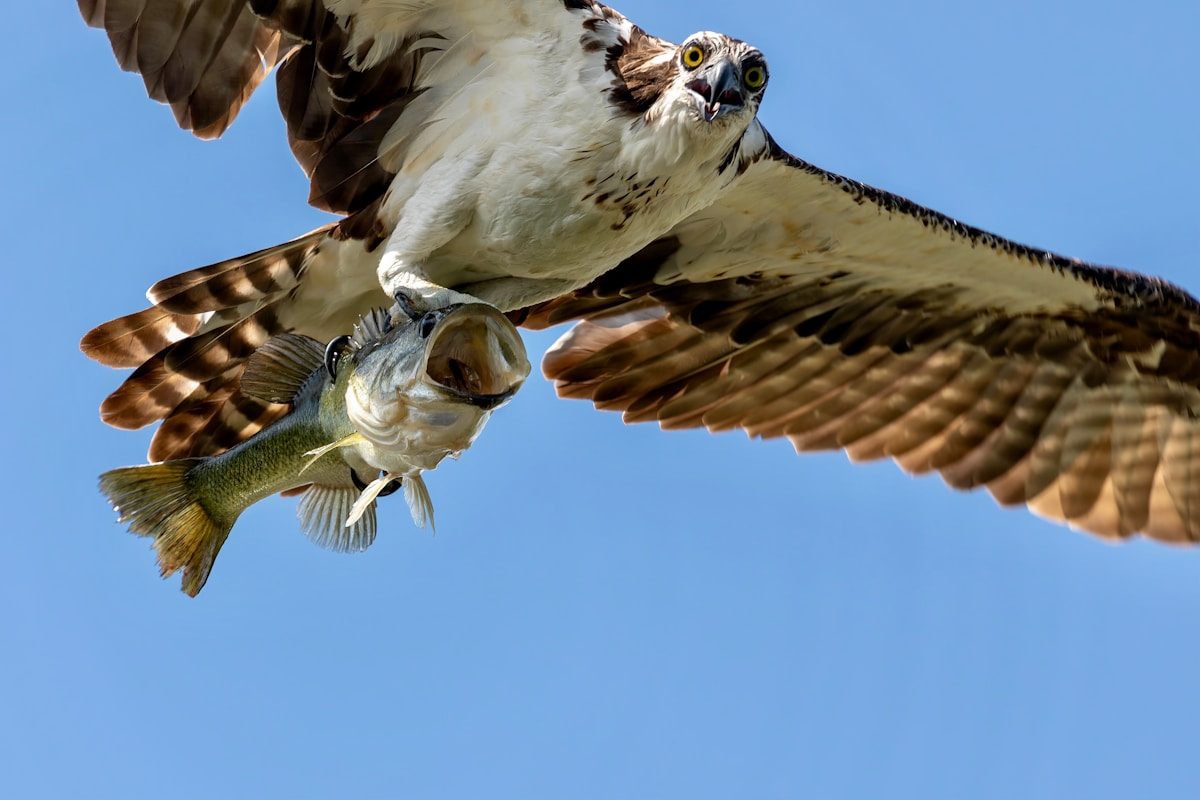
Look at the underside in flight. An Osprey shows a clean white belly with dark wrist patches and a distinctly bent, gull-like wing shape. A Bald Eagle shows a flat, broad wing held straight out, with a fully white head and tail (adults) or mottled brown-and-white (juveniles) — never the crisp white-below, dark-above pattern of an Osprey.
That’s the 90% answer. Here is the complete picture.
Osprey: Identification
- Color pattern: White underneath, dark brown above. White head with a distinct dark stripe through the eye — sometimes called a “bandit mask.”
- Wing shape in flight: Long, narrow wings held with a visible bend at the wrist — often described as M-shaped or gull-like. This is the single most reliable field mark at a distance.
- Size: 21–26 inches long, wingspan 59–71 inches. Noticeably smaller and slimmer than a Bald Eagle.
- Flight style: Distinctive stiff, shallow wingbeats. Hovers over water before diving feet-first for fish — a behavior Bald Eagles do not perform.
- Voice: A series of sharp, high whistled chirps — quite different from the eagle’s surprisingly weak, high-pitched chittering call.
Bald Eagle: Identification
- Color pattern: Adults are dark brown overall with a fully white head and white tail — no eye stripe, no white belly. Juveniles (under 4–5 years old) are mottled brown and white throughout and lack the white head, frequently causing confusion with both Ospreys and Golden Eagles.
- Wing shape in flight: Broad, flat, held straight out from the body — described as a “flying door” silhouette. No wrist bend.
- Size: 28–40 inches long, wingspan 70–90 inches. Considerably larger and bulkier than an Osprey.
- Flight style: Slow, powerful wingbeats with long glides. Often soars at altitude rather than hovering low over water.
- Voice: A weak, high-pitched series of chirps and chittering notes — famously unimpressive for a bird of its size, which is why most “eagle screech” sounds in movies are actually Red-tailed Hawk calls.
The Juvenile Eagle Problem
Most Osprey/eagle confusion happens specifically with juvenile Bald Eagles, which don’t yet have the white head and tail. A juvenile eagle is mottled brown and white in a blotchy, irregular pattern — nothing like the Osprey’s clean, sharply divided white-below/dark-above pattern. If the white and brown look randomly mixed rather than cleanly separated, it’s a young eagle, not an Osprey.
Diet and Hunting Behavior
Osprey vs Eagle
Both species eat primarily fish, but the hunting method differs completely.
Ospreys are fish specialists — over 99% of their diet is fish, caught exclusively by diving feet-first into water from a hover or a steep dive, sometimes submerging completely. Their feet have a reversible outer toe and backward-facing spines on the pads (specialized for gripping slippery fish), features Bald Eagles lack.
Bald Eagles eat fish too, but opportunistically — they also take waterfowl, carrion, and will steal fish directly from Ospreys rather than catching their own. This kleptoparasitic behavior is well documented and is part of why Benjamin Franklin famously objected to the Bald Eagle as a national symbol, calling it a bird of “bad moral character” for stealing food from the Osprey (which he called “that diligent bird”).
Nesting
Ospreys build large stick nests on platforms, dead trees, or purpose-built nesting poles, often near water and sometimes on artificial structures like cell towers or channel markers. They tolerate nesting close to human activity better than eagles do.
Bald Eagles build massive nests — among the largest of any North American bird, sometimes exceeding 1,000 pounds after years of reuse — typically high in mature trees near large bodies of water, generally with more distance from human disturbance than Ospreys require.
Range and Season
Ospreys breed across most of North America in summer and migrate to Central and South America for winter — true long-distance migrants. Bald Eagles are present year-round across most of their range, with some northern populations shifting south in winter when waterways freeze.
This means an “eagle-like” bird seen fishing over a lake in January in the northern US is almost certainly a Bald Eagle, not an Osprey — most Ospreys have already left for the winter.
Quick Reference Table
| Feature | Osprey | Bald Eagle |
|---|---|---|
| Underside color | White with dark wrist patches | All dark (adult) or mottled (juvenile) |
| Head | White with dark eye stripe | Solid white (adult) or brown (juvenile) |
| Wing shape | Bent at wrist, M-shaped | Flat, held straight out |
| Size | 59–71 in. wingspan | 70–90 in. wingspan |
| Hunting style | Hovers, dives feet-first | Snatches from surface, steals from others |
| Winter presence | Migrates south, mostly absent | Present year-round in most areas |
FAQ: Osprey vs Eagle
What is the easiest way to tell an Osprey from a Bald Eagle?
Look at the wing shape in flight. Ospreys hold their wings bent at the wrist in an M-shape; eagles hold theirs flat and straight. The Osprey’s clean white belly is also distinctive.
Are juvenile Bald Eagles often mistaken for Ospreys?
Yes, this is the most common confusion. The fix: juvenile eagles show a blotchy, irregular brown-and-white pattern, while Ospreys show a sharply divided clean white-below, dark-above pattern.
Do Ospreys and Bald Eagles compete for food?
Yes. Bald Eagles regularly steal fish directly from Ospreys rather than catching their own — a behavior documented since Benjamin Franklin’s era.
For more raptor identification, see our guides on juvenile Red-tailed Hawk ID, Bald Eagle lifespan, and Barn Owl identification.

MD Imdadul Haque is the founder of BirdzFly, a research-backed resource on North American backyard birds. Drawing on years of independent study into bird identification, behavior, and migration patterns, he writes in-depth guides designed to help US birders understand the species in their own backyards — from common feeder visitors to seasonal migrants passing through.

