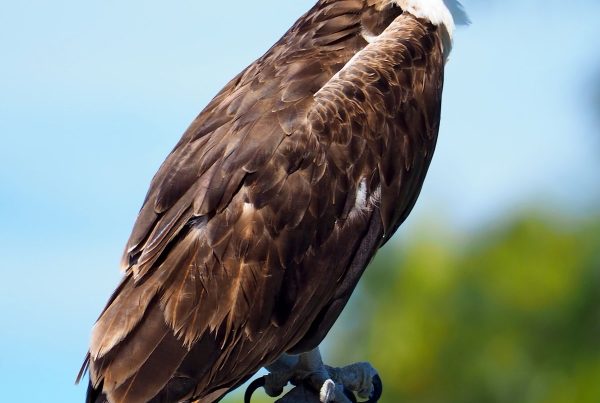

There’s a good chance you already know what a Red-tailed Hawk sounds like — you just think it’s an eagle. The long, raspy, descending scream that plays in almost every movie or TV show whenever a majestic bird appears in the sky? That’s a Red-tailed Hawk. The actual Bald Eagle call — a thin, weak chittering — is so unimpressive that Hollywood replaced it decades ago with the Red-tail’s much more dramatic vocalization.
The Red-tailed Hawk is the most common large hawk in North America, and its call is one of the most recognizable bird sounds on the continent once you know it.
What Does a Red-Tailed Hawk Sound Like?
The classic Red-tailed Hawk call is a raspy, drawn-out scream that descends in pitch: “keeeeeeer” — starting high and trailing off downward over about 2–3 seconds. It’s harsh, wild-sounding, and carries a long distance.
The call has several variations:
- The territorial scream — The classic descending “keeeeer.” Used to advertise territory, communicate between mates, and warn off intruders. Most commonly heard during breeding season (January–June) and when defending food or a perch.
- Alarm call — A shorter, sharper version of the scream. Given when the hawk is disturbed by a person, predator, or another raptor approaching too close.
- Begging call (juveniles and females during courtship feeding) — A more insistent, repeated “kee-kee-kee” — higher pitched and more urgent. Juveniles use this when soliciting food from parents after fledging. Females use a similar sound during the early breeding period when the male brings food.
- Pair contact call — A softer version used between mated pairs when one approaches the other or the nest, lower intensity than the full territorial scream.
Why the Red-Tailed Hawk Replaced the Eagle on Screen
The substitution is almost universal in film and television, going back decades. The reason is straightforward: the Bald Eagle’s real call is a thin, high-pitched series of chittering whistles — not remotely intimidating, and out of proportion with how imposing the bird looks visually.
The Red-tailed Hawk’s scream is everything the eagle’s call isn’t: loud, harsh, wild, and instantly associated with wilderness. Directors needed a sound that matched the visual weight of a large soaring bird, and the Red-tail’s call provided it.
The result is that most Americans have been hearing Red-tailed Hawk calls their whole lives without knowing it — every time an eagle screams in a movie, every nature documentary with a dramatic aerial shot, every Westerns scene with a hawk circling overhead.
When Red-Tailed Hawks Call Most
Red-tailed Hawks are more vocal than most people realize. Peak calling periods:
- Breeding season (January–April) — Most vocal period. Pairs perform aerial courtship displays with frequent calling. Both male and female call regularly during nest building and incubation.
- Territory establishment — When a hawk is defending its territory against another raptor or establishing a new one, it calls repeatedly from a perch or in soaring flight.
- Mobbing events — When crows, jays, or other birds mob a perched Red-tail, the hawk often responds with alarm calls or simply screams back. These events are common and loud.
- Near the nest — Hawks with active nests call more frequently, particularly if a person or predator approaches. The call becomes sharper and more urgent as the intruder gets closer.
How to Identify a Red-Tailed Hawk by Sound
The descending raspy scream is unique enough that it rarely causes confusion with other local raptors:
- Red-shouldered Hawk — A similar large buteo, but its call is a rapid repeated “kee-aah, kee-aah, kee-aah” — more musical, less harsh, and often repeated in a series rather than the single long scream of the Red-tail. Blue Jays are famous for imitating Red-shouldered Hawk calls accurately enough to fool people.
- Cooper’s Hawk — “Kak-kak-kak-kak” — fast, staccato, and much shorter. Associated with nest defense rather than territory advertisement.
- Osprey — High, whistled “cheep-cheep-cheep” — much higher and more bird-like, nothing like the Red-tail’s raspy quality.
- Bald Eagle — Thin, weak chittering — the sound most people don’t expect and barely notice when they finally hear the real thing.
Using Call to Find Red-Tailed Hawks
Listening for Red-tail calls is one of the most effective ways to locate them, especially in breeding season. A hawk calling repeatedly from the same area is almost always a territorial male or a bird near a nest. The call carries far enough that you can often locate the bird before you see it.
When you hear the classic scream in an open area and scan the sky, look for the broad wings and wide rounded tail soaring in slow circles. In winter, scan fence posts and utility poles along roadsides — Red-tails perch in the open where they have a clear view of the ground below.
Recording and Apps
The free Merlin Bird ID app from Cornell Lab includes audio identification and call recordings for every North American bird, including all of the Red-tailed Hawk’s call variants. It also has a Sound ID feature that identifies birds from a live recording made on your phone — hold it up near a calling hawk and it will confirm the species in real time.
FAQ: Red-Tailed Hawk Call
What does a Red-tailed Hawk sound like?
A raspy, descending scream — “keeeeeeer” — starting high and dropping in pitch over 2–3 seconds. Harsh, wild, and carries a long distance. The same call used in movies and TV whenever an eagle appears on screen.
Why do eagles sound like hawks in movies?
Because the Bald Eagle’s real call is weak and unimpressive. The dramatic screaming sound in films is actually a Red-tailed Hawk call, dubbed in because it sounds more impressive on screen.
Do Red-tailed Hawks make noise at night?
Rarely. Red-tailed Hawks are diurnal — active during daylight — and don’t typically call at night. If you hear a raspy scream at night, it’s more likely a Barn Owl or a Great Horned Owl, not a hawk.
How do you tell a Red-tailed Hawk call from a Red-shouldered Hawk call?
Red-tailed Hawk: long, single descending scream. Red-shouldered Hawk: rapid series of repeated “kee-aah” notes, more musical and less harsh.
For more on Red-tailed Hawks and raptor identification, see our guides on juvenile Red-tailed Hawk identification, Cooper’s vs Sharp-shinned Hawk, hawk nests, and the 5 most common hawks in North America.

MD Imdadul Haque is the founder of BirdzFly, a research-backed resource on North American backyard birds. Drawing on years of independent study into bird identification, behavior, and migration patterns, he writes in-depth guides designed to help US birders understand the species in their own backyards — from common feeder visitors to seasonal migrants passing through.