
The Northern Mockingbird gets most of the attention for song mimicry, but the Brown Thrasher actually holds the real record. Research has documented individual Brown Thrashers singing more than 1,100 distinct song types — the largest vocal repertoire of any bird in North America, mockingbird included.
Identification
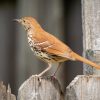
Overall impression: A large, long-tailed, rich rufous-brown bird with heavy dark streaking on a white-to-buff breast — often mistaken for a large thrush at first glance, though the proportions and behavior are quite different once you look closely.
Key field marks:
- Rich rufous-brown upperparts — Warm reddish-brown back, wings, and tail, more saturated in color than most North American thrushes
- Heavy dark streaking — Bold, distinct streaks (not spots) running down a white-to-buff breast and belly, denser and more pronounced than a thrush’s typical spotting pattern
- Yellow eyes — Bright yellow iris, a distinctive and somewhat startling feature visible at close range
- Long, slightly downcurved bill — Noticeably longer and more curved than a thrush’s bill, built for probing leaf litter and soil
- Long tail — Proportionally longer than most similarly sized songbirds, often held at a slight downward angle
- Two white wing bars — Visible on the folded wing, adding to the overall patterned look
Size: 9.1–11.8 inches long, wingspan 11.4–12.6 inches. Notably larger than most backyard songbirds — closer in size to an American Robin, though with a much longer tail.
Basic Facts
| Feature | Detail |
|---|---|
| Scientific name | Toxostoma rufum |
| Family | Mimidae (mockingbirds, thrashers, catbirds) |
| Length | 9.1–11.8 inches |
| Weight | 2.1–3.1 oz (61–89g) |
| Wingspan | 11.4–12.6 inches |
| Lifespan | Up to 12 years on record |
| Eggs per clutch | 2–6, pale blue to bluish-white with reddish spots |
| Incubation | 11–14 days |
| Conservation status | Least concern, though declining in parts of range |
The Largest Song Repertoire in North America
Documented research places the Brown Thrasher’s repertoire at more than 1,100 distinct song types, with some estimates suggesting the true number may exceed 3,000 when accounting for how frequently the bird introduces new material. This isn’t a fixed, unchanging set of songs — thrashers continue learning and adding new phrases throughout their lives, incorporating imitations of other species along with invented phrases of their own.
Cornell Lab’s All About Birds describes the song’s structure with a memorable mnemonic: “plant a seed, plant a seed, bury it, bury it, cover it up, cover it up, let it grow, let it grow, pull it up, pull it up, eat it, eat it” — a long, loud series of paired phrases with no fixed beginning or end.
The key structural difference from the Northern Mockingbird’s song — the other major mimic in the same family — comes down to repetition count: mockingbirds typically repeat each phrase three or more times before switching; Brown Thrashers typically repeat each phrase exactly twice. Once you know this pattern, distinguishing the two species by ear becomes much easier even without seeing the bird.
Documented imitations in Brown Thrasher songs include Chuck-will’s-widow, Northern Flicker, White-eyed Vireo, Tufted Titmouse, Wood Thrush, and Northern Cardinal — a wide range of species incorporated into the thrasher’s own extended vocal performance.
Behavior: Secretive But Territorial
Despite the loud, conspicuous song delivered from an exposed perch, Brown Thrashers spend most of their actual foraging time low in dense brush or on the ground, using the long, curved bill to sweep through leaf litter — a behavior that gives the species its name, “thrashing” through debris to expose insects.
They are notably territorial and will aggressively defend a nest against intruders considerably larger than themselves, including documented attacks on humans, dogs, and snakes that approach too closely. This defensive intensity is disproportionate to the bird’s size in a way that echoes the Northern Mockingbird’s similarly aggressive nest defense — both species share this trait as members of the same family.
Diet
Omnivorous, shifting seasonally:
- Insects — Beetles, grasshoppers, caterpillars, and other invertebrates found by sweeping through leaf litter, making up the bulk of the spring and summer diet
- Fruit and berries — Increasingly important in late summer and fall: wild cherries, blackberries, elderberries, and other soft fruits
- Nuts and acorns — Occasionally taken, particularly in fall and winter
- Small vertebrates — Occasionally, including small lizards or frogs, though this is uncommon
At feeders, Brown Thrashers will take suet and occasionally fruit offerings, but their ground-foraging habits mean they’re more often seen working through garden beds and brush than at an elevated feeder.
Range and Habitat
The only thrasher species found regularly east of the Rocky Mountains — breeding across most of the eastern and central United States and southern Canada, with year-round residency in the southeastern states. Strongly associated with dense shrubby habitat, thickets, and forest edges, similar to the Eastern Towhee and Gray Catbird, though thrashers generally avoid close proximity to human housing more than those two related species do.
Northern populations migrate to the southeastern US for winter; southern populations remain year-round.
Brown Thrasher vs Wood Thrush
The two species cause genuine field confusion given similar coloring:
| Feature | Brown Thrasher | Wood Thrush |
|---|---|---|
| Underparts pattern | Bold streaks | Round spots |
| Eyes | Bright yellow | Dark |
| Bill | Long, curved | Short, straight |
| Tail | Long | Short |
| Behavior | Ground-thrashing, loud song | Flute-like song, more forest interior |
FAQ: Brown Thrasher
How many songs can a Brown Thrasher sing?
More than 1,100 distinct song types have been documented — the largest repertoire of any North American bird, exceeding even the Northern Mockingbird.
How do you tell a Brown Thrasher’s song from a Mockingbird’s?
Repetition count. Mockingbirds repeat each phrase three or more times before switching; Brown Thrashers typically repeat each phrase exactly twice.
Why is it called a “thrasher”?
From its foraging behavior — using its long, curved bill to vigorously sweep and “thrash” through leaf litter to expose hidden insects.
Are Brown Thrashers aggressive?
Yes, particularly in nest defense — they will attack intruders significantly larger than themselves, including documented cases involving humans and dogs approaching a nest too closely.
For more on mimic birds and thicket-dwelling songbirds, see our guides on Northern Mockingbird and Gray Catbird.

MD Imdadul Haque is the founder of BirdzFly, a research-backed resource on North American backyard birds. Drawing on years of independent study into bird identification, behavior, and migration patterns, he writes in-depth guides designed to help US birders understand the species in their own backyards — from common feeder visitors to seasonal migrants passing through.