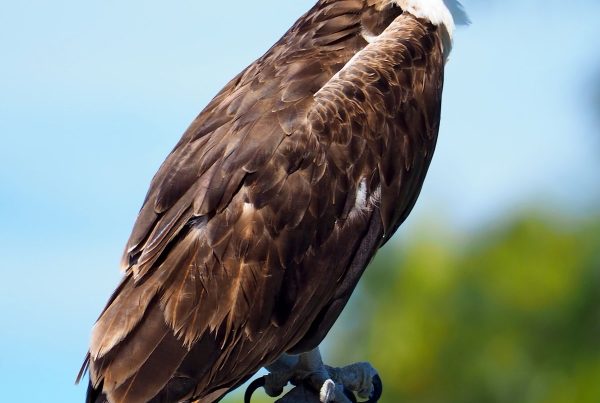

The Northern Mockingbird is the only North American bird that routinely sings through the night. Unpaired males, especially, will sing from before midnight until after dawn — producing an unbroken stream of borrowed phrases from dozens of other species, sometimes for hours without repeating. The Latin name, Mimus polyglottos, translates directly to “many-tongued mimic.” It’s accurate.
Identification
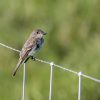
Overall impression: Medium-sized, slim, gray-brown bird with a long tail. Often seen perched conspicuously on high shrubs, fence posts, or power lines, sometimes singing from the very top of a tree. The white wing patches flash distinctively in flight — the single most useful field mark when the bird is moving.
Key field marks:
- White wing patches — Two white wing bars that merge into a larger white patch, visible in flight as a bold flash. This separates it instantly from similar gray songbirds like the Gray Catbird and Brown Thrasher.
- White outer tail feathers — Visible in flight and when the tail is fanned during territorial displays.
- Long tail — Proportionally longer than most similarly sized songbirds, often cocked or fanned during displays.
- Gray overall — Medium gray above, paler gray-white below. No strong markings on the head or breast.
- Slim, slightly curved bill — Noticeably slimmer than a thrush, slightly curved at the tip.
Size: 8.1–11 inches long, wingspan 12–15 inches. Similar size to an American Robin but slimmer.
Basic Facts
| Feature | Detail |
|---|---|
| Scientific name | Mimus polyglottos |
| Family | Mimidae (mockingbirds, thrashers, catbirds) |
| Length | 8.1–11 inches |
| Weight | 1.4–2.0 oz (40–58g) |
| Wingspan | 12.2–15.0 inches |
| Lifespan | Up to 14 years and 10 months (record); typically 8 years |
| Eggs per clutch | 2–6, pale blue-green with reddish-brown spots |
| Incubation | 12–13 days |
| Broods per year | 2–3 |
| Conservation status | Least concern |
The Mimicry: How It Works
A Northern Mockingbird builds its song repertoire throughout its life by learning and copying the sounds of other birds — and other sounds in its environment. The repertoire expands continuously: older males typically have larger repertoires than younger ones. Research suggests males can learn and retain around 150–200 distinct songs, though some individuals may exceed this.
The mimicry is not random copying — it’s active learning. A mockingbird in a new area will spend time listening to the local birds and gradually incorporate their calls into its repertoire. Move a banded mockingbird from Florida to New England, and within a season it begins adding the calls of birds it had never previously encountered.
The song is structured as a series of phrases, each phrase repeated 3–6 times before switching to the next. This repetition-and-switch pattern is what distinguishes a mockingbird from an actual bird giving its own call — the original species says something once or twice, the mockingbird repeats it rhythmically.
Beyond bird calls, mockingbirds have been documented imitating: car alarms, cell phone ringtones, cricket sounds, barking dogs, and the sounds of rusty gates.
Why Do Mockingbirds Sing at Night?
Unmated males are the primary nighttime singers. The current best-supported explanation is that nocturnal singing reaches female mockingbirds who are actively searching for a mate — females cover significant distances at night during early breeding season, and a singing male is easier to locate than a silent one. Females don’t sing at night the same way.
Nighttime singing also peaks during the full moon, when light levels are high enough for the birds to be active and visible. This isn’t coincidence — mockingbirds are visually active and prefer light conditions that allow normal daytime behavior.
Once a male has paired successfully, the nighttime singing generally stops. If the singing continues through summer, it usually means the male has lost a mate or failed to attract one.
The Wing-Flash Display
One of the more distinctive mockingbird behaviors: while foraging on the ground, the bird will suddenly open its wings partway to reveal the white patches, hold the pose for a moment, then close them. Sometimes the wings are opened and closed repeatedly in a slow, deliberate display.
The purpose is debated. The leading hypothesis is prey flushing — the flash of white startles insects hiding in grass or leaf litter into moving, making them detectable. Experiments have produced mixed results: some studies show increased prey capture after wing-flashing; others don’t. The behavior persists regardless, suggesting some benefit that isn’t yet fully documented.
Territorial Behavior and Aggression
Northern Mockingbirds are famously aggressive territorial defenders. They maintain and defend two separate territories: a breeding territory in spring and summer, and an individual winter territory centered on a productive fruit source (a berry-laden shrub or tree). Males and females each hold and defend their own winter territories independently.
They will attack animals many times their size to defend these territories — cats, dogs, crows, hawks, and humans who approach nests. The attack behavior is direct: diving at the intruder from behind, sometimes making contact. Mockingbirds have been documented chasing Red-tailed Hawks off their territories through persistence rather than any physical advantage.
The territorial song serves as the primary defense: a male whose song repertoire is larger and more complex is signaling greater age and experience, which functions as a deterrent to potential competitors. If two males of roughly equal repertoire size encounter each other, direct confrontation and escalating displays follow.
Diet
Mockingbirds eat both insects and fruit, shifting seasonally. In spring and summer, insects dominate — they are active foragers that pursue prey on the ground, in shrubs, and in the air. In fall and winter, fruit becomes the primary food: holly, hackberry, blackberry, multiflora rose, sumac, and many other native and introduced berry plants.
The winter territory is typically defended around a productive fruit source. A mockingbird that stakes out a holly tree with hundreds of berries will defend it through the winter against all comers — other mockingbirds, robins, Cedar Waxwings, and any other species that tries to use the same resource.
Range and Habitat
Year-round resident across the southern and eastern US, with range extending into the northern states and expanding northward over the past several decades — likely due to climate warming and the spread of fruiting shrubs (including multiflora rose) that provide winter food in northern areas.
Highly adaptable to human-modified landscapes: suburban yards, parks, hedgerows, roadsides, and urban gardens all support mockingbird populations. They require some open ground for foraging combined with shrubby cover for nesting, which describes most residential areas in the US.
State Bird
The Northern Mockingbird is the state bird of five US states: Arkansas, Florida, Mississippi, Tennessee, and Texas — more states than any other bird species. The mockingbird was a popular choice in the South during the period when state birds were designated (1920s–1940s), reflecting its abundance, its prominent song, and its status as a familiar and beloved garden bird.
FAQ: Northern Mockingbird
Why does a mockingbird sing all night?
Unmated males sing through the night, especially during full moons, to attract females who are actively searching for mates. Once paired, the nighttime singing usually stops.
How many songs can a Northern Mockingbird learn?
Around 150–200 over a lifetime, with older males typically having larger repertoires. The repertoire grows continuously through active learning from surrounding birds.
What is the wing-flash display?
A behavior where the mockingbird suddenly opens its wings to reveal the white patches while foraging on the ground. Most likely functions to startle hidden insects into moving, making them easier to detect.
Are mockingbirds aggressive?
Yes — among the most aggressively territorial songbirds in North America. They will physically attack animals much larger than themselves to defend nests and winter food sources, including cats, dogs, and humans.
Is the mockingbird a state bird?
Yes — five states: Arkansas, Florida, Mississippi, Tennessee, and Texas. More than any other species.
For more on songbirds with remarkable vocal abilities, see our guides on American Robin song and Baltimore Oriole song.

MD Imdadul Haque is the founder of BirdzFly, a research-backed resource on North American backyard birds. Drawing on years of independent study into bird identification, behavior, and migration patterns, he writes in-depth guides designed to help US birders understand the species in their own backyards — from common feeder visitors to seasonal migrants passing through.