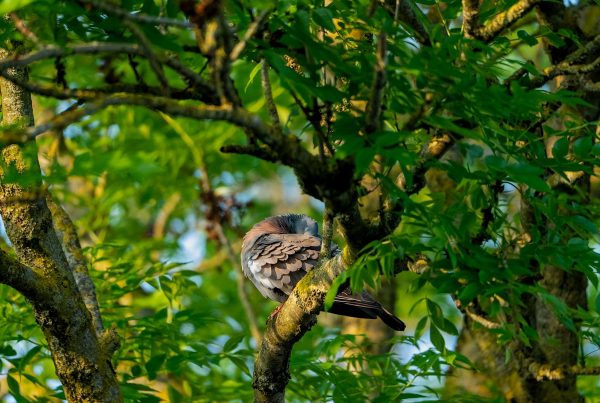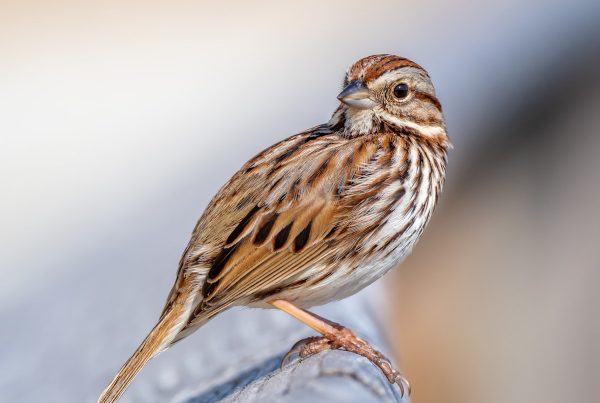

The House Wren looks like nothing special — small, plain brown, no bold markings, easy to overlook entirely. But behind that unremarkable appearance is one of the more aggressively competitive small birds in North America, willing to destroy the eggs of other cavity-nesting species to secure a nest site for itself. Understanding this behavior changes how you look at a bird most people dismiss at a glance.
Identification
Overall impression: A small, plain brown bird with faint barring on the wings and tail, no bold field marks, and a cocked tail typical of wrens. Genuinely one of the least visually distinctive common backyard birds — identification relies more on behavior, voice, and habitat than plumage detail.
Key field marks:
- Uniform brown coloring — Warm grayish-brown overall, without the bold white eyebrow stripe that distinguishes the Carolina Wren
- Faint eye-ring — A subtle pale ring around the eye, much less prominent than the Carolina Wren’s bold eyebrow
- Fine barring — Thin dark barring visible on the wings and tail at close range
- Cocked tail — Held upright, standard wren posture
- Thin, slightly curved bill — Built for insect gleaning
Size: 4.3–5.1 inches long, wingspan 5.9 inches. Slightly smaller and noticeably plainer than the Carolina Wren.
Basic Facts
| Feature | Detail |
|---|---|
| Scientific name | Troglodytes aedon |
| Family | Troglodytidae (wrens) |
| Length | 4.3–5.1 inches |
| Weight | 0.3–0.4 oz (10–12g) |
| Wingspan | 5.9 inches |
| Lifespan | Up to 9 years on record |
| Eggs per clutch | 3–10, white or pinkish with brown speckling |
| Incubation | 13–15 days |
| Conservation status | Least concern |
The Aggressive Side of a Small, Plain Bird
House Wrens compete intensely for nest cavities, and males will destroy the eggs of other cavity-nesting birds — including their own species, bluebirds, and Tree Swallows — by puncturing them, a behavior documented extensively in ornithological research. This isn’t incidental damage; it’s deliberate competition for limited nest sites, and it happens regularly enough that House Wrens are considered a genuine management concern for bluebird trail operators, who often need to actively manage nest box spacing and placement to reduce House Wren interference.
Males also build multiple “dummy nests” — incomplete stick structures in several cavities within their territory — partly to attract a female (who then chooses which nest to complete and use) and partly, some researchers suggest, to occupy potential nest sites and deny them to competing House Wrens or other cavity-nesting species. A single male may build 5 or more dummy nests in a season.
This combination of behaviors — a small, unassuming bird engaging in active nest-site sabotage — is part of why House Wrens generate more mixed feelings among backyard birders than almost any other common species. Bluebird enthusiasts in particular often have strong opinions about House Wren management.
The Song
Despite the plain appearance, the House Wren’s song is loud, bubbly, and complex — a cascading series of chattering trills and warbles delivered with remarkable energy for such a small bird. Males sing frequently and persistently through the breeding season, often from a low, exposed perch near their territory.
The song serves double duty: attracting a mate and advertising territorial claim to competing males, which connects directly to the aggressive nest-site competition described above — a House Wren’s song is as much a warning to rivals as it is a courtship display.
Diet
Almost entirely insectivorous — beetles, caterpillars, spiders, and other invertebrates gleaned from dense low vegetation, brush piles, and garden beds. House Wrens forage energetically and constantly, rarely still for more than a few seconds while active.
They are not typical feeder visitors given their insect-focused diet, though they will occasionally take mealworms if offered, particularly during the breeding season when the extra protein benefits nestlings.
Range and Habitat
One of the most widely distributed songbirds in the Americas — breeding across virtually all of the continental US and southern Canada, with a range extending through Mexico and Central America into South America (where local populations and subspecies are sometimes treated separately). Highly adaptable to suburban yards, gardens, and edge habitat, tolerating human presence more readily than many songbirds.
Northern populations migrate south for winter; southern populations are largely resident year-round.
Managing House Wren Competition
For anyone managing bluebird boxes or other cavity nest sites, the most effective approach is spatial: House Wrens strongly prefer nest sites near brushy cover and are less likely to compete for boxes placed in open areas away from dense vegetation, which is also generally better bluebird habitat anyway. Spacing boxes at least 100 yards apart and away from brush lines reduces House Wren interference without requiring direct intervention.
FAQ: House Wren
Are House Wrens aggressive?
Yes — males regularly puncture the eggs of competing cavity-nesting birds, including bluebirds and Tree Swallows, to secure nest sites. This is a well-documented and genuine management concern for bluebird conservation efforts.
Why does a House Wren build multiple nests?
Males build several incomplete “dummy nests” in different cavities, partly to give a prospective female options to choose from and partly to occupy potential nest sites, denying them to rivals.
How do you tell a House Wren from a Carolina Wren?
The House Wren is plainer overall with only a faint eye-ring; the Carolina Wren has a bold white eyebrow stripe and warmer, more reddish coloring. The Carolina Wren is also slightly larger.
What does a House Wren eat?
Almost entirely insects — beetles, caterpillars, and spiders gleaned from dense low vegetation. They rarely visit seed feeders.
For more on wrens and cavity-nesting birds, see our guides on Carolina Wren and Eastern Bluebird.

MD Imdadul Haque is the founder of BirdzFly, a research-backed resource on North American backyard birds. Drawing on years of independent study into bird identification, behavior, and migration patterns, he writes in-depth guides designed to help US birders understand the species in their own backyards — from common feeder visitors to seasonal migrants passing through.