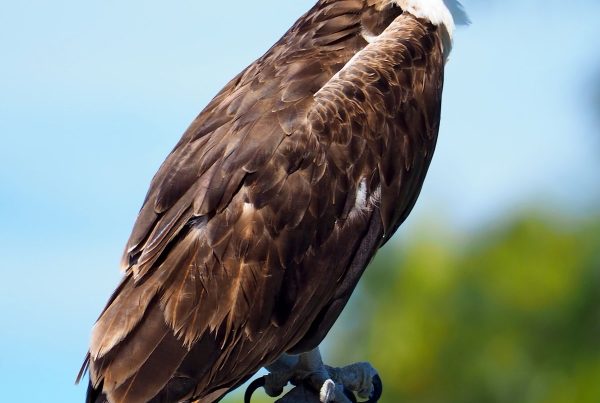

The Eastern Phoebe is one of the plainest-looking common backyard birds in eastern North America — no bold colors, no bright patterns, nothing that immediately catches the eye. But it makes up for the plain appearance with two behaviors that make it one of the easier flycatchers to identify with confidence: a distinctive tail-wagging habit and a call that says its own name.
Identification
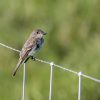
Overall impression: A small, plain, grayish-brown flycatcher with a slightly darker head, pale underparts, and virtually no strong field marks beyond overall shape and behavior — genuinely one of the more understated common birds, identified more by what it does than what it looks like.
Key field marks:
- Constant tail-wagging — Pumps its tail downward repeatedly while perched, a near-constant behavior that is one of the most reliable ways to identify the species even at a distance where plumage details aren’t visible
- Dark gray-brown head — Slightly darker than the rest of the upperparts, though the contrast is subtle
- No wing bars or eye-ring — Unlike many similar small flycatchers (particularly the Empidonax genus), Eastern Phoebes lack both bold wing bars and a distinct eye-ring, which is itself a useful identification clue by elimination
- Upright perching posture — Sits notably upright on an exposed perch, typical flycatcher behavior
- Pale yellowish wash on underparts — Subtle, more visible in fresh fall plumage than in worn breeding plumage
Size: 5.5–6.7 inches long, wingspan 10.2 inches. A small, compact bird similar in overall size to a sparrow.
Basic Facts
| Feature | Detail |
|---|---|
| Scientific name | Sayornis phoebe |
| Family | Tyrannidae (tyrant flycatchers) |
| Length | 5.5–6.7 inches |
| Weight | 0.6–0.8 oz (16–21g) |
| Wingspan | 10.2 inches |
| Lifespan | Up to 10 years on record |
| Eggs per clutch | 2–6, white, sometimes with brown speckling |
| Incubation | 15–16 days |
| Conservation status | Least concern |
The Call: A Genuinely Onomatopoeic Name
The Eastern Phoebe’s most common vocalization is a rough, burry, two-part call rendered as “fee-bee” — sung with an emphatic downward inflection, from which the bird’s common name is directly derived. Unlike many bird names that come from a describer’s name or a physical feature, “phoebe” is a genuine attempt to spell out the sound the bird actually makes, one of relatively few North American bird names that work this way.
The call is given persistently through the breeding season from an exposed perch, often the same perch used repeatedly over days or weeks, making the bird’s location predictable once a calling male is located.
Why the Tail-Wagging Matters for Identification
Eastern Phoebes belong to a genus (Sayornis) and broader family (Tyrannidae, the tyrant flycatchers) that includes many visually similar species, particularly the notoriously difficult-to-identify Empidonax flycatchers. Many of these species overlap significantly in size, color, and habitat, making visual identification genuinely challenging even for experienced birders.
The Eastern Phoebe’s persistent tail-wagging — a distinctive downward pump repeated frequently while perched — is one of the most useful behavioral shortcuts in this confusing group. Few other small flycatchers share this exact habit with the same frequency and intensity, making it a practical field mark that works even when plumage details are hard to see clearly.
Nesting: Comfortable Near Human Structures
Eastern Phoebes build a cup nest of mud, moss, and grass, and are strongly associated with nesting on or near human-made structures — under bridges, in barn eaves, on porch light fixtures, and under building overhangs. This preference for artificial ledges and overhangs likely developed from an original habit of nesting on natural rock ledges and cliff faces, which human structures effectively mimic.
This tolerance for nesting near people means Eastern Phoebes are one of the more commonly and directly observed nesting birds for people with a barn, porch, or bridge on their property — a phoebe nest above a porch light is a common and often welcomed sight through spring and summer.
Diet and Hunting
Classic flycatcher behavior: Eastern Phoebes perch on an exposed branch or wire, watch for flying insects, then sally out to catch prey in midair before returning to the same or a nearby perch — a foraging style called “hawking” or “flycatching” that gives the entire family its common name.
Primary prey includes flies, beetles, wasps, bees, and other flying insects. In colder weather, particularly during early spring arrival and late fall departure when flying insects are scarce, Eastern Phoebes will supplement the diet with small fruits and berries — an unusual dietary flexibility among flycatchers that likely helps the species tolerate colder temperatures than many of its relatives.
One of the Earliest Spring Migrants
Eastern Phoebes are among the earliest-arriving migratory songbirds in spring, often returning to breeding areas in March while overnight frost is still common — earlier than most insectivorous songbirds, made possible by their dietary flexibility to fall back on fruit when insects aren’t yet reliably available. This early arrival timing has made the species a recognized harbinger of spring across much of its range.
Range and Migration
Breeds across the eastern and central United States and southern Canada, wintering primarily in the southeastern US, Mexico, and parts of Central America. Strongly associated with habitat near water — streams, ponds, and wooded edges — combined with the nearby structures (bridges, buildings) increasingly used for nesting.
FAQ: Eastern Phoebe
Why does an Eastern Phoebe wag its tail?
It’s not fully understood, but the persistent tail-pumping is a reliable behavioral field mark that helps distinguish the species from visually similar flycatchers, particularly the difficult-to-identify Empidonax genus.
Why is it called a “phoebe”?
The name comes directly from the bird’s call — a rough “fee-bee” — making it one of the relatively few North American bird names based on an attempt to spell out the actual sound.
Where do Eastern Phoebes build nests?
Often on or near human structures — under bridges, in barn eaves, on porch light fixtures — a habit likely derived from an original preference for natural rock ledges.
What do Eastern Phoebes eat?
Primarily flying insects, caught by watching from a perch and sallying out to catch prey in midair. In cold weather when insects are scarce, they supplement with small fruits and berries.
For more on flycatchers and early spring migrants, see our guide on spring bird migration 2026.

MD Imdadul Haque is the founder of BirdzFly, a research-backed resource on North American backyard birds. Drawing on years of independent study into bird identification, behavior, and migration patterns, he writes in-depth guides designed to help US birders understand the species in their own backyards — from common feeder visitors to seasonal migrants passing through.