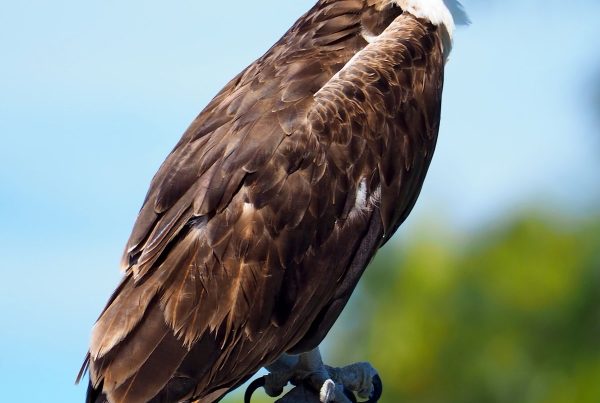

Most North American birds nest in trees, shrubs, or cavities excavated in wood. The Belted Kingfisher does something almost no other bird on the continent does — it digs a tunnel into a dirt riverbank, sometimes 3 to 6 feet deep, and raises its young in complete darkness at the far end. It’s one of the more unusual nesting strategies in North American birdlife, and it happens entirely underground.
Identification
Overall impression: A large-headed, stocky, blue-gray bird with a shaggy crest, an oversized dagger-like bill, and a habit of perching prominently over water — often the first clue to its presence before any plumage detail is visible.
Key field marks:
- Shaggy crest — A ragged, spiky crest on top of the head, giving a distinctive silhouette unlike any other common North American bird near water
- Large, heavy bill — Long, thick, dagger-shaped bill proportionally oversized for the bird’s body, built for catching and gripping fish
- Blue-gray upperparts with white collar — Solid blue-gray back, wings, and crest, with a white ring around the neck
- Blue-gray breast band — Present in both sexes
- Rust-colored belly band (females only) — This is one of the few North American bird species where the female is more colorful than the male — females have an additional rusty-orange band across the belly that males lack entirely, making this one of the more reliable and visually obvious sex-identification cases in North American birding
Size: 11–14 inches long, wingspan 19–23 inches. A substantial bird, larger than a robin, with a notably oversized head and bill relative to body size.
Basic Facts
| Feature | Detail |
|---|---|
| Scientific name | Megaceryle alcyon |
| Family | Alcedinidae (kingfishers) |
| Length | 11–14 inches |
| Weight | 4.9–6.0 oz (140–170g) |
| Wingspan | 19–23 inches |
| Lifespan | Up to 12 years on record |
| Eggs per clutch | 5–8, white |
| Incubation | 22–24 days |
| Conservation status | Least concern |
Tunnel Nesting: The Defining Behavior
Belted Kingfishers excavate nest burrows into vertical earthen banks, typically near water — riverbanks, lake shores, sand pits, or road cuts with exposed soil. Both parents dig using their bill as a pick and their feet to kick loose soil backward out of the tunnel, a process that can take one to three weeks depending on soil conditions.
The completed tunnel typically runs 3 to 6 feet horizontally into the bank, sometimes angled slightly upward (likely to help drainage and prevent flooding), ending in a small nesting chamber where the eggs are laid directly on bare dirt with no nesting material added. Both parents incubate the eggs and feed the young entirely within this dark underground chamber, emerging only to hunt.
This tunnel-nesting strategy provides significant protection from most predators and weather, though it does require suitable exposed earthen banks — which is part of why kingfisher distribution is tied so closely to natural riverbank erosion, sand pits, and similar exposed-soil habitat features.
Hunting: The Classic Perch-and-Dive
Belted Kingfishers hunt using a distinctive perch-and-plunge-dive technique: the bird watches from an elevated perch over water — a branch, wire, or piling — scanning for fish near the surface, then dives directly into the water, sometimes from significant height, to seize prey in its bill. When no suitable perch is available, kingfishers will also hover in place over water before diving, similar to an Osprey’s hunting style but on a smaller scale.
After a successful catch, the kingfisher returns to a perch and beats the fish against the branch repeatedly before swallowing it headfirst — a behavior that both stuns/kills the prey and orients it properly for swallowing without the fins catching in the throat.
Diet
Small fish make up the large majority of the diet — the species is essentially a fish specialist, though it supplements this with:
- Crayfish and other crustaceans
- Amphibians, particularly tadpoles and small frogs
- Aquatic insects
- Occasionally small reptiles or even small mammals, taken opportunistically
The Rattling Call
The Belted Kingfisher’s call is a loud, dry, mechanical rattle — often the first indication of the bird’s presence, given both in flight and from a perch. The sound has a distinctive harsh, repetitive quality unlike typical songbird vocalization, closer to a wooden rattle or football-stadium noisemaker than a conventional bird call. This distinctive rattle carries well over water and is frequently heard before the bird itself is spotted.
Range and Habitat
Found across virtually all of North America wherever suitable water and fishing habitat exist — rivers, lakes, ponds, coastal areas, and estuaries. Northern populations migrate south in winter to areas where water remains unfrozen; southern and coastal populations are largely resident year-round. The species requires both open water for hunting and appropriate earthen banks nearby for nesting, which shapes its distribution more specifically than many generalist species.
FAQ: Belted Kingfisher
Why does a Belted Kingfisher dig a tunnel to nest?
The underground burrow, dug into a vertical earthen bank near water, provides strong protection from predators and weather. Both parents share the digging, which can take one to three weeks.
Is the female or male Belted Kingfisher more colorful?
The female — she has an additional rust-orange belly band that males completely lack, making this one of the few North American bird species where females are more colorful than males.
What does a Belted Kingfisher eat?
Primarily small fish, supplemented by crayfish, amphibians, and aquatic insects, caught using a plunge-dive technique from an elevated perch or hover.
What does a Belted Kingfisher sound like?
A loud, dry, mechanical rattling call, given both in flight and from a perch — distinctive and often heard before the bird is seen.
For more on water-associated birds, see our guides on Heron vs Egret and Osprey vs Eagle.

MD Imdadul Haque is the founder of BirdzFly, a research-backed resource on North American backyard birds. Drawing on years of independent study into bird identification, behavior, and migration patterns, he writes in-depth guides designed to help US birders understand the species in their own backyards — from common feeder visitors to seasonal migrants passing through.