Nearly every hawk and eagle in North America has a broad, varied diet — small mammals, birds, reptiles, whatever’s available. The Osprey is different. Fish make up roughly 99% of its diet, an extraordinary degree of dietary specialization for a large raptor, and its entire body — feet, feathers, even its nostrils — is built specifically around catching fish from the water’s surface.
Identification
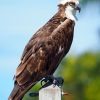
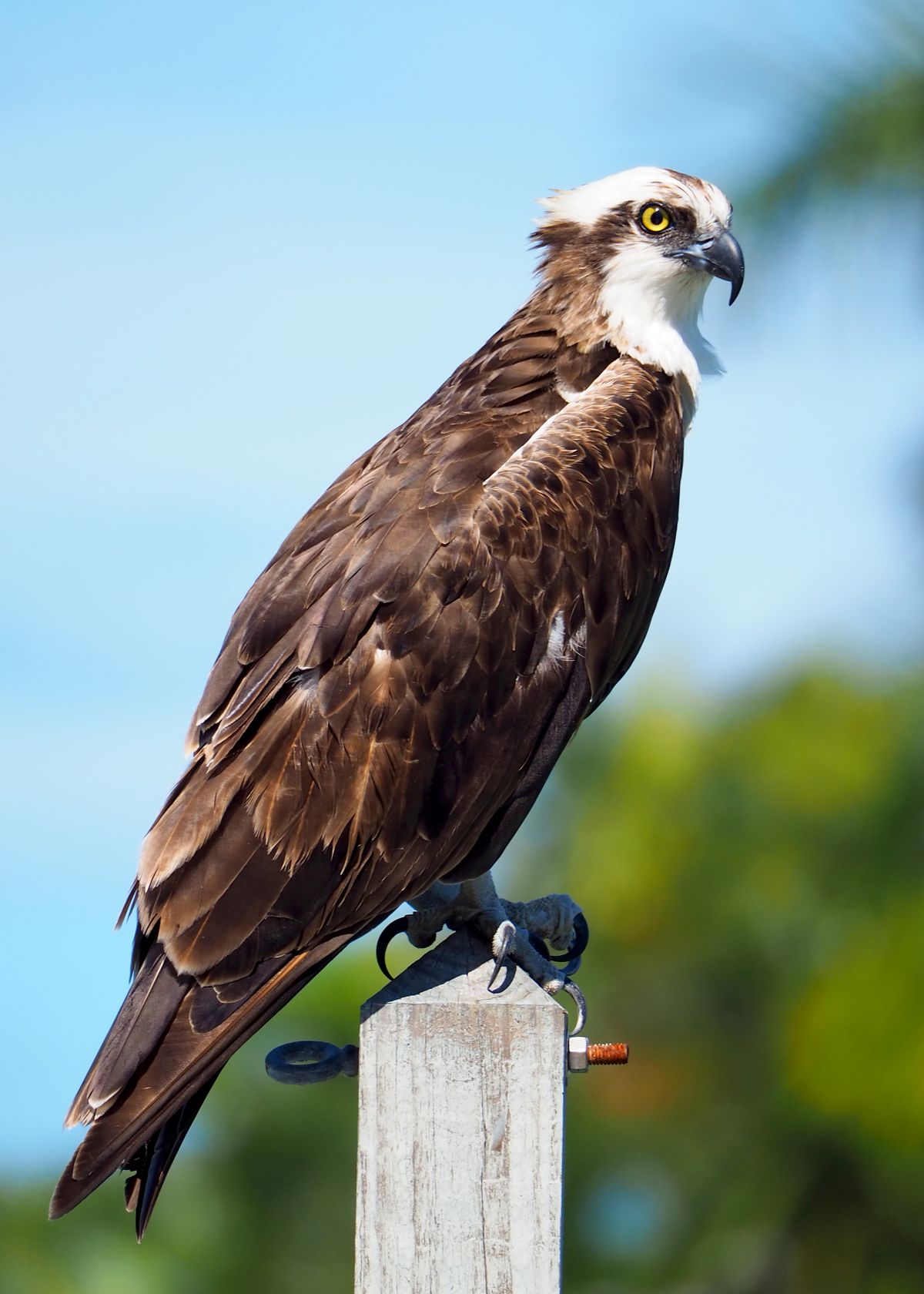
Overall impression: A large, long-winged raptor, dark brown above and mostly white below, with a distinctive dark eye-stripe and a habit of hunting directly over open water — often visible from a considerable distance thanks to size and flight style.
Key field marks:
- White head with dark eye-stripe — A bold black stripe running through the eye against an otherwise white head and throat, one of the most useful field marks at a distance
- Dark brown upperparts, white underparts — Strong contrast, often described as “gull-like” in overall color pattern compared to most hawks and eagles
- Distinctive bent-wing flight silhouette — In flight, the wings show a characteristic crook or bend at the wrist, giving an “M” shape when viewed head-on that separates Osprey from eagles at a distance
- Reversible outer toe — Unique among North American raptors, the Osprey can rotate its outer toe backward, giving it a two-forward, two-backward grip (like an owl) specifically adapted for gripping slippery fish
Size: 21–23 inches long, wingspan 59–71 inches. A large raptor, close in wingspan to a Bald Eagle though considerably lighter and more slender-bodied.
Basic Facts
| Feature | Detail |
|---|---|
| Scientific name | Pandion haliaetus |
| Family | Pandionidae (sole member of this family) |
| Length | 21–23 inches |
| Weight | 49–71 oz (1,400–2,000g) |
| Wingspan | 59–71 inches |
| Lifespan | Up to 25 years on record |
| Eggs per clutch | 2–4, whitish with brown blotching |
| Incubation | 36–42 days |
| Conservation status | Least concern (recovered from DDT-era decline) |
Built Entirely Around Catching Fish
The Osprey’s anatomy is a genuine case study in specialization:
- Reversible outer toe — Allows a two-in-front, two-behind grip that dramatically increases hold on a struggling, slippery fish — the only North American hawk-family raptor with this adaptation
- Barbed foot pads (spicules) — Small, sharp spines on the underside of the toes that further improve grip on wet, slippery prey
- Closable nostrils — Valve-like nostrils that close automatically during the plunge-dive into water, preventing water from entering the airway on impact
- Dense, oily plumage — Feathers with a structure that sheds water efficiently, allowing the bird to become fully or partially submerged during a dive and then take off again without becoming waterlogged
This combination of adaptations makes the Osprey uniquely equipped among North American raptors for a fishing lifestyle that most other hawks and eagles only pursue opportunistically.
The Hunting Dive
Osprey hunt by flying or hovering 30-100 feet above water, scanning for fish near the surface. On spotting prey, the bird folds its wings and dives feet-first, sometimes plunging completely underwater before emerging with a fish gripped in its talons. Success rates are notably high for a raptor — estimated at around 1 in 4 dives resulting in a catch, better than many other hunting strategies among large birds of prey.
After a successful catch, Osprey characteristically reposition the fish in flight to carry it head-first — reducing wind resistance during the flight back to a perch or nest, a behavior distinctive enough that it’s a reliable way to confirm an Osprey sighting versus another large raptor carrying prey.
Nesting: Large Stick Platforms
Osprey build large stick nests, often reused and added to across many years, growing to substantial size over time. Historically built in dead trees near water, Osprey have adapted remarkably well to artificial nesting platforms — utility poles, purpose-built nest platforms, channel markers, and cell towers are all commonly used, especially in coastal and wetland areas where nest platform programs have significantly supported population recovery.
Osprey are typically monogamous and often reuse the same nest site across multiple years, with pairs frequently reuniting at the same nest each breeding season even though they may migrate separately and winter apart.
Recovery From DDT-Era Decline
Like the Bald Eagle and Peregrine Falcon, Osprey populations crashed dramatically in the mid-20th century due to DDT-caused eggshell thinning, which severely reduced breeding success across much of the range. Following the 1972 US ban on DDT, Osprey populations recovered strongly over subsequent decades, aided significantly by nest platform programs that provided secure nesting sites in areas where natural trees had become scarce due to shoreline development.
Today, Osprey are considered a genuine conservation success story, with healthy and in many areas expanding populations across their range — one of the more visible recoveries among North American raptors affected by the DDT era.
Migration
North American Osprey are long-distance migrants, with many populations wintering in Central and South America — some individuals travel over 2,500 miles each way. Modern satellite tracking has revealed that individual Osprey often follow remarkably consistent migration routes year after year, and that mated pairs frequently migrate separately, meeting back at the same nest site the following spring despite having wintered in different locations.
Osprey vs Bald Eagle
Both are large, fish-eating raptors often confused at a distance, but several features separate them reliably:
| Feature | Osprey | Bald Eagle |
|---|---|---|
| Head | White with dark eye-stripe | Solid white (adults) |
| Underparts | Mostly white | Dark brown |
| Flight silhouette | Bent “M” shaped wings | Flat, broad wings |
| Diet | Almost exclusively fish, caught by diving | Fish plus varied scavenging and other prey |
| Hunting style | Deep plunge-dive, often submerged | Snatches fish from surface, rarely submerges |
FAQ: Osprey
What does an Osprey eat?
Fish make up approximately 99% of the diet — one of the most specialized diets of any North American raptor.
How is an Osprey different from a Bald Eagle?
Ospreys have white underparts and a dark eye-stripe on an otherwise white head, plus a distinctive bent-wing flight silhouette. Bald Eagles have solid white heads (as adults) and dark brown underparts.
Why can Osprey grip fish so well?
A reversible outer toe allows a two-forward, two-backward grip, combined with sharp barbed foot pads (spicules) that improve hold on wet, slippery prey — adaptations unique among North American hawk-family raptors.
Where do Osprey nest?
Large stick nests near water, historically in dead trees but now frequently on artificial platforms, utility poles, and channel markers, often reused across many breeding seasons.
For more on fish-eating and water-associated raptors, see our guides on Belted Kingfisher and Bald Eagle lifespan.

MD Imdadul Haque is the founder of BirdzFly, a research-backed resource on North American backyard birds. Drawing on years of independent study into bird identification, behavior, and migration patterns, he writes in-depth guides designed to help US birders understand the species in their own backyards — from common feeder visitors to seasonal migrants passing through.