
A day-old Wood Duck weighs almost nothing and has never flown — yet within 24 hours of hatching, it will climb to the entrance of a tree cavity that might be 50 feet above the ground and jump. No flight, no gliding, just a controlled fall onto forest floor, water, or whatever happens to be below. This is completely normal Wood Duck behavior, and the ducklings survive it reliably thanks to a body built specifically to absorb the impact.
Identification
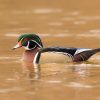
Overall impression: Widely considered one of the most strikingly colored waterfowl species in North America — males in particular show an almost overwhelming combination of iridescent green, purple, chestnut, white, and red that makes them instantly recognizable and frequently described as looking almost artificial in their intensity.
Key field marks (male, breeding plumage):
- Iridescent green and purple head — A sweeping crest running from the head down the back of the neck, glossy green and purple depending on the angle of light
- Bold white facial stripes — Sharp white lines running through the crest and around the face, providing dramatic contrast against the dark iridescent head
- Red eye and red-based bill — Bright red iris and a multicolored bill with red at the base transitioning to black and yellow
- Chestnut breast with white speckling — Rich reddish-brown breast marked with fine white spotting
- Iridescent bronze-green back and sides — Rounding out one of the most visually complex plumage patterns of any North American duck
Females are considerably more subdued — gray-brown overall with a distinctive white teardrop-shaped eye-ring and patch, useful for identification even without the male’s dramatic coloring nearby for comparison.
Size: 18.5–21.3 inches long, wingspan 26.0–28.7 inches.
Basic Facts
| Feature | Detail |
|---|---|
| Scientific name | Aix sponsa |
| Family | Anatidae (ducks, geese, and swans) |
| Length | 18.5–21.3 inches |
| Weight | 16.0–30.4 oz (454–862g) |
| Wingspan | 26.0–28.7 inches |
| Lifespan | Up to 15 years on record |
| Eggs per clutch | 6–16, whitish to buff |
| Incubation | 28–37 days |
| Conservation status | Least concern (major conservation success story) |
Cavity Nesting: An Unusual Choice for a Duck
Most North American ducks nest on the ground, typically hidden in dense vegetation near water. Wood Ducks are a genuine exception — they nest in tree cavities, often old woodpecker excavations or natural hollows, sometimes located a considerable distance from water and well above ground level, occasionally 50 feet up or higher.
The female selects the cavity, lines it with down feathers, and lays a large clutch of eggs — sometimes 6 to 16, occasionally more if multiple females “dump” eggs into the same nest (a documented behavior called nest parasitism that occurs more frequently in Wood Ducks than in most waterfowl species). Incubation takes roughly a month, with the female alone responsible for incubation.
The Jump: How Ducklings Survive a 50-Foot Fall
Within roughly 24 hours of hatching, the female leads her brood to the cavity entrance and calls them out — and one by one, the ducklings climb to the opening and jump. There is no learning curve, no practice attempt; the very first jump a Wood Duck duckling ever makes can be from significant height directly to the ground or water below.
Ducklings survive this because of specific physical adaptations: an extremely low body weight relative to surface area, and a body structure that distributes impact force effectively on landing, similar in principle to how a small, light object survives a fall that would seriously injure something heavier and less structurally suited to absorbing impact. Injuries from the jump itself are rare. Once on the ground, the entire brood follows the female, often over a significant distance, to reach suitable water and cover.
Diet
Omnivorous and seasonally variable:
- Aquatic plants and seeds — Duckweed, pondweed, and various aquatic vegetation make up a large portion of the adult diet
- Acorns and other mast — Particularly important in fall and winter, when Wood Ducks forage on the ground in wooded areas near water for fallen acorns
- Insects and aquatic invertebrates — Especially important for ducklings, which need higher protein intake for rapid growth than adults require
The species’ close association with wooded wetlands and its willingness to forage on the forest floor for acorns is part of what gives it the “wood” in its common name — a genuine departure from the more open-water habitat many other duck species prefer.
A Major Conservation Success Story
Wood Duck populations declined severely in the late 19th and early 20th centuries due to unregulated hunting and the widespread loss of forested wetland habitat and large trees with natural nesting cavities. The species came close enough to serious trouble that early 20th-century conservationists genuinely worried about its long-term survival.
Recovery came through a combination of hunting regulation (particularly protections established under the Migratory Bird Treaty Act) and — significantly — the widespread adoption of artificial nest boxes to compensate for the loss of natural tree cavities in managed and altered landscapes. Wood Duck nest box programs, now common across much of the species’ range, have become one of the most visible and successful examples of artificial cavity provision directly supporting a North American bird species’ recovery, a conservation model that later influenced similar efforts for species like the Eastern Bluebird.
Range and Habitat
Found across much of the eastern United States and parts of the Pacific coast, strongly associated with wooded wetlands, swamps, beaver ponds, and slow-moving rivers with adjacent forest cover. Northern populations migrate south for winter; southern populations are largely resident year-round.
FAQ: Wood Duck
How do Wood Duck ducklings survive jumping from a tree cavity?
Their extremely low body weight relative to size lets them absorb the fall’s impact without serious injury — a physical advantage similar to how small, light objects survive drops that would seriously harm something heavier and less structurally adapted to the impact.
Why does a Wood Duck nest in a tree instead of on the ground like most ducks?
Tree cavity nesting provides protection from ground-based predators that threaten typical ground nests — a genuine departure from most North American duck species’ nesting strategy.
What do Wood Ducks eat?
Aquatic plants and seeds, acorns and other mast (especially in fall and winter), and insects, with ducklings requiring significantly more protein-rich insect food than adults.
Are Wood Ducks endangered?
No — after a serious population decline in the early 20th century, hunting regulation and widespread nest box programs helped the species recover into one of North America’s most successful waterfowl conservation stories.
For more on cavity-nesting birds, see our guides on the Eastern Bluebird and Purple Martin.

MD Imdadul Haque is the founder of BirdzFly, a research-backed resource on North American backyard birds. Drawing on years of independent study into bird identification, behavior, and migration patterns, he writes in-depth guides designed to help US birders understand the species in their own backyards — from common feeder visitors to seasonal migrants passing through.