Female Eastern Bluebird
Most people expect a female Eastern Bluebird to be dull brown — a plain counterpart to the vivid male. What they actually find is a bird with real color: soft blue in the wings and tail, pale rusty orange on the chest, white belly. It’s understated, not plain. And once you know what to look for, it’s not hard to identify.
What She Actually Looks Like
- Back and wings: Grayish-brown with blue-gray tones, transitioning to clear blue on the wing feathers and tail. The blue is softer than the male’s electric blue but unmistakable in decent light.
- Chest: Pale rusty orange or buff-orange, similar to the male’s but less saturated.
- Belly: White, clean.
- Head: Grayish-brown with a faint blue tinge on the crown. Incomplete white eye ring visible at close range.
- Bill: Short, straight, slightly pointed — typical thrush family.
- Size: About 6–7 inches. Larger than a House Sparrow, smaller than a robin.
The key field mark is the combination of blue in the wings and tail with the rusty orange chest. No other small common bird in Eastern Bluebird habitat has both.
Male vs. Female
| Feature | Male | Female |
|---|---|---|
| Back/wings | Vivid electric blue | Gray-brown with blue-gray |
| Chest | Deep rusty orange | Pale orange-buff |
| Head | Bright blue | Grayish-brown, faint blue |
| Overall | Vivid, unmistakable | Subtle but distinctive |
Confusion Species
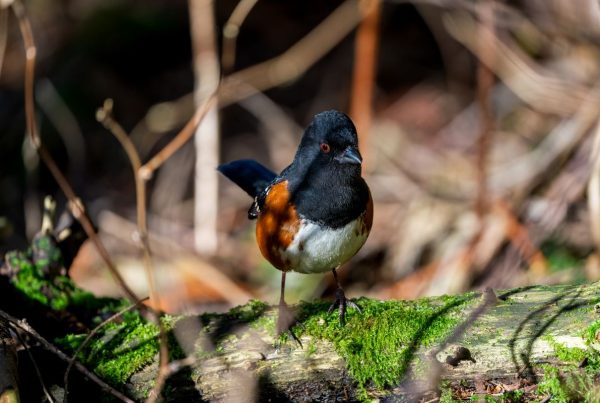
Eastern Towhee female: Rufous coloring on the sides, not the chest, and no blue anywhere on the bird.
Hermit Thrush: Spotted chest, spotted back, reddish tail — no blue.
House Sparrow female: Streaky brown, no blue, no orange, buffy eyebrow stripe.
Once you’ve seen a female bluebird clearly, the soft blue in the wings separates her from all of these.
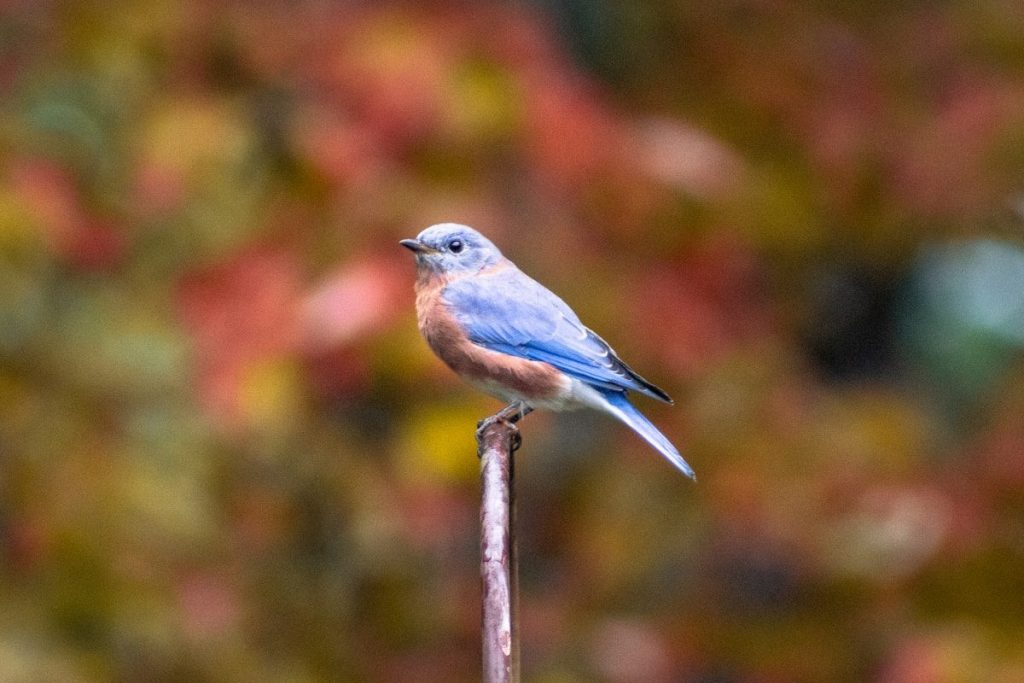
Female Eastern Bluebird
Nesting Behavior
The female does most of the nest building — dry grass, pine needles, fine plant material arranged into a cup inside the nest box. The male accompanies her and sometimes carries material, but the actual construction is primarily hers.
She lays 3–5 pale blue eggs (occasionally white) and incubates them for 13–16 days. During this period, the male makes regular trips to the nest box entrance to feed her. Watching a male arrive with an insect and pass it to the female inside is one of those small backyard moments worth sitting still for.
After hatching, both parents feed the nestlings. The female broods (keeps the young warm) for the first week while the male does most of the foraging. Both adults feed roughly equally as the nestlings grow. Young birds fledge at 17–21 days.
Signs Your Nest Box Is Being Used
- Female entering and exiting repeatedly while carrying dried grass — nest building
- Male perching on or near the box and singing
- Male arriving with food and passing it into the entrance — incubation is underway
- Soft churring from inside the box — nestlings
Check the box no more than once a week during incubation. Stop opening it when nestlings are 12 days old — disturbing them after this point can cause premature fledging.
Where to Find Them
Open habitats with scattered trees — meadows, golf courses, farmland edges, suburban yards with open lawns and some trees. Females need perches with clear sightlines for spotting insects and cavities for nesting. Year-round in the southern half of their range; arrive in early spring in the North, usually a week or two after the males.
FAQ
What does a female Eastern Bluebird look like?
Gray-brown overall with soft blue in the wings and tail, pale rusty-orange chest, white belly. The blue in the wings is the key field mark.
How do you tell male from female?
Males are vivid electric blue with deep rusty orange. Females are grayer with softer blue-gray tones and a paler, more washed-out orange chest.
Who builds the nest?
Primarily the female, though the male accompanies her. The female also does the incubating while the male brings her food.
For more on attracting bluebirds, see our guide on what colors attract birds to your yard.

MD Imdadul Haque is the founder of BirdzFly, a research-backed resource on North American backyard birds. Drawing on years of independent study into bird identification, behavior, and migration patterns, he writes in-depth guides designed to help US birders understand the species in their own backyards — from common feeder visitors to seasonal migrants passing through.