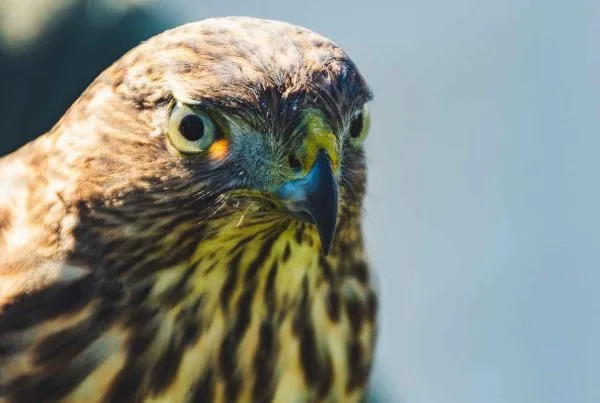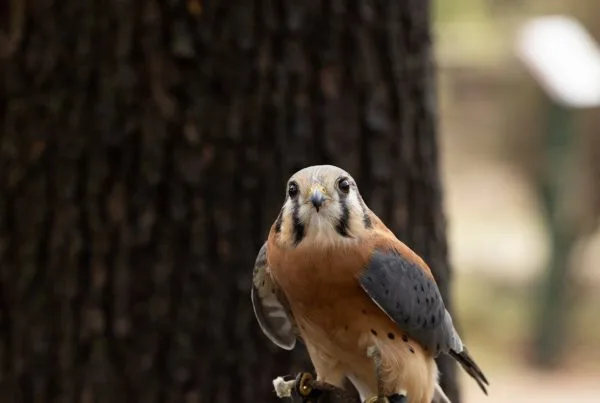

Seeing a hawk is one of those moments that tends to stop people. They’re large, they move deliberately, and when one locks eyes with you from a fence post or a branch overhead, it feels pointed in a way that a sparrow passing through doesn’t.
Across cultures and traditions, hawks carry consistent symbolic weight. Here is what they represent and what various traditions say about specific encounters.
What Hawks Symbolize
The core associations are consistent across nearly every tradition that engages with hawk symbolism:
- Vision and perspective — Hawks have extraordinary eyesight, roughly 8 times more acute than human vision. They see the full landscape from above. In spiritual terms, this translates to the ability to see situations clearly and from a wider perspective than ground-level thinking allows.
- Focus and precision — A hawk hunting doesn’t hesitate. It waits, watches, and acts with complete commitment when the moment is right. Symbolically, this represents decisive action, focus, and the willingness to commit fully to a path.
- Messenger — In many traditions, hawks are considered messengers between the human world and something beyond it. Their ability to move between earth and sky makes them natural symbols of communication between realms.
- Freedom and independence — Solitary hunters, holding their own territory, moving through open sky. Hawks represent autonomy and the freedom that comes from knowing your own capabilities.
- Leadership — In cultures where hawks appear as totems or spiritual symbols, they are frequently associated with chiefs, warriors, and leaders — those who must see the full situation and act for others.
What It Means When You See a Hawk
The most commonly searched question — and the honest answer depends partly on context and partly on which tradition you are drawing from.
The most consistent interpretation across traditions: a hawk sighting is a call to pay attention. Not necessarily to the hawk itself, but to what is happening around you. Hawks are associated with heightened awareness — seeing them is sometimes interpreted as a signal that you need to look more carefully at something in your life that deserves sharper focus.
In more specific situations:
A hawk appearing during a decision or transition — Often interpreted as encouragement to trust your perspective and proceed with confidence. The hawk’s precision is being reflected back at you.
A hawk crossing your path — In many Native American traditions, this signals that a message is on its way or that something you have been waiting for is close.
A hawk at your window — Interpreted in several traditions as an invitation to examine something you have been avoiding. The window as a barrier between inside and outside makes it a natural symbol for the boundary between the conscious and unconscious, or between where you are and where you are being called to go.
Two hawks together — Associated with partnership, balance, and the alignment of two forces. Often interpreted as significant in the context of relationships.
Hawks in Native American Traditions
Hawks are among the most significant birds in many Native American spiritual traditions. The specific meaning varies by tribe, but several themes appear consistently:
In many Plains traditions, the hawk is a messenger of the spirit world and a protector of warriors. Hawk feathers are used in ceremony and given as honors. The hawk’s vision is associated with the ability to see truth that others cannot.
The Red-tailed Hawk specifically is considered by many Lakota and other Plains peoples to be a particularly powerful messenger. Its red tail is associated with the energy of the root chakra in some traditions — grounding, survival, and the connection to earth.
In Ojibwe tradition, the hawk clan is associated with warriors and protectors of the people.
Hawks in Egyptian Mythology
The hawk is one of the most central animals in ancient Egyptian symbolism. Horus — one of the most important deities in the Egyptian pantheon — was depicted as a hawk or a man with a hawk head. Horus represented sky, kingship, and divine protection.
The Eye of Horus, one of the most recognized symbols in ancient Egyptian culture, is derived from the hawk’s eye. It represents protection, royal power, and good health.
Ra, the sun god, was also sometimes depicted with a hawk head, particularly in his aspect as Ra-Horakhty — Ra combined with Horus, the hawk of the horizon.
Hawks in Celtic Tradition
In Celtic mythology, hawks are associated with truth, memory, and the connection to ancestry. They are sometimes seen as guides to wisdom — birds that carry the accumulated knowledge of what has come before.
The hawk was considered capable of seeing through illusion, making it a symbol of discernment and clear perception in Celtic spiritual practice.
Hawks in Christianity
In Christian symbolism, the hawk has a dual nature. In some interpretations, particularly medieval ones, the hawk represents the converted sinner — a bird of prey that, when tamed, becomes a symbol of redemption and service. In illuminated manuscripts, hawks sometimes appear as symbols of the soul moving toward spiritual truth.
Hawks are also associated with watchfulness and spiritual vigilance — the quality of staying alert to what matters.
Hawks in Dreams
Dream interpretations of hawks generally follow the waking symbolism:
- A hawk soaring — Freedom, elevated perspective, call to rise above current limitations and see the broader situation
- A hawk hunting or diving — Focus, precision, commitment to a goal; sometimes a warning to act decisively before an opportunity passes
- A hawk injured or unable to fly — Something constraining your perspective or vision; a situation where you feel limited in your ability to see clearly or act freely
- A hawk delivering something — A message is coming, or information you need is near
Red-Tailed Hawk: Specific Spiritual Meaning
The Red-tailed Hawk is the most common large hawk in North America and the one most people encounter. Its specific symbolism in North American traditions:
The red tail is associated with passion, life force, and the connection to earth. In traditions that work with chakra energy, the red tail links to the root chakra — stability, grounding, and the courage to remain present during transformation.
When a Red-tailed Hawk appears in someone’s path, it is often interpreted as a reminder to stay grounded while pursuing higher goals — to keep the vision of the hawk without losing contact with what is real and immediate in daily life.
FAQ: Hawk Spiritual Meaning
What does it mean spiritually when you see a hawk?
Across most traditions, a hawk sighting is a call to heightened awareness and clarity. It is often interpreted as a message to pay attention, trust your vision, and act decisively on what you see clearly.
Is seeing a hawk a good omen?
Generally yes. Hawks are associated with protection, guidance, and clear vision in most traditions. They are rarely interpreted as negative omens unless appearing injured or dead.
What does a hawk represent in Native American culture?
Depending on the tribe, hawks represent messengers of the spirit world, protectors of warriors, guardians of the people, and symbols of vision and truth. The specific meaning varies significantly between traditions.
What does it mean when a hawk visits your yard?
Often interpreted as a message to look more carefully at something in your life. Some traditions see it as a sign of protection. Others interpret it as a call to act on something you have been observing but not yet moved on.
For more on bird symbolism, see our guides on what a cardinal visit means and robin symbolism.

MD Imdadul Haque is the founder of BirdzFly, a research-backed resource on North American backyard birds. Drawing on years of independent study into bird identification, behavior, and migration patterns, he writes in-depth guides designed to help US birders understand the species in their own backyards — from common feeder visitors to seasonal migrants passing through.