


birds know migrate
The Incredible Navigation System
Nobody taught them the route.
No parent explained to a young Blackpoll Warbler that its early years in the boreal forests of Canada did not prepare it for a 2,500-mile flight to the rainforests of Venezuela. This journey is mostly over open Atlantic Ocean and takes up to 90 hours without rest stops.
No one drew a map. No one described the landmarks. No one explained what Venezuela looks like from the air or how to navigate over 2,000 miles of featureless water at 3 a.m. in October.
And yet, every autumn, millions of Blackpoll Warblers make this journey. Many are flying for the first time, just weeks out of the nest. They launch from the New England coast and fly south into the Atlantic. They cross the ocean and find South America. They arrive, tired and worn out, in just the right spot.
And then they return in spring.
The Quest for Answers
The issue of how they navigate has puzzled scientists for over a century. The answer, still not fully known, involves several complex navigation systems.
The Big Idea: Why Migration Exists
Migration exists because resources are seasonal. In North America, insects, berries, and seeds are plentiful in summer but scarce in winter. During summer, daylight hours allow for efficient foraging, while winter days are harsh.
Birds that evolved to take advantage of summer abundance and avoid winter scarcity thrived. Migration became a biological necessity, written in their genetics and hormones, over millions of years.
Birds don’t choose to migrate; they feel a pressure they cannot ignore. This is known as Zugunruhe, or migratory restlessness. Caged birds show this by hopping and fluttering toward their migration target, even if they cannot see it.
The direction is already within them.
Navigation Systems
Navigation System #1 – The Magnetic Compass
Birds have a unique sense of the Earth’s magnetic field.
-
Specialized structures in their biology allow them to detect the magnetic field without visual landmarks, time of day, or weather.
-
Cryptochromes in their eyes help them sense magnetic fields through a quantum process.
-
Birds may literally see the magnetic field as a visual overlay.
-
Magnetite crystals near their beaks may also help them navigate.
This compass does not point north like a human compass. Instead, it senses the angle of magnetic field lines, giving birds both directional and positional information.
Navigation System #2: The Star Map
Migrating birds use stars for navigation on clear nights.
-
Experiments showed that young Indigo Buntings orient themselves toward the north when placed beneath a planetarium dome.
-
Birds do not memorize star patterns; they locate the center of celestial rotation to find north.
Young birds learn this during their first summer, observing the night sky. Polaris, the North Star, is a key reference for both birds and humans.
Navigation System #3: The Sun Compass
During the day, many migratory birds navigate using the sun.
-
They combine the sun’s position with their internal clock, or circadian rhythm, to get accurate directional information.
-
Experiments show that when birds’ internal clocks are shifted, they adjust their navigation accordingly.
This sophisticated calculation happens in real-time while they fly, which is quite remarkable.
Navigation System #4: Olfactory Navigation
Some birds may also navigate using their sense of smell.
-
Homing pigeons and some seabirds have shown they can create smell maps based on odor gradients in the wind.
-
Experiments show that when their sense of smell is disrupted, their navigation abilities suffer.
The idea that a bird crossing the ocean might be guided by the scent of its destination feels mythical, but the evidence suggests it could be true.
Navigation System 5: Infrasound Detection
Infrasound Detection is a little-known yet fascinating navigation tool used by birds.
The Earth produces infrasound, or very low-frequency sound waves, from sources like:
-
Ocean waves crashing on shorelines
-
Wind gusts across mountain ranges
-
Atmospheric pressure differences
-
Geological phenomena
These waves travel across the globe with little loss in strength. They create a unique acoustic “fingerprint” that birds can use to navigate.
How Birds Use Infrasound
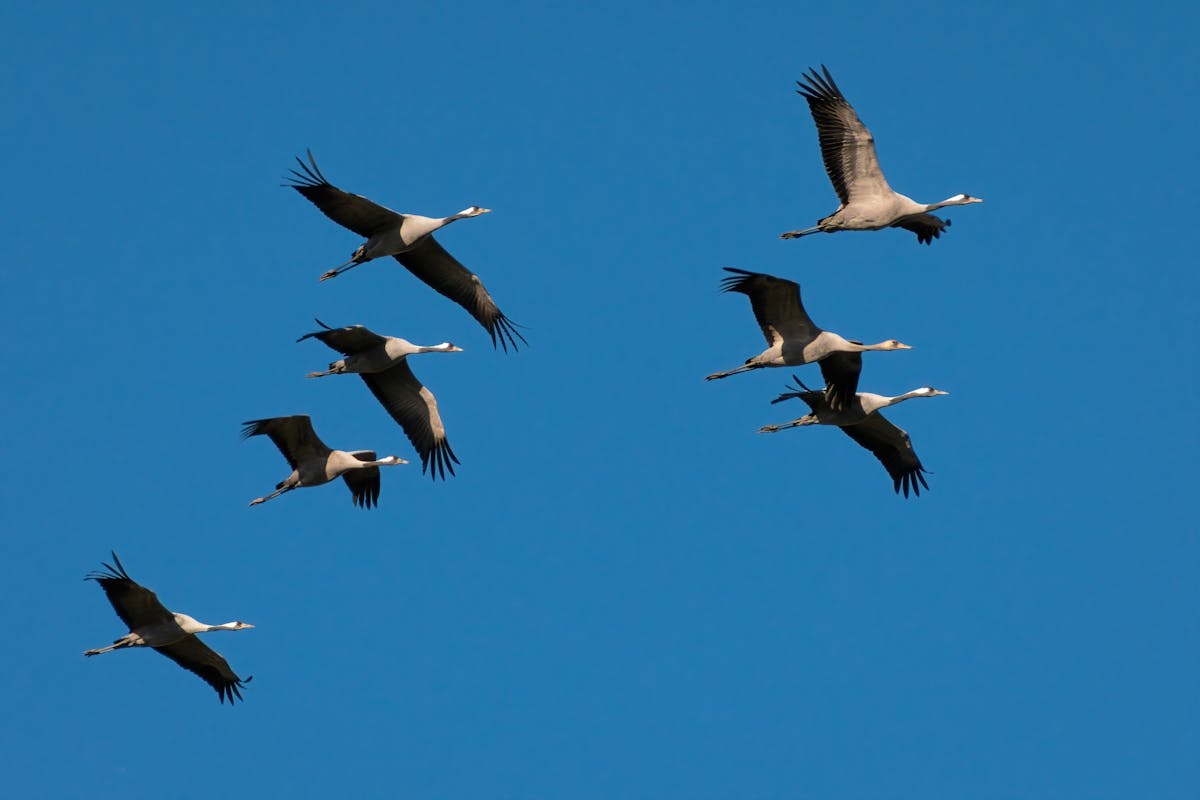
birds know where to go
Research shows that some migratory birds can detect infrasound. They may use these sound signatures as long-distance reference points. For example, a bird flying over the cloud-covered Atlantic at night can still receive infrasound signals from the Appalachian Mountains to the west. This helps the bird understand its location even without visual cues.
Navigation System 6: Visual Learning and Landmark Memory
For some birds, visual guides are very important. This is especially true for:
-
Experienced birds making familiar journeys
-
Short-distance migrants with clear routes
Visual landmarks include:
-
Rivers
-
Mountain ranges
-
Coastlines
-
Forest edges
These seasoned migrants create detailed mental maps of the geography below them. This helps them navigate more accurately than first-time travelers, who rely heavily on magnetic compasses and stars.
Site Fidelity in Long-Distance Migrants
Some long-distance migrants show strong site fidelity. They return not just to the same general area but to specific spots each year. This includes:
-
The same shrub
-
The same patch of woods
-
The same roost tree
Their mental maps are precise, not just rough estimates.
Navigation System 7: Polarized Light Detection
During dawn and dusk, many songbirds face challenges in navigation. The usual celestial cues are not fully visible.
Polarized light detection helps birds find their way. They use the way sunlight scatters based on atmospheric conditions to navigate. Even if the sun is hidden, birds can detect the pattern of polarized light in the sky. This information helps them orient themselves.
Benefits of Polarized Light Detection
-
Extends the time for sky-based navigation beyond sunrise and sunset
-
Provides cues when neither stars nor direct sunlight is visible
How the Systems Work Together
Bird navigation is fascinating because it operates as an integrated network. Here’s how it works:
-
Clear skies at night: Stellar navigation is used and calibrated against the magnetic compass.
-
Cloudy skies at night: The magnetic compass works alone, possibly enhanced by infrasound.
-
Daylight / clear weather: The sun compass is calibrated to the internal clock and cross-checked against the magnetic compass and visual landmarks.
-
Dawn and dusk: Polarized light detection bridges the gap between stellar and solar navigation.
-
Familiar areas: Fixed memory sharpens and reaffirms every navigation cue.
-
All conditions: The magnetic compass provides a reliable baseline, working in any weather or visibility.
When one system fails, others compensate. This means the navigation system remains operational, with no single point of failure.
The First Journey: How Young Birds Navigate
The first journey of young birds is remarkable. First-time migrants often travel alone, guided only by genetic migration plans. These include:
-
Directional preferences
-
Distance metrics unique to their species
For example, a young Blackpoll Warbler from Alaska might have genes that tell it to:
-
Fly southeast for a set number of days
-
Turn south-southwest
-
Descend upon detecting certain conditions
Though imprecise, this genetic plan helps the bird get close enough to use local cues for its final destination.
When Navigation Goes Wrong
Bird navigation is extraordinary but not infallible.
Common issues include:
-
Magnetic anomalies: Local geology can confuse birds.
-
Light pollution: Blurs stars and disrupts navigation at dawn and dusk.
-
Severe weather: Can push birds off course.
-
Landscape fragmentation: Reduces visual reference points.
Understanding these challenges is crucial as migratory birds face increasing pressures.
What Happens in the Brain
Birds process navigation inputs in a small part of their brain. Research shows that this area becomes denser with use, similar to how muscles grow stronger with exercise. More experienced migratory birds have better spatial processing abilities than first-year migrants.
Practice Makes Perfect
Every trip enhances a bird’s navigation skills, making it a better navigator over time.
An Expedition That Continues to Amaze
The Bar-tailed Godwit holds the record for the longest nonstop migration. In 2022, an immature Godwit named B6 flew 13,560 kilometers (about 8,425 miles) from Alaska to Tasmania without stopping.
This remarkable journey took 11 days over open water, guided by:
-
Detectable magnetic fields
-
Stars and clouds
-
Infrasound from distant coastlines
-
An inherited genetic program
When you see a bird flying south, remember it’s not just a bird. It’s part of a complex navigation system, finely tuned over millions of years.
Continue exploring on BirdzFly:

MD Imdadul Haque is the founder of BirdzFly, a research-backed resource on North American backyard birds. Drawing on years of independent study into bird identification, behavior, and migration patterns, he writes in-depth guides designed to help US birders understand the species in their own backyards — from common feeder visitors to seasonal migrants passing through.

