

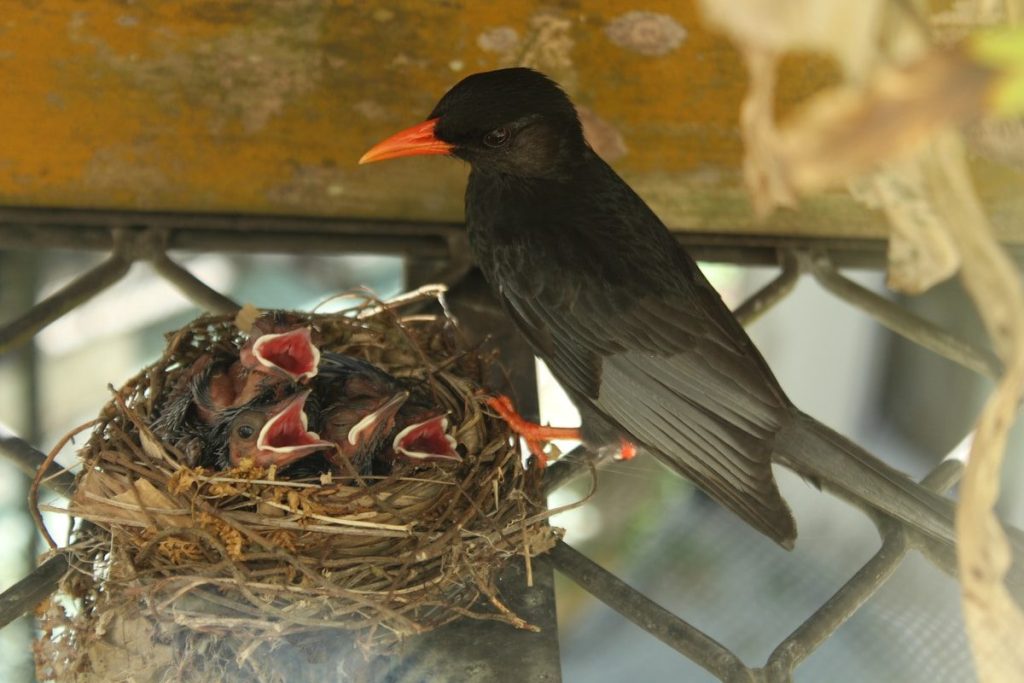
Nesting Blackbirds
When people say “blackbirds are nesting in my yard,” they usually mean one of several very different birds. The term “blackbird” gets applied loosely to any dark bird in the general area — Red-winged Blackbirds, Common Grackles, Brown-headed Cowbirds, European Starlings. They look superficially similar and often flock together. But their nesting biology is completely different, and knowing which one you’re dealing with changes what you’d do about it.
Red-Winged Blackbird
The most widespread nesting blackbird in North America. Males are unmistakable — jet black with red and yellow shoulder patches. Females are streaky brown and regularly get misidentified as large sparrows.
Where they nest: Marshes, wetland edges, wet meadows, roadside ditches with tall vegetation. Also increasingly in dry upland fields.
The nest: A deep cup woven from wet plant material and attached to cattails, rushes, or low shrubs. The wet material dries and hardens around the support stems. Usually 1–3 feet above water or wet ground.
Eggs and behavior: 3–4 pale blue-green eggs with dark markings. Incubation about 11–13 days. Males are aggressively territorial — they’ll dive-bomb people, dogs, and large birds that approach the nest. If you’ve ever had a bird come after you on a walk near a marsh in spring, it was almost certainly a Red-winged Blackbird.
Season: April through July, one to three broods per year.
Common Grackle
Large iridescent black birds with long keeled tails and yellow eyes. More adaptable nesters than Red-wings — they use a wider range of habitats.
Where they nest: Forest edges, suburban neighborhoods, parks, and areas near water. They strongly prefer conifers when available — spruce, pine, and juniper.
The nest: A bulky cup of grass and plant material, often reinforced with mud. Placed in a dense conifer or in a cavity. Sometimes multiple pairs nest in the same large conifer — loose colonial nesting.
Notable behavior: Grackles raid other birds’ nests and steal eggs. They also follow lawn mowers to catch insects flushed by the blades.
Brown-Headed Cowbird
The outlier. Brown-headed Cowbirds don’t build nests. They’re obligate brood parasites — females lay eggs in other birds’ nests and leave the host parents to raise the cowbird chick.
Appearance: Males are glossy black with a brown head. Females are plain gray-brown — frequently mistaken for large sparrows or female blackbirds.
How it works: A female cowbird monitors a host nest while the host is laying. She sneaks in, removes one host egg, and deposits her own. The cowbird egg usually hatches faster, and the cowbird chick grows faster, outcompeting the host’s young for food.
Impact: Cowbird parasitism has contributed to declines in several host species — warblers, vireos, sparrows, and flycatchers are particularly affected. In forest-fragmented landscapes where cowbirds have access to previously inaccessible nesting areas, the impact can be significant.
European Starling
Aggressive cavity nesters that compete with native species for nest holes. Introduced in 1890, now over 200 million in North America.
Where they nest: Almost any cavity — tree holes, building crevices, nest boxes, utility poles, dryer vents. Especially common in suburban and urban areas.
The nest: A loose collection of grass, leaves, and feathers stuffed into a cavity. Not a careful builder.
Competition impact: Starlings are the primary reason bluebird populations declined in the 20th century. They evict native cavity nesters and take over nest boxes. Bluebird monitoring programs specifically address starling competition — if you maintain nest boxes, weekly checks and starling nest removal are standard practice.
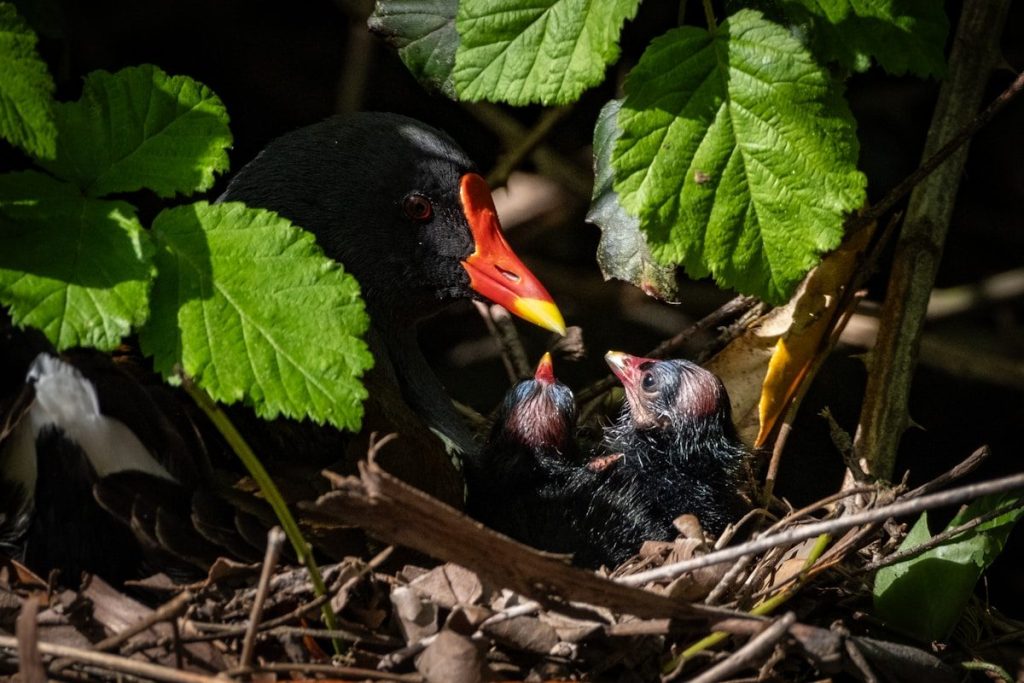
Nesting Blackbirds
Brewer’s Blackbird
Common in the western US. Males are glossy black with yellow eyes; females are gray-brown. Often nests near human activity — campus quads and suburban parks are typical locations in the West. Nests on the ground or in low shrubs, sometimes in loose colonies.
Quick ID Table
| Species | Key Field Mark | Nest Location |
|---|---|---|
| Red-winged Blackbird | Red/yellow shoulder patches (male) | Wetland vegetation |
| Common Grackle | Long keeled tail, yellow eye | Conifers, near water |
| Brown-headed Cowbird | Brown head (male); no nest | Parasitizes other nests |
| European Starling | Short tail, spotted in winter | Cavities, nest boxes |
| Brewer’s Blackbird | Yellow eye, no red patches | Ground or low shrubs (West) |
FAQ
What blackbird nests in marshes?
Red-winged Blackbirds. They weave nests into cattails and rushes at marsh edges — one of the most common nesting birds in wetland habitats across North America.
Which blackbird doesn’t build a nest?
The Brown-headed Cowbird. Obligate brood parasite — lays eggs in other birds’ nests and leaves the raising to the hosts.
How do I stop starlings from taking my nest boxes?
Use boxes with a 1.5-inch entrance hole for bluebirds — starlings can’t fit through. Check boxes weekly and remove starling nests before eggs are laid.
Are blackbirds protected?
Native species — Red-winged Blackbird, Grackle, Cowbird, Brewer’s Blackbird — are protected under the Migratory Bird Treaty Act. European Starlings are not protected and can legally be removed from nest boxes.
For more on nesting birds, see our guides on hawk nests and grackle vs starling ID.

MD Imdadul Haque is the founder of BirdzFly, a research-backed resource on North American backyard birds. Drawing on years of independent study into bird identification, behavior, and migration patterns, he writes in-depth guides designed to help US birders understand the species in their own backyards — from common feeder visitors to seasonal migrants passing through.

