
Dark-eyed Juncos are so reliably tied to winter that they earned the nickname “snowbirds” long before the term meant a retiree heading south — for millions of North Americans, the first junco at the feeder each fall is as strong a seasonal signal as the first frost. What most people don’t realize is how genuinely varied this “one species” actually looks depending on where you live.
Identification
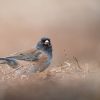
Overall impression: A small, plump sparrow-relative with a distinctive two-tone pattern — dark upperparts contrasting sharply with a white belly — and bright white outer tail feathers that flash conspicuously when the bird flies or hops.
Key field marks:
- White outer tail feathers — Flash brightly in flight, one of the most reliable field marks across every regional form of the species
- Pink bill — A small, pale pink conical bill, contrasting against the dark head
- Sharp two-tone body pattern — Dark above, white below, with the exact boundary and dark color varying significantly by regional form
- Ground-hopping behavior — Forages almost exclusively on the ground, hopping rather than walking, often in small flocks
Size: 5.5–6.3 inches long, wingspan 7.1–9.8 inches.
Basic Facts
| Feature | Detail |
|---|---|
| Scientific name | Junco hyemalis |
| Family | Passerellidae (New World sparrows) |
| Length | 5.5–6.3 inches |
| Weight | 0.6–1.1 oz (18–30g) |
| Wingspan | 7.1–9.8 inches |
| Lifespan | Up to 11 years on record |
| Eggs per clutch | 3–6, whitish with brown speckling |
| Incubation | 12–13 days |
| Conservation status | Least concern |
One Species, Many Looks
Dark-eyed Juncos are unusual among North American birds for how dramatically their appearance varies by region while remaining a single species. Several distinct regional forms exist, once considered separate species before ornithologists determined they interbreed extensively where their ranges overlap:
- “Slate-colored” (most of the East and much of the North) — Uniform slate-gray above and on the breast, sharply demarcated from a white belly
- “Oregon” (Pacific Northwest and West) — Black or dark gray hood, contrasting with a warm rufous-brown back and flanks
- “Pink-sided” (Rocky Mountain region) — Gray hood with distinctly pink-buff flanks
- “Gray-headed” (Southern Rockies) — Pale gray overall with a contrasting rufous patch on the back
- “White-winged” (Black Hills region, rare) — Similar to Slate-colored but with white wing bars, the only form that shows them
Despite these substantial visual differences, genetic studies confirm all forms are a single species with extensive interbreeding in zones where ranges meet — one of the more striking examples of geographic plumage variation within a single North American bird species.
Why “Snowbird”
The nickname comes directly from the species’ seasonal pattern across much of its range: Dark-eyed Juncos breed in northern and high-elevation coniferous forest, then move to lower elevations and further south for winter, arriving at backyard feeders right around the time the first real cold sets in. For people in much of the US, a junco showing up at the feeder is one of the most reliable seasonal markers of approaching winter — sometimes more reliable than the actual weather forecast.
The association is old enough and strong enough that “snowbird” was used for this species long before the term became common slang for retirees who migrate south for winter, itself borrowed from the same seasonal pattern.
Diet
Primarily seeds, especially in fall and winter — small grass and weed seeds make up the bulk of the diet, foraged almost entirely on the ground. In breeding season, insects become significantly more important, particularly for feeding nestlings.
At feeders, juncos strongly prefer millet and mixed seed scattered on the ground or a low platform, rather than hanging tube feeders — their ground-foraging instinct is strong enough that elevated feeders see relatively little junco activity compared to ground-level offerings.
Winter Flocking and Social Hierarchy
Outside breeding season, juncos form loose flocks that maintain a genuine social hierarchy — research has shown that flocks develop a consistent dominance order, with older, more experienced birds typically ranking above younger ones, and males often dominant over females in mixed flocks. These hierarchies affect foraging position and access to the best feeding spots, playing out visibly at any backyard feeder hosting a wintering flock.
Range and Migration
One of the most abundant and widespread birds in North America, with an estimated population in the hundreds of millions. Breeds across Canada, Alaska, and higher-elevation forest throughout much of the western US; winters across virtually the entire continental United States. Populations at high elevations in the West may be present year-round without significant migration, while northern and high-latitude breeders undertake substantial seasonal movement south.
FAQ: Dark-Eyed Junco
Why is the Dark-eyed Junco called a “snowbird”?
Because its arrival at feeders each fall closely tracks the onset of winter across much of its range — for many people, the first junco sighting is a more reliable seasonal signal than the actual weather.
Why do Dark-eyed Juncos look so different depending on where I live?
The species has several distinct regional forms — Slate-colored, Oregon, Pink-sided, Gray-headed, and White-winged — that were once considered separate species before genetic research confirmed they’re one species with extensive interbreeding where ranges overlap.
What is the best food to attract juncos?
Millet and mixed seed scattered on the ground or a low platform feeder — juncos are ground foragers and use elevated tube feeders far less than many other backyard birds.
For more on sparrow-family birds, see our guide on the Chipping Sparrow.

MD Imdadul Haque is the founder of BirdzFly, a research-backed resource on North American backyard birds. Drawing on years of independent study into bird identification, behavior, and migration patterns, he writes in-depth guides designed to help US birders understand the species in their own backyards — from common feeder visitors to seasonal migrants passing through.