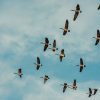

Every fall, the V-shaped skeins of geese crossing overhead look almost too neat to be accidental — and they aren’t. Scientists have understood for decades that the formation saves real energy, but a study published in July 2026 by Brown University engineers finally nailed down exactly how that energy savings happens at the level of a single flapping wing, closing a gap in the science that had persisted since the shape was first studied seriously.
The Basic Mechanism: Riding the Upwash
Every flapping wing sheds small trailing vortices off its tips — miniature horizontal tornadoes of spinning air. Directly behind a flying bird, that spinning air creates a zone of downward-moving air called downwash. But off to the side and slightly behind, the same vortex creates the opposite effect: an area of upward-moving air called upwash.
A bird positioned in that upwash zone — behind and to one side of the bird ahead, exactly the classic V position — gets a small but real boost from air that’s already moving upward, reducing how hard it has to work to stay aloft. This basic idea has been suspected since at least the 1970s and confirmed more rigorously in a landmark 2014 study on northern bald ibises published in Nature, which tracked wild migratory ibises with GPS and found they positioned themselves in aerodynamically ideal spots within the formation and even matched their wingbeat timing to maximize the effect.
What the New 2026 Research Actually Found
The 2014 ibis study confirmed birds seek out the upwash zone and benefit from it, but it didn’t fully explain the specific mechanical reason the benefit exists. A study published in Proceedings of the National Academy of Sciences in July 2026, led by researchers at Brown University, built a detailed aerodynamic model specifically to answer that question.
The finding: a bird flying in the optimal V position doesn’t necessarily generate more lift from the upwash directly. Instead, the biggest change is in how far it needs to move its wings. The model showed the trailing bird’s wingbeat amplitude — how far up and down each flap actually travels — dropped to roughly 70% of what a solo bird’s flap would be. A shorter, shallower wingbeat requires meaningfully less muscular effort per stroke, and that reduction alone accounted for most of the measured energy savings: an 11% drop in the mechanical power needed for flight.
In plain terms: the trailing bird isn’t working less because the air is magically holding it up — it’s working less because it doesn’t have to flap as far to get the same result.
How Much Energy Does It Actually Save?
Different studies, using different methods, have landed on figures in a consistent general range:
- 11% — the 2026 Brown University mechanical power model (northern bald ibis)
- 11% — a 2001 heart-rate monitoring study on Great White Pelicans, based on reduced heart rate in trailing birds
- 10–14% — general field estimates cited across multiple bird species
- Up to 25% — wind tunnel experiments specifically with starlings, a higher figure attributed to the more controlled conditions of a lab setting versus real-world flight
The consistency across such different methodologies — GPS tracking, heart rate monitors, wind tunnels, and now detailed aerodynamic modeling — is part of why scientists consider the energy-saving effect well established, even though the precise mechanical explanation only became fully clear with the 2026 research.
Why Geese Take Turns in the Lead
The upwash advantage doesn’t exist for the very front bird — leading the formation means flying in undisturbed air with no aerodynamic assist from anyone ahead, making it measurably more tiring than any other position in the V. This is why flocks are frequently observed rotating leadership: the lead bird, having worked hardest, drops back into the formation once fatigued, and another bird moves up to take over breaking the air for the rest of the group.
This rotation means the formation functions less like a single leader guiding followers and more like a cooperative, shared effort where the workload is distributed across the flock over the course of a long flight.
Why Bigger Birds Benefit More
The V-formation advantage is most clearly documented in larger birds — geese, pelicans, cranes, ibises, cormorants, and swans — rather than small songbirds. Researchers studying wake dynamics have suggested that the wingtip vortices produced by larger birds, flying with slower and more powerful wingbeats, persist longer and remain more coherent in the air behind them. Smaller birds with faster, more erratic wingbeats may produce wake structures that decay too quickly for a trailing bird to reliably exploit, which likely explains why V-formation flight is a large-bird phenomenon rather than something seen across all migratory species.
FAQ: Why Birds Fly in a V
Why do birds fly in a V formation?
Trailing birds position themselves in the upwash created by the wingtip vortices of the bird ahead, which reduces how far they need to flap their wings — cutting the mechanical power needed for flight by roughly 11% according to current research.
Why does the lead bird in a V formation keep changing?
The front position gets no aerodynamic benefit from other birds and is measurably more tiring. Flocks rotate leadership so the workload of breaking the air is shared rather than falling on one bird the whole flight.
Do all birds fly in V formations?
No — it’s mainly documented in larger birds like geese, pelicans, cranes, and ibises. Their slower, more powerful wingbeats produce longer-lasting wake structures that trailing birds can reliably exploit, an effect that may not hold for smaller, faster-flapping species.
For more on bird flight and migration, see our guides on Sandhill Crane migration, Arctic Tern’s record-breaking migration, and Killdeer nesting behavior. Read the original findings in the Brown University press release on the July 2026 PNAS study.

MD Imdadul Haque is the founder of BirdzFly, a research-backed resource on North American backyard birds. Drawing on years of independent study into bird identification, behavior, and migration patterns, he writes in-depth guides designed to help US birders understand the species in their own backyards — from common feeder visitors to seasonal migrants passing through.