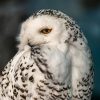

The idea that an owl can spin its head in a full 360-degree circle is one of the most widely repeated animal facts in circulation — and it’s slightly wrong in a way that’s actually more impressive than the myth itself. Owls can’t rotate their heads a full 360 degrees. What they can do is turn roughly 270 degrees, more than three-quarters of a full circle, using an anatomical setup unlike almost anything else in the animal kingdom.
The Real Number: About 270 Degrees
A human head can typically rotate about 90 degrees to either side before the neck’s range of motion runs out — roughly 180 degrees total range. An owl can turn its head approximately 270 degrees in either direction from center, meaning it can look almost directly behind itself without moving its body at all. That’s three-quarters of a full rotation, not the complete circle the popular myth describes, but still an extraordinary range that vastly exceeds what any mammal neck can achieve.
The 360-degree version of the claim likely persists simply because 270 degrees already looks and sounds so extreme that rounding up to “all the way around” doesn’t feel like an exaggeration to most people describing it casually.
Why Owls Need This at All
Unlike most birds, owls have eyes that are fixed in their sockets — unable to move side to side or up and down the way human eyes or even many other birds’ eyes can. This tradeoff exists because an owl’s eyes are enormous relative to its skull, tubular in shape rather than spherical, and packed to maximize light-gathering ability for hunting in low light. That size and shape leaves essentially no room for the eye muscles needed to move the eyeball independently within the socket.
Because the eyes themselves can’t move, the entire visual field an owl can access depends entirely on how far it can turn its head. The extreme head rotation isn’t a party trick — it’s the direct compensation for an eye structure that sacrificed mobility for exceptional night vision.
How the Neck Physically Allows This
Turning a head 270 degrees without cutting off blood supply or damaging the spinal cord is a genuine engineering problem, and owls solve it with several specific adaptations documented in anatomical research:
- More neck vertebrae — Owls have 14 neck vertebrae, compared to 7 in humans and most mammals, giving far more flexible points of rotation distributed across the neck
- Specialized blood vessel structure — The vertebral arteries supplying blood to the brain pass through unusually large openings in the neck vertebrae, providing slack that prevents the vessels from being pinched or torn during extreme rotation
- Blood reservoirs — Small pooling structures near the base of the skull are believed to store a reserve of blood that helps maintain circulation to the brain and eyes even during moments when rotation temporarily restricts normal blood flow
- Reinforced arterial connections — The connections between major blood vessels in an owl’s neck are proportionally larger and more elastic than in most animals, allowing them to accommodate significant twisting without rupturing
This combination is specific enough to owls that it has been studied directly as a model for understanding how biological systems handle extreme rotational stress without damage — research with genuine relevance beyond ornithology.
FAQ: Owl Head Rotation
Can owls really turn their heads all the way around?
No — the true figure is approximately 270 degrees, not a full 360-degree rotation. It’s still far more than any mammal neck can achieve, just not literally “all the way around.”
Why can’t owls just move their eyes instead of turning their whole head?
An owl’s eyes are fixed in their sockets and can’t move independently — they’re tubular rather than spherical, sized to maximize low-light vision, which leaves no room for eye-moving muscles.
How do owls avoid cutting off blood flow when they turn their heads so far?
Extra neck vertebrae, oversized openings for blood vessels, small blood-pooling reservoirs, and unusually elastic arterial connections all work together to maintain circulation during extreme rotation.
For more on owls, see our guides on Great Horned Owl, Snowy Owl, Barred Owl, and what’s actually inside an owl pellet. Read more on the original 2013 Johns Hopkins research in ScienceDaily’s coverage of the study.

MD Imdadul Haque is the founder of BirdzFly, a research-backed resource on North American backyard birds. Drawing on years of independent study into bird identification, behavior, and migration patterns, he writes in-depth guides designed to help US birders understand the species in their own backyards — from common feeder visitors to seasonal migrants passing through.