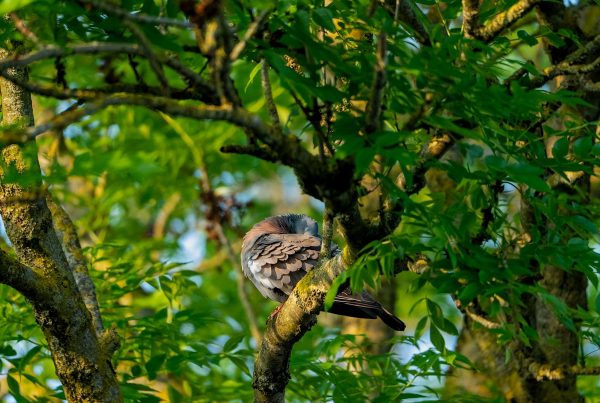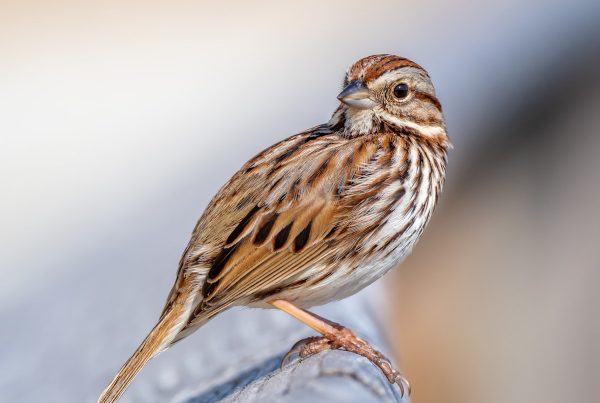

Most woodpeckers spend their lives on tree trunks. The Northern Flicker breaks that pattern more than any other North American woodpecker — it’s often seen hopping across lawns, probing the ground with its slightly curved bill, doing something that looks a lot more like what a robin does than what a woodpecker does. This ground-feeding habit, combined with a spectacular flash of color in flight, makes the Flicker one of the more distinctive and commonly misidentified birds in North America.
Identification
Overall impression: A large, brown, boldly patterned woodpecker with a spotted breast, black bib, and a bold white rump patch visible in flight. Unlike the black-and-white woodpeckers most people picture (Downy, Hairy, Red-bellied), the Flicker is brown and heavily patterned — different enough that people frequently don’t recognize it as a woodpecker at all on first sighting.
Key field marks:
- Black bib — A solid black crescent across the upper breast, one of the most distinctive marks on a perched bird.
- Spotted underparts — Black spots scattered across a buff-tan breast and belly, unlike any other common woodpecker’s pattern.
- White rump patch — Highly visible in flight — a bold white flash at the base of the tail that catches the eye immediately when the bird flushes.
- Wing/tail flash color — Eastern birds (“Yellow-shafted” form) show bright yellow on the underside of the wings and tail in flight. Western birds (“Red-shafted” form) show salmon-red instead. These were once considered separate species and still show a hybrid zone through the Great Plains where the two forms interbreed.
- Facial mark — Males of the Yellow-shafted form have a black mustache mark; males of the Red-shafted form have a red mustache mark. Females of both forms lack this mark entirely.
Size: 11–14 inches long, wingspan 16.5–20 inches. One of the larger common woodpeckers, similar in size to a Red-bellied Woodpecker but with a longer tail.
Basic Facts
| Feature | Detail |
|---|---|
| Scientific name | Colaptes auratus |
| Family | Picidae (woodpeckers) |
| Length | 11–14 inches |
| Weight | 3.9–5.6 oz (110–160g) |
| Wingspan | 16.5–20 inches |
| Lifespan | Up to 9 years on record |
| Eggs per clutch | 5–8, white |
| Incubation | 11–12 days |
| Conservation status | Least concern (though gradual population decline noted) |
Why Flickers Feed on the Ground
Unlike other woodpeckers, which forage primarily by drilling into wood for beetle larvae, Northern Flickers eat mostly ants — and the most efficient way to find ants is on the ground, not in trees. Flickers hop across lawns, gardens, and open ground, probing the soil with their slightly downcurved bill to locate ant colonies.
Their diet is unusually specialized for a woodpecker: ants make up as much as 45% of the annual diet based on stomach content studies, making the Northern Flicker one of the most ant-dependent birds in North America. They use a long, sticky, barbed tongue — similar in mechanism to an anteater’s — to extract ants from underground colonies once they’ve excavated an opening.
Beyond ants, the diet includes:
- Beetles and beetle larvae
- Other insects found on the ground or in dead wood
- Berries and fruit — particularly important in fall and winter when insects become scarce, including poison ivy berries, dogwood, sumac, and wild grape
- Seeds, occasionally taken at feeders (though Flickers are not typical feeder visitors)
Drumming and Territory
Like other woodpeckers, Flickers drum on resonant surfaces to establish territory and attract mates — but Flickers are particularly notorious for choosing loud, non-wood surfaces. Metal chimney caps, gutters, and even satellite dishes are frequently used specifically because they produce a louder, more far-carrying sound than wood. A Flicker drumming on a metal roof at 6 AM is a common source of noise complaints in suburban areas during spring.
The call is a loud, sustained “wick-wick-wick-wick” repeated rapidly, along with a single loud “klee-yer” call. Both are far-carrying and commonly heard well before the bird is spotted.
Nesting
Flickers excavate nest cavities in dead or dying trees, taking 1–2 weeks to complete a cavity. Unlike some woodpeckers, Flickers will also readily use nest boxes if a suitable natural cavity isn’t available, making them one of the easier woodpeckers to support with a properly sized box.
Both parents share incubation and feeding duties. Clutches are relatively large for a woodpecker — 5 to 8 eggs — and Flickers are known for their ability to lay replacement clutches if the first is lost, sometimes producing an unusually high number of eggs in a season under experimental conditions (a trait studied extensively in ornithology as an example of indeterminate egg-laying).
Range and Migration
Found across virtually all of North America — the most widespread woodpecker on the continent. Northern populations are migratory, moving south in fall; southern and western populations are largely resident year-round. Migration is more conspicuous in Flickers than most other woodpeckers, with visible daytime movement in fall, sometimes in loose flocks — unusual for a typically solitary bird family.
Yellow-Shafted vs Red-Shafted: A Split That Almost Happened
The eastern Yellow-shafted Flicker and western Red-shafted Flicker were originally classified as separate species. They were combined into a single species (Northern Flicker) in 1973 after research showed extensive interbreeding in a hybrid zone running roughly along the Great Plains, where birds show intermediate or mixed characteristics. The two forms remain distinct enough in appearance that birders often still refer to them separately, even though they’re technically one species.
FAQ: Northern Flicker
Why does a Flicker feed on the ground?
Because ants — its primary food source, making up nearly half its diet — are found in the ground, not in trees. This makes the Flicker one of the most ground-associated woodpeckers in North America.
What does a Northern Flicker sound like?
A loud, sustained “wick-wick-wick-wick” call repeated rapidly, plus a single loud “klee-yer.” Also known for loud drumming on metal surfaces like gutters and chimney caps.
What is the difference between a Yellow-shafted and Red-shafted Flicker?
Eastern (Yellow-shafted) birds show yellow under the wings and tail with a black mustache mark on males. Western (Red-shafted) birds show salmon-red in the same areas with a red mustache mark. They’re now considered one species with a hybrid zone through the Great Plains.
Do Flickers visit bird feeders?
Rarely, since their diet is so heavily ant-based. They occasionally take suet or fruit but aren’t reliable feeder visitors the way many other woodpeckers are.
For more on woodpeckers, see our guides on Pileated Woodpecker and Red-bellied Woodpecker.

MD Imdadul Haque is the founder of BirdzFly, a research-backed resource on North American backyard birds. Drawing on years of independent study into bird identification, behavior, and migration patterns, he writes in-depth guides designed to help US birders understand the species in their own backyards — from common feeder visitors to seasonal migrants passing through.