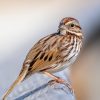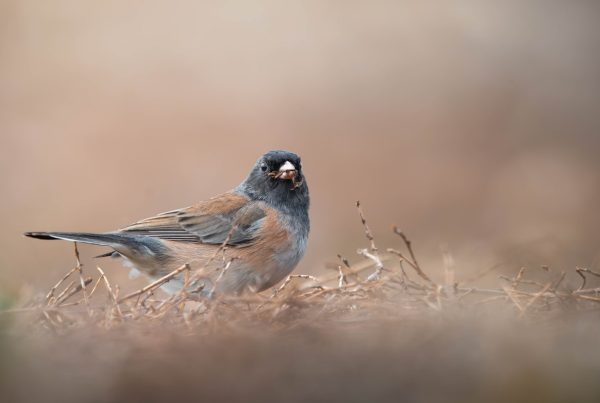

Take a Song Sparrow from Maine and one from California, and their songs sound different enough that even inexperienced birders can hear it. Unlike most songbirds, which sing a broadly similar version of their species’ song wherever you go, Song Sparrows develop genuine regional dialects — 24 to 52 recognized subspecies across North America, each shaped by local populations of birds learning slightly different variations from each other over generations.
Identification
Overall impression: A medium-sized, heavily streaked brown sparrow — genuinely one of the plainer-looking common backyard sparrows, but with a distinctive dark central breast spot that helps confirm identification once other streaky sparrows have been ruled out.
Key field marks:
- Dark central breast spot — A concentrated dark smudge in the middle of the streaked breast, formed where the streaks converge — one of the more reliable field marks separating Song Sparrow from similar streaked sparrows
- Heavy brown streaking — Dense streaks running the length of the breast and flanks against a whitish background
- Gray eyebrow stripe and malar stripe — Subtle facial pattern, less bold than many sparrows but present on close inspection
- Rounded tail, pumped in flight — Song Sparrows characteristically pump their tail up and down while flying, a useful behavioral field mark at a distance
Size: 4.7–6.7 inches long, wingspan 7.1–9.4 inches — notably variable in size across its range, with larger-bodied populations in colder northern and coastal areas.
Basic Facts
| Feature | Detail |
|---|---|
| Scientific name | Melospiza melodia |
| Family | Passerellidae (New World sparrows) |
| Length | 4.7–6.7 inches |
| Weight | 0.4–1.9 oz (12–53g) |
| Wingspan | 7.1–9.4 inches |
| Lifespan | Up to 11 years on record |
| Eggs per clutch | 1–6, greenish-white with reddish-brown blotching |
| Incubation | 12–15 days |
| Conservation status | Least concern |
Regional Song Dialects
Song Sparrows are one of the most geographically variable songbirds in North America, both in appearance and in voice. The species is divided into roughly two to three dozen recognized subspecies (estimates range from about 24 to 52 depending on the classification system used), varying in overall size, plumage darkness, and — most distinctively — song structure.
The basic song pattern is consistent across the species: a series of clear introductory notes followed by a buzzy trill, commonly rendered with the mnemonic “maids, maids, maids, put on your tea kettle-ettle-ettle.” But the specific notes, tempo, and phrasing within that basic structure vary by region, and research on song learning in this species has shown that young males learn their song by listening to adult males in their local area — meaning song dialects develop and persist locally in much the same way human regional accents do, passed down through cultural transmission rather than fixed genetics.
This makes Song Sparrows a genuinely important study species in bioacoustics and animal culture research — few other North American birds show this degree of documented, geographically distinct vocal learning.
One of the Most Studied Songbirds in North America
Beyond song dialects, Song Sparrows have been the subject of decades of long-term research, particularly a multi-generation study population on Mandarte Island, British Columbia, that has tracked individual birds and their descendants since the 1970s. This research has produced foundational findings in ornithology on topics including inbreeding depression, natural selection in wild populations, and the heritability of specific traits — making the Song Sparrow one of the best-studied wild bird species in the world for understanding evolutionary biology in real time.
Diet
Diet shifts seasonally between insects and seeds:
- Spring and summer — Insects and other invertebrates dominate, especially important for feeding nestlings
- Fall and winter — Seeds become the primary food, foraged from the ground in weedy fields, marsh edges, and garden borders
At feeders, Song Sparrows readily take mixed seed and millet scattered on the ground or a low platform, similar to other ground-foraging sparrows.
Habitat
Song Sparrows are habitat generalists, found in an unusually wide range of environments across North America — marshes, brushy fields, suburban gardens, forest edges, and streamside thickets all support breeding populations. This flexibility is part of why the species has developed such extensive geographic variation: different populations have adapted to genuinely different local conditions, from coastal salt marshes to desert scrub to northern boreal edges.
Range
Among the most widely distributed songbirds in North America, found from Alaska to Mexico and coast to coast. Northern populations are migratory, moving south for winter; many populations across the milder parts of the range are year-round residents.
FAQ: Song Sparrow
Why do Song Sparrows sound different depending on where I live?
Song Sparrows develop genuine regional song dialects, learned by young males from adult males in their local area — similar to how human regional accents develop and persist through cultural transmission rather than fixed genetics.
How do you identify a Song Sparrow?
Look for heavy brown streaking on the breast that converges into a dark central spot — one of the more reliable field marks among North America’s many streaky sparrow species.
Why are Song Sparrows important to scientific research?
A decades-long study population on Mandarte Island, British Columbia has produced foundational research on evolutionary biology, including inbreeding effects and natural selection in wild bird populations.
For more on sparrow-family birds, see our guides on the Chipping Sparrow and Dark-eyed Junco.

MD Imdadul Haque is the founder of BirdzFly, a research-backed resource on North American backyard birds. Drawing on years of independent study into bird identification, behavior, and migration patterns, he writes in-depth guides designed to help US birders understand the species in their own backyards — from common feeder visitors to seasonal migrants passing through.