
Every year, right around late February or March, someone posts the same photo: a robin on their lawn, captioned “spring is here!” It’s one of the most reliable folk beliefs in North American backyard culture. It’s also, according to Cornell Lab of Ornithology and the American Bird Conservancy, largely a case of mistaken identity. That robin very likely never left.
Robins Are Not Reliable Long-Distance Migrants
Unlike hummingbirds or many warblers, which genuinely vacate their entire breeding range each fall for a defined winter territory farther south, American Robins do something messier. Some individuals do move south for winter. Others move only short distances. And a significant number simply stay put in the same general area year-round, including in states as far north as much of the lower 48. Cornell’s eBird tracking data confirms robins have been reported in every U.S. state except Hawaii during winter months.
The species isn’t absent from northern winters — it’s just behaving completely differently than it does in spring and summer, which is why it disappears from the one place people actually look for it: the front lawn.
Where the “Missing” Robins Actually Go
In winter, robins stop defending breeding territories and become nomadic, gathering into large, wide-ranging flocks that can number in the hundreds or even thousands of birds. These flocks move through wooded areas and forest edges hunting for a completely different food source than the one people associate with robins.
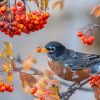
Spring and summer robins are famous for pulling earthworms out of open lawns. But earthworms become largely inaccessible once the ground freezes or dries out seasonally, so winter robins switch almost entirely to fruit — crabapples, hawthorn berries, holly, juniper, and sumac, foraged from trees and shrubs in forested or semi-wooded habitat rather than open yards. This is a real dietary and behavioral shift, not just a change in location.
Why You Don’t Notice Them
Three factors combine to make winter robins nearly invisible to the average person, even in areas where they’re genuinely present in large numbers:
- Wrong habitat — Winter robins concentrate in forests and wooded fruit sources, not the open lawns most people associate with the species
- Much quieter behavior — Robins are considerably less vocal in winter than during breeding season, when males sing constantly to defend territory. A large winter flock can move through an area with very little sound
- No territorial spacing — Spring robins are spread out, one pair per yard, making individual birds highly visible in a predictable location. Winter robins are concentrated in flocks in specific fruit-rich spots, meaning most yards simply have zero robins passing through, even while nearby forests have thousands
The visual effect is that robins seem to vanish completely from most people’s daily view, even in regions where the species never actually left.
So Why Does It Feel Like They “Return” in Spring?
What actually happens each spring is a genuine, visible behavioral shift, even if it isn’t the migration people assume: as breeding season approaches, winter flocks disperse, individual robins claim and defend territories again, and — critically — males become loudly, conspicuously vocal, singing to establish those territories. That combination of birds spreading into open yards and suddenly becoming much easier to hear is what creates the strong impression of “the robins are back,” even for robins that spent the entire winter in a nearby patch of woods a half mile away.
Some robins genuinely are new arrivals moving up from farther south. But plenty of the robins showing up on a lawn in March were present the entire winter — just somewhere the average person wasn’t looking, doing something the average person doesn’t associate with the species.
The Real Answer to “Is the Robin a Sign of Spring?”
Sources that have looked closely at this call it a genuine “yes and no.” Robin presence isn’t a reliable spring indicator on its own, since robins are present somewhere in most of the lower 48 all winter. But the specific behavior — robins back on open lawns, singing loudly, defending territory — is a real and legitimate signal that breeding season and the associated seasonal shift is underway, even if the birds themselves didn’t travel far to produce it.
FAQ: The First Robin of Spring Myth
Do robins really migrate south for winter?
Some do, some don’t, and many simply shift local habitat and behavior rather than making a long migration. Robins have been documented in nearly every U.S. state during winter months.
Why don’t I see robins in my yard during winter?
Winter robins shift from lawns to wooded, fruit-bearing habitat and switch their diet from earthworms to berries. They also become much quieter, making even large flocks easy to miss.
Is it true that seeing a robin means spring has arrived?
Not reliably — robins are present somewhere in most regions all winter. What actually signals spring is the visible behavioral shift: robins returning to open lawns and singing loudly to establish breeding territory.
For more on American Robin behavior, see our guides on where robins go in winter and whether robins actually migrate.

MD Imdadul Haque is the founder of BirdzFly, a research-backed resource on North American backyard birds. Drawing on years of independent study into bird identification, behavior, and migration patterns, he writes in-depth guides designed to help US birders understand the species in their own backyards — from common feeder visitors to seasonal migrants passing through.