

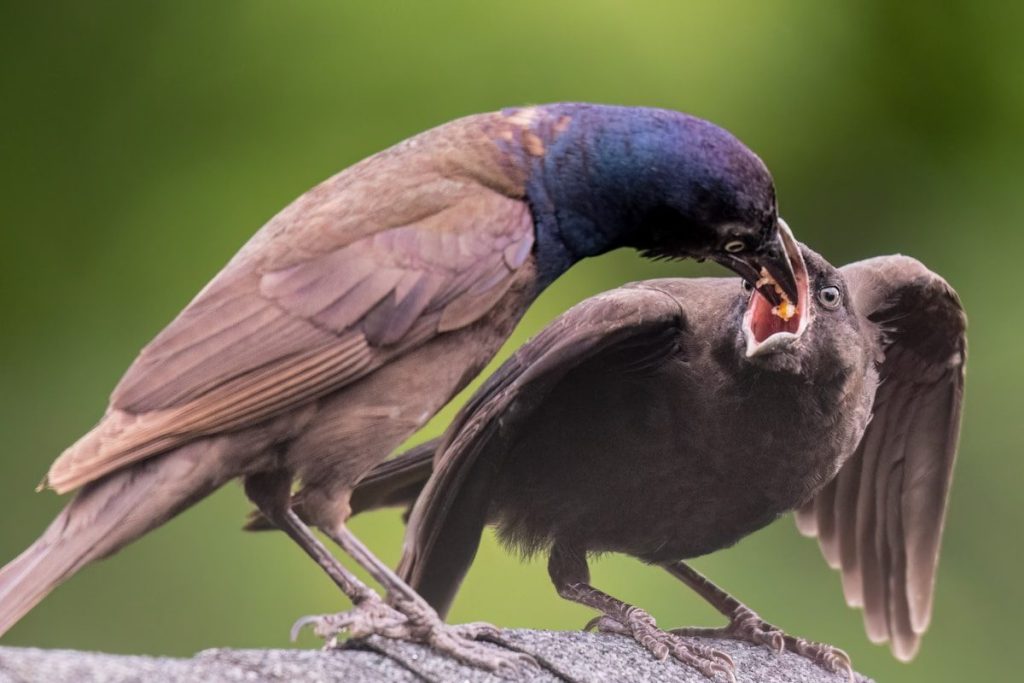
Grackle vs Starling
Grackles and starlings are two of the most commonly confused birds at feeders and in parking lots. Both are dark, both travel in noisy flocks, both have a reputation for being difficult. But they’re completely unrelated — from different continents, different families, different everything — and once you learn a few field marks, you won’t mix them up again.
The Quick Version
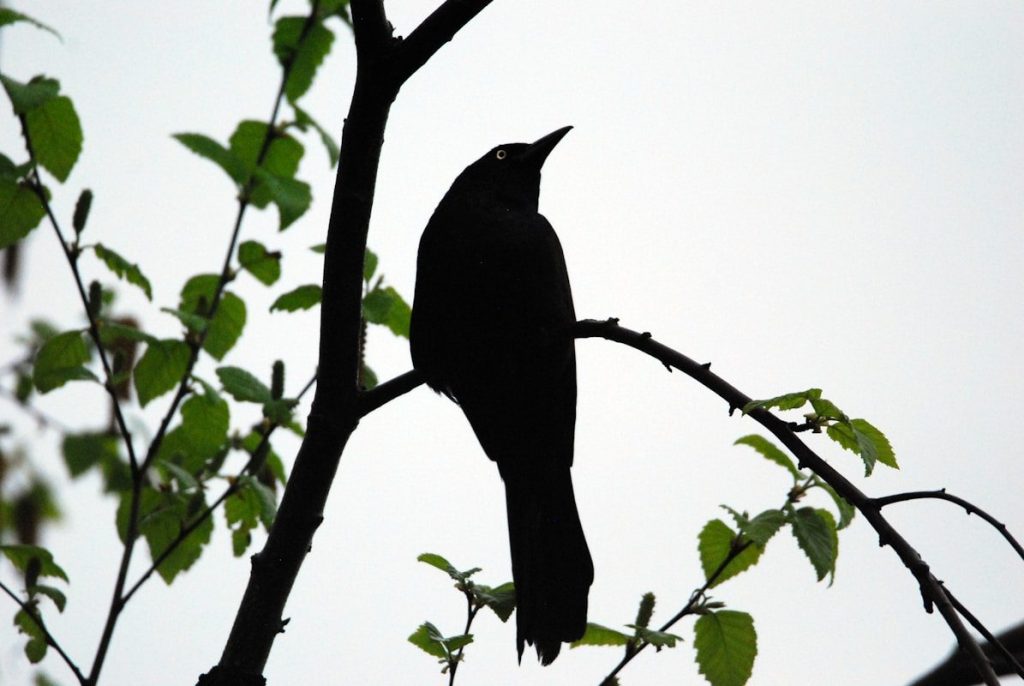
Grackles are large, long-tailed, iridescent black birds native to North America. Starlings are smaller, short-tailed, spotted birds introduced from Europe in 1890. The tail is the fastest field mark at a distance: a grackle’s tail is long and often held in a V or keel shape; a starling’s tail is short and squared off.
Grackle: What to Look For
The Common Grackle is what most people in the eastern US encounter.
- Size: Larger than a robin, smaller than a crow. About 11–13 inches long.
- Tail: Long, often held in a V or keel shape — creased lengthwise. This is the clearest field mark at a distance.
- Color: Glossy black with iridescent purple, blue, or bronze sheen. The sheen shifts with the angle of light.
- Eyes: Pale yellow — striking up close.
- Bill: Long, heavy, slightly curved.
- Flight: Direct, steady wingbeats. The long tail is obvious in flight.
Great-tailed and Boat-tailed Grackles occur in the South and West and are even larger, with more dramatically long tails.
Grackle vs Starling
European Starling: What to Look For
Introduced to Central Park in 1890 in a misguided attempt to establish every bird mentioned in Shakespeare. Now over 200 million across North America.
- Size: Smaller than a grackle, similar to a robin but stockier. About 8–9 inches.
- Tail: Short and squared off. This alone tells you it’s not a grackle.
- Color: In winter: dark brown to black with white spots all over. In summer: spots wear away and the bird becomes glossy greenish-black with a yellow bill.
- Bill: Short, pointed, dark in winter and yellow in spring.
- Flight: Fast and direct with triangular pointed wings — looks like a flying arrowhead. Very different from a grackle.
- Walk: Fast, purposeful strut. Grackles walk more deliberately.
Side-by-Side
| Feature | Common Grackle | European Starling |
|---|---|---|
| Size | Robin to jay-sized | Robin-sized, stockier |
| Tail | Long, keeled V shape | Short, squared |
| Color | Glossy iridescent black | Spotted in winter, glossy in summer |
| Eyes | Pale yellow | Dark brown |
| Bill | Long, heavy, curved | Short, pointed; yellow in spring |
| Wings in flight | Broad, rounded | Triangular, pointed |
| Origin | Native | Introduced from Europe |
Behavior Differences
Both flock, but differently. Grackles are loud and deliberate at feeders, dominating with size. They mix readily with other blackbirds — Red-winged Blackbirds and cowbirds flock with them regularly. Their call is a harsh, grating creak.
Starlings move faster and more chaotically. Their most dramatic behavior is the murmuration — the swirling, shape-shifting mass flight thousands of them perform at dusk before roosting. Nothing grackles do looks remotely like this. Starlings also mimic other bird calls convincingly, which adds to the identification confusion.
Dealing with Both at Feeders
To deter starlings: use short-perch feeders or upside-down suet cages — they struggle with anything requiring sustained clinging. Nyjer feeders are ignored by starlings entirely.
To deter grackles: switch to safflower seed (grackles generally avoid it), use tube feeders with shorter perches, or weight-sensitive feeders that close under heavier birds.
FAQ
What’s the difference between a grackle and a starling?
Grackles are larger, have long keeled tails, yellow eyes, and are native. Starlings are smaller, have short squared tails, dark eyes, and were introduced from Europe. Tail shape is the fastest separator.
Are they the same bird?
No. Not even related. Grackles are in the blackbird family (Icteridae), native to the Americas. Starlings are Sturnidae, from Europe and Asia.
Which is bigger?
Grackles, noticeably. About 12 inches versus 8–9 for starlings.
For more ID guides, see our posts on birds with red heads and spring birds to watch for.

MD Imdadul Haque is the founder of BirdzFly, a research-backed resource on North American backyard birds. Drawing on years of independent study into bird identification, behavior, and migration patterns, he writes in-depth guides designed to help US birders understand the species in their own backyards — from common feeder visitors to seasonal migrants passing through.

