Hummingbird Migration
A bird weighing less than a nickel crosses 500 miles of open ocean twice a year. It navigates well enough to return to the same backyard feeder in the same week across multiple years. If you haven’t thought much about hummingbird migration before, the biology is worth knowing — it makes every feeder visit mean something different.
What Actually Triggers Migration
Hummingbirds don’t leave because it’s getting cold or food is running out. The trigger is photoperiod — shortening day length in late summer causes hormonal changes that initiate migratory behavior regardless of temperature. This is why hummingbirds depart in August and September even during warm falls, and why feeders in October don’t prevent them from leaving. The drive is hormonal, not weather-based.
Before departure, birds enter hyperphagia — intensive feeding that can double their body weight in a matter of days. That extra weight is almost entirely fat that will be burned during the migration flight.
Spring Migration: Males First
Spring migration isn’t a single wave. It’s a progressive expansion northward that follows flower and insect emergence along the route. Males lead — they leave wintering grounds in Mexico and Central America in late January and February, arriving on the breeding grounds weeks before females.
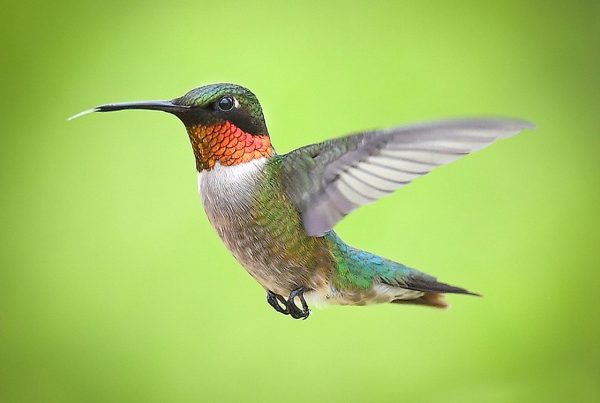
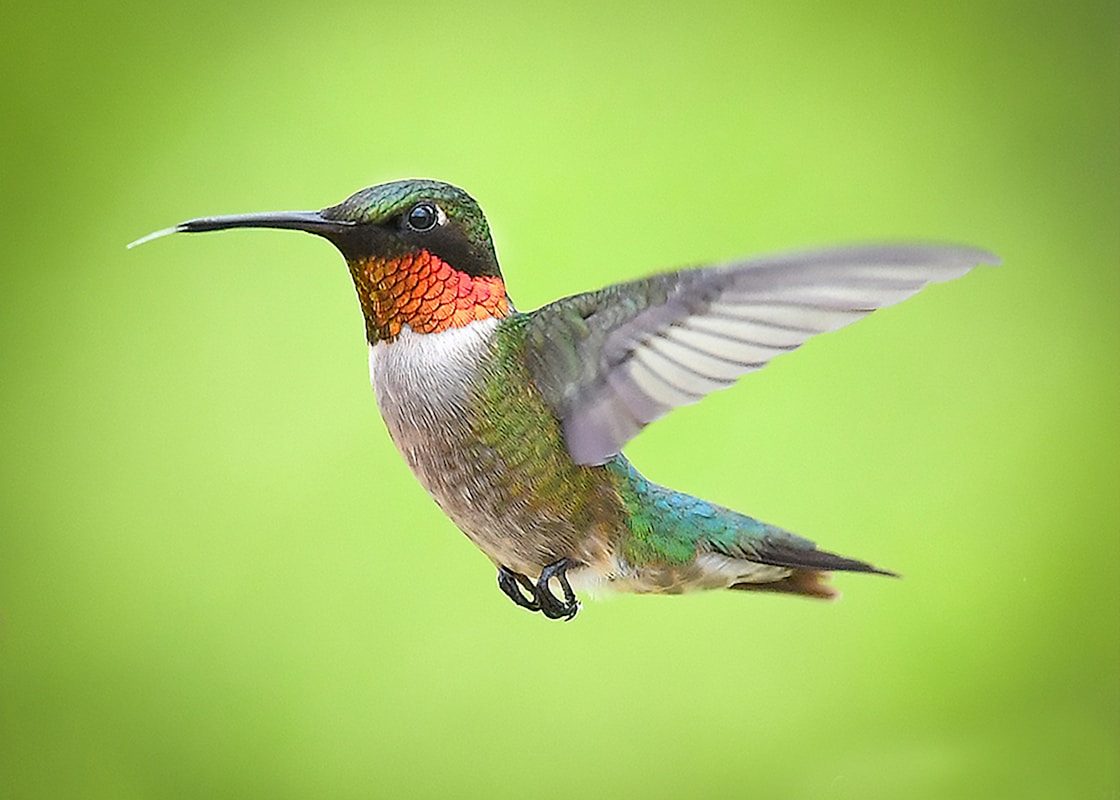
Ruby-throated Hummingbirds typically reach the Gulf Coast by mid-February, the Southeast by late March, the mid-Atlantic and Midwest by April, and the Northeast and Canada by early May. The timing tracks closely with early spring bloom along the migration corridor.
Females follow 1–2 weeks later, arriving to find territories already established and competing males already in place.
The Gulf of Mexico Crossing
This is the part of Ruby-throated Hummingbird migration that stops people when they first learn about it. Up to 500 miles of open water, no land, no food, no rest. The crossing takes 18–24 hours under favorable conditions.
Birds spend several days along the Gulf Coast beforehand, feeding intensively. A typical Ruby-throat weighs about 3.5 grams at rest. Pre-migration, it may reach 5–6 grams — the extra weight almost entirely fat. That fat fuels the entire flight.
Favorable tailwinds help considerably. Headwinds can be fatal. Not all birds cross the Gulf; some migrate overland through Texas and Mexico, especially in spring when they can follow flowering trees northward.
Fall Migration: Earlier Than People Think
Hummingbird Migration
Fall migration begins in July — often before many people realize it’s happening. Adult males move first. Adult females follow in August. Juveniles, making their first migration, go last — typically August through September.
The fall route tends to be more westward than the spring route. Many Ruby-throats that moved north along the Atlantic coast return south through the interior of the continent, funneling down through Texas. This means the birds at your August feeder may include individuals that didn’t pass through your area in spring.
How They Navigate
Multiple systems simultaneously:
- Magnetic compass — detects Earth’s magnetic field for directional orientation, especially useful at night or in overcast conditions
- Sun compass — position of the sun plus an internal clock for daytime navigation
- Landmark memory — experienced birds recognize mountains, coastlines, and river valleys along their route
- Innate programming — first-year birds navigating their first migration have no learned route; they follow a genetic directional preference that points them roughly correctly
The precision of return migration is genuinely striking. Individual birds banded at specific feeders have been recaptured at those same feeders in the same week in subsequent years — navigating to within a few hundred meters of a specific point after thousands of miles.
Western Hummingbird Migration
The Rufous Hummingbird makes the longest migration of any North American hummingbird relative to body size — roughly 3,900 miles one way, from Alaska and the Pacific Northwest to wintering grounds in western Mexico. Spring route goes north along the Pacific Coast; fall route returns south through the Rocky Mountains, giving the species a clockwise loop around the western US.
That fall Rocky Mountain route passes through mountain meadows at peak wildflower season in July and August — a natural fueling corridor.
Watching Migration
The most accessible way is a well-maintained feeder during peak passage: late April to mid-May in the East for northward spring migration, late August to mid-September for southward fall. Feeder activity is highest during these windows.
Journey North (journeynorth.org) maps crowd-sourced sightings in real time during migration season. eBird (ebird.org) shows recent sightings by location. Watching the migration front advance northward on a Journey North map in April is one of the better phenological experiences available without leaving your yard.
FAQ
How far do hummingbirds migrate?
Ruby-throated Hummingbirds: 1,500–3,000 miles round trip. Rufous Hummingbirds: roughly 3,900 miles one way.
Do they migrate alone or in groups?
Alone. Each bird migrates independently. No flocking, no shared routes.
What triggers migration?
Shortening day length in late summer. Not cold, not food scarcity — photoperiod.
Can they fly over the ocean?
Yes. Ruby-throated Hummingbirds cross the Gulf of Mexico — up to 500 miles nonstop — twice a year.
For state-by-state timing, see our when do hummingbirds migrate guide. For what to plant for migrating hummingbirds, see our plants that attract hummingbirds.

MD Imdadul Haque is the founder of BirdzFly, a research-backed resource on North American backyard birds. Drawing on years of independent study into bird identification, behavior, and migration patterns, he writes in-depth guides designed to help US birders understand the species in their own backyards — from common feeder visitors to seasonal migrants passing through.