

Purple Martin Migration
Purple Martins winter in Brazil. They breed in North America. The round trip is somewhere between 7,000 and 14,000 miles depending on the individual bird, and they make it twice a year.
They are the largest swallow in North America, and they are entirely dependent on humans for nesting in the eastern United States. That last part is worth thinking about.
Where Purple Martins Spend Winter
The wintering grounds are in the Amazon Basin of Brazil — primarily in the states of Pará and Amazonas. Millions of Purple Martins concentrate there between October and February, roosting in large communal groups in cities and towns as well as in native forest.
Researchers tracking banded and satellite-tagged birds have mapped the routes. Birds from eastern North America tend to cross the Gulf of Mexico, land along the Gulf Coast or in the Yucatan Peninsula, continue through Central America, and enter South America through Colombia and Venezuela before reaching Brazil. The entire journey takes several weeks.
They don’t follow the same route twice — the fall path often differs from the spring path, which is typical of trans-hemispheric migrants.
Spring Migration: When They Return
Purple Martins are among the earliest spring migrants to return to North America. Adult males — “scouts” — arrive first, sometimes as early as January along the Gulf Coast, February in the southeastern US.
The timing by region:
- Gulf Coast (TX, LA, FL): January–February
- Southeast (GA, SC, AL): February–March
- Mid-Atlantic (VA, NC, TN): March–April
- Midwest and Northeast: April–May
- Upper Midwest and Canada: May
Females and young birds follow the males by several weeks. Once a colony is established at a site, birds typically return to that site year after year — often to the same specific gourd or compartment they used the previous year.
The Human Dependency in the East
In eastern North America, Purple Martins almost exclusively use man-made nest structures. They nest in multi-compartment martin houses or clusters of hanging gourds provided by people. Natural cavities — tree holes, old woodpecker excavations — are used occasionally, but the vast majority of eastern Purple Martin nesting happens in structures humans put up specifically for them.
This dependency is thought to have developed over centuries of association with Native American communities, who hung hollow gourds to attract martins to their villages. The birds that were already partially comfortable with human structures became the ancestors of today’s eastern population.
In the West, Purple Martins still use natural cavities and are not dependent on man-made structures in the same way.
Setting Up for Purple Martins
If you want Purple Martins in your yard, the setup requirements are specific:
- Open area: Martins need open flight paths — houses placed in the middle of wooded areas don’t work. Ideally 30–120 feet from human structures with no trees taller than the martin house within 40 feet.
- Height: Houses should be 10–20 feet off the ground.
- Near water: Proximity to a pond, lake, or river is strongly preferred. Martins eat flying insects caught in the air, and water concentrates insects.
- Timing: Houses should be up and open before the scouts arrive in your area. Putting them up in March works for most of the eastern US; earlier for the Gulf Coast.
Starling and House Sparrow exclusion is one of the main management challenges. Both species will try to claim martin houses and both will kill martin eggs and young. Monitoring and removing their nests during the early season is standard practice for martin landlords.
Fall Departure
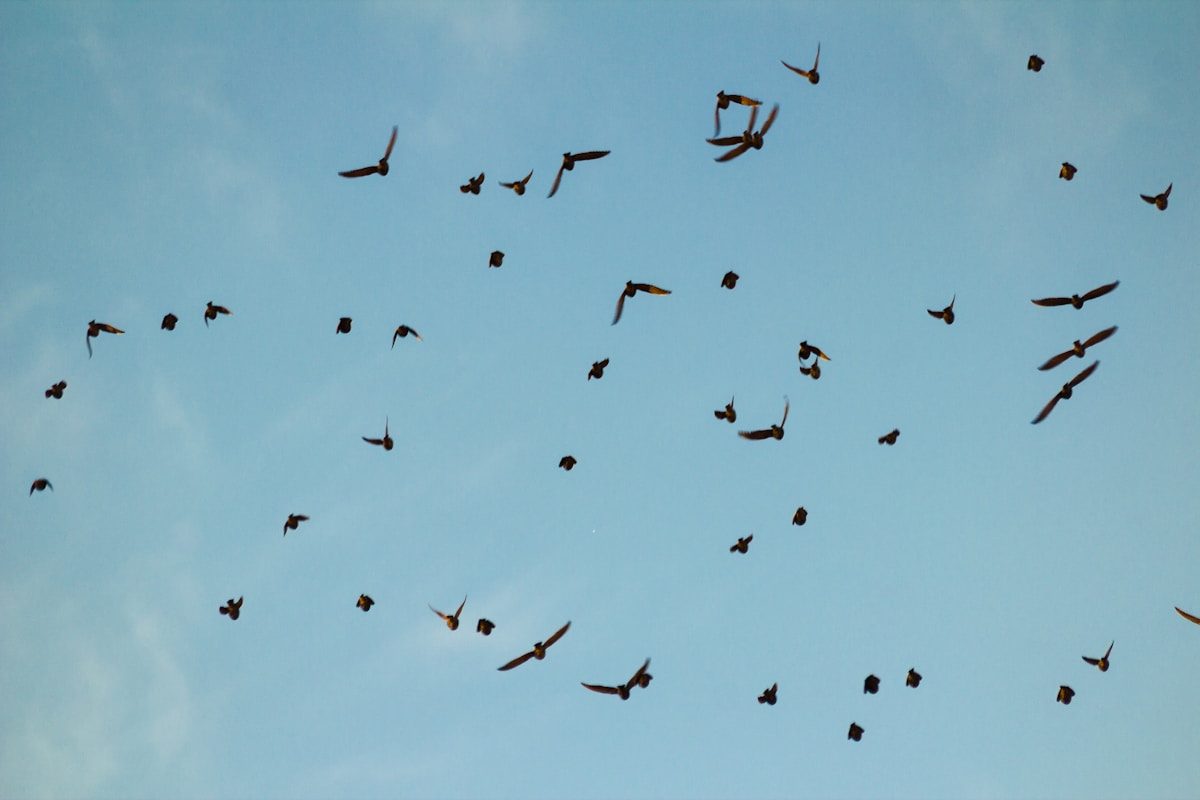
Purple Martins begin gathering in large pre-migratory roosts in July — often in urban areas where utility lines and structures provide communal roosting spots. These roosts can number in the hundreds of thousands of birds and are dramatic enough to show up on weather radar.
Most birds have left the US by September. The last stragglers go by October along the Gulf Coast.
Purple Martin Migration
What Purple Martins Look Like
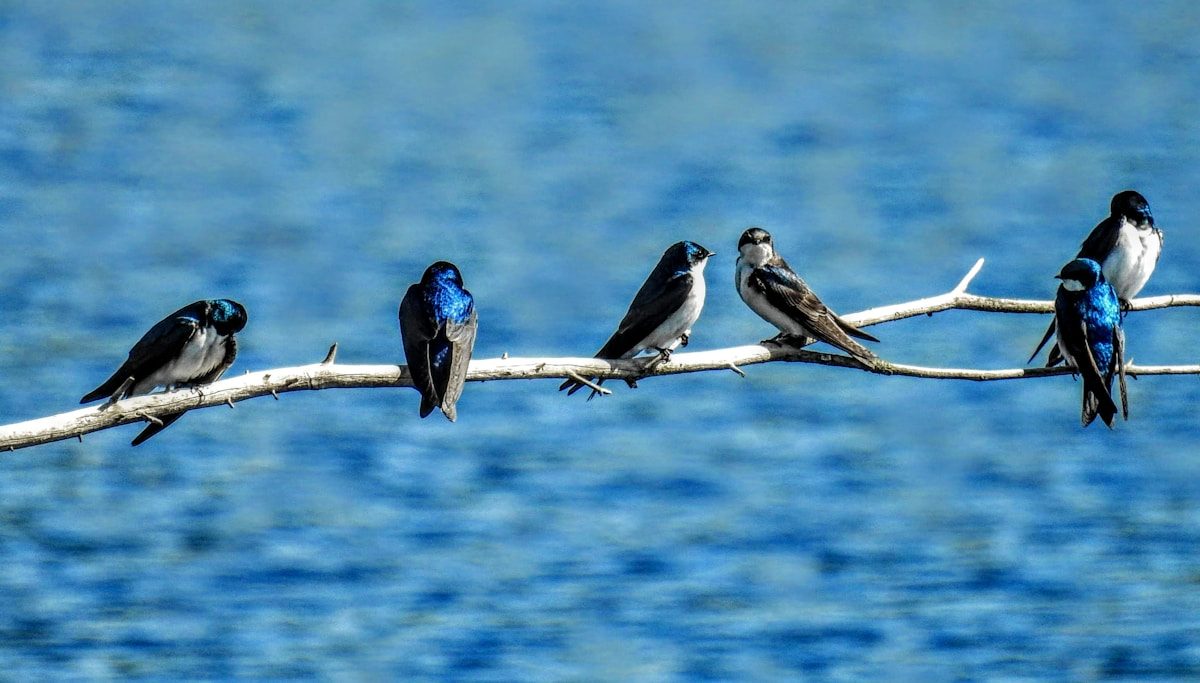
Adult males are glossy blue-black — the only all-dark swallow in North America. Females are similar but with a gray-white belly and pale collar. Juveniles look like females.
In flight: pointed wings, forked tail, swift and agile. They catch all their food in the air, rarely landing except at the nest and roost sites.
The song is a distinctive series of gurgling and liquid notes — recognizable once you know it, and worth learning before the season starts so you hear them when they arrive.
Conservation
Purple Martin populations have declined in recent decades, particularly in the East. The reasons include competition from European Starlings and House Sparrows for nest sites, insect declines, and weather events that affect migration timing and food availability.
Active martin landlords — people who maintain houses, monitor nests, and manage competitors — are considered a meaningful part of conservation efforts for the species. It’s an unusual situation: a wild bird that depends on a network of volunteer stewards to maintain its breeding habitat.
FAQ
Where do Purple Martins go in winter?
Brazil, primarily the Amazon Basin in the states of Pará and Amazonas. They winter there from October through February before returning north.
When do Purple Martins return in spring?
Gulf Coast: January–February. Southeast: February–March. Mid-Atlantic and Midwest: March–April. Northeast and Canada: April–May.
How do I attract Purple Martins?
Multi-compartment martin house or hanging gourds, 10–20 feet high in an open area near water, with no tall trees nearby. Houses should be up before the scouts arrive in your area.
Why do Purple Martins use man-made houses?
Eastern Purple Martins have been associated with human settlements for centuries, likely beginning with Native American gourd provision. The dependency on man-made structures in the East is now essentially complete.
For more on swallow species and spring migration timing, see our guide on 15 spring birds to watch for in your backyard.

MD Imdadul Haque is the founder of BirdzFly, a research-backed resource on North American backyard birds. Drawing on years of independent study into bird identification, behavior, and migration patterns, he writes in-depth guides designed to help US birders understand the species in their own backyards — from common feeder visitors to seasonal migrants passing through.

