Most years, Snowy Owls stay in the Arctic. Then, periodically, something shifts — and hundreds or thousands of Snowy Owls appear across the northern United States, showing up at airports, beaches, farm fields, and rooftops in cities that almost never see them. People who grew up watching birds their whole lives suddenly have a Snowy Owl in their local park. These events are called irruptions, and understanding why they happen explains a lot about what Snowy Owls actually are.
Identification
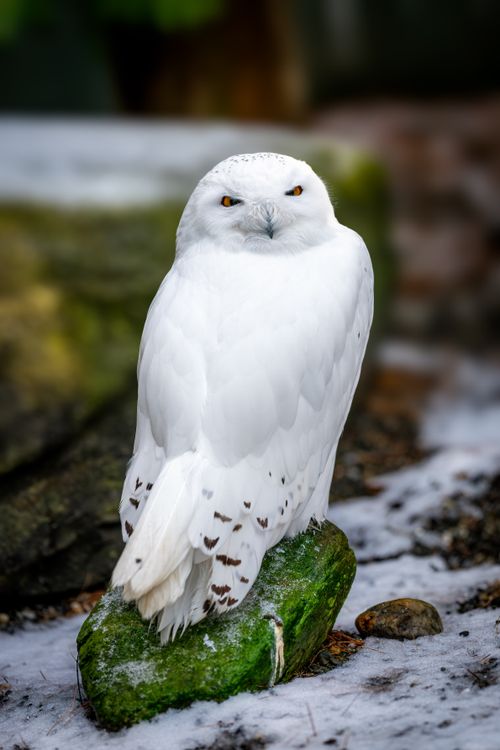
Overall impression: Large, white, round-headed, with yellow eyes. Unmistakable. No other large owl in North America is predominantly white, and the sheer size eliminates any confusion with smaller white birds.
Key field marks:
- White plumage — Varies by age and sex. Adult males are the whitest, sometimes nearly pure white with minimal dark barring. Adult females and immature birds show heavier brown-black barring on the wings, back, and breast — some younger birds appear more brown-barred than white at distance.
- No ear tufts — Unlike Great Horned Owls, Snowy Owls have a smooth, round head profile with no visible ear tufts. The rounded silhouette is distinctive.
- Yellow eyes — Bright yellow, prominent against the white face.
- Heavily feathered feet — Feet and toes are covered in dense white feathers for insulation — visible at close range and distinctive.
- Large size — The heaviest owl in North America by weight, though the Great Gray Owl is longer. Females average heavier than males.
Size: 20–28 inches long, wingspan 49–57 inches. One of the largest owls in the world by wingspan.
Basic Facts
| Feature | Detail |
|---|---|
| Scientific name | Bubo scandiacus |
| Family | Strigidae (typical owls) |
| Length | 20–28 inches |
| Weight | 56–104 oz (1,600–2,950g) — heaviest North American owl |
| Wingspan | 49–57 inches |
| Lifespan | Up to 28 years in captivity; typically 10 years in wild |
| Eggs per clutch | 3–11, depending on food availability |
| Conservation status | Vulnerable — population declining |
Where Snowy Owls Live
Snowy Owls breed on the Arctic tundra — open, treeless terrain from Alaska and northern Canada across to Greenland, Scandinavia, and Russia. They nest on the ground, often on a slight elevation with a clear view in all directions.
Outside the breeding season, Snowy Owls move south to varying degrees depending on food availability. In low-food years, large numbers push south into the northern US. In high-food years, most remain in the Arctic or just south of it.
What Are Irruptions and Why Do They Happen?
An irruption is a large, irregular movement of birds outside their normal range. Snowy Owl irruptions happen when the Arctic lemming population crashes.
Lemmings make up the majority of the Snowy Owl’s diet during the breeding season. When lemmings are abundant, Snowy Owls breed prolifically — a female can lay up to 11 eggs in a good lemming year, compared to the typical 5–7. The result is a large class of young owls that fledge that summer. When the lemming population then collapses (part of a regular 3–5 year cycle), both adult owls and the large cohort of young owls face a food shortage. Young owls in particular, with less experience finding alternative prey, push south in large numbers searching for food.
This means irruptions follow bumper breeding years rather than food scarcity alone — you need both a productive year (lots of young birds produced) and a subsequent crash (those birds forced south). The major irruptions of 2011-12 and 2013-14 both followed exceptional breeding seasons.
Where to See Snowy Owls During an Irruption
When irruptions occur (typically November through March), Snowy Owls show up in habitat that resembles their treeless Arctic home:
- Airports — Open, flat, grassy expanses are some of the best Snowy Owl habitat in the continental US. Major airports across the northern tier regularly host wintering Snowy Owls.
- Beaches and coastal dunes — Open, windswept, similar to tundra. Atlantic Coast beaches from Nova Scotia to Virginia attract Snowy Owls in irruption years.
- Farm fields and open agricultural land — Large flat fields with visible vole populations.
- Rooftops in urban areas — Snowy Owls occasionally perch on rooftops, water towers, and other elevated structures in cities, attracting significant attention.
Diet and Hunting
Lemmings are the primary food on breeding grounds, but Snowy Owls are versatile predators that adapt to whatever prey is available:
- Voles, mice, and other small rodents (most common winter prey)
- Rabbits and hares
- Ducks and seabirds — Snowy Owls regularly hunt waterfowl, especially at coastal sites
- Fish — less common but documented
Unlike most owls, Snowy Owls are regularly active during daylight hours — they have to be, given that the Arctic summer involves near-constant daylight. This makes them much more visible than nocturnal owls and contributes to the excitement during irruptions when they show up in populated areas.
Conservation Status: Vulnerable
Despite their iconic status, Snowy Owls are classified as Vulnerable by the IUCN, with an estimated global population of fewer than 30,000 individuals. Climate change is affecting both the Arctic tundra habitat they depend on and the lemming cycles that drive their breeding success. Long-term monitoring data from breeding sites in North America and Europe show declining trends in several populations.
FAQ: Snowy Owl
When do Snowy Owls come south?
Typically November through March during irruption years. The largest irruptions follow exceptional breeding seasons in the Arctic caused by high lemming abundance.
How do you tell a male Snowy Owl from a female?
Adult males are whiter with minimal dark barring; females and immature birds show heavier brown-black barring. Pure white adults are almost always males.
Are Snowy Owls nocturnal?
No — they are active during daylight hours, unlike most owls. This is an adaptation to Arctic conditions where the sun doesn’t set during the breeding season.
What is the Snowy Owl’s conservation status?
Vulnerable globally, with fewer than 30,000 individuals estimated and population trends declining in several areas due to climate change and habitat alteration.
For more on owls, see our guides on Barn Owl, Great Horned Owl, and owl spiritual meaning. For more on winter birds and irruptions, see our fall bird migration guide.

MD Imdadul Haque is the founder of BirdzFly, a research-backed resource on North American backyard birds. Drawing on years of independent study into bird identification, behavior, and migration patterns, he writes in-depth guides designed to help US birders understand the species in their own backyards — from common feeder visitors to seasonal migrants passing through.