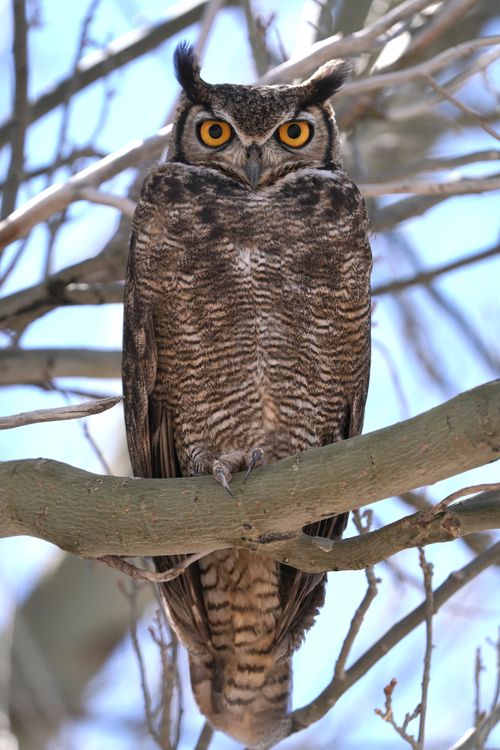
The Great Horned Owl begins nesting in January — often while snow still covers the ground and temperatures drop below zero. No other large North American bird starts breeding this early. The timing is deliberate: by the time the young owls are old enough to hunt on their own, the spring surge of small mammals and other prey is at its peak. The Great Horned Owl is working on a schedule nothing else in the forest follows.
Identification
Overall impression: Large, stocky, powerfully built. The largest common owl in North America. The distinctive “horns” — ear tufts — are immediately recognizable, though they have nothing to do with ears or hearing. Dark brown and buff mottling throughout, with a white throat patch that is often conspicuous in the field.
Key field marks:
- Ear tufts (plumicorns) — The two prominent feather tufts on top of the head. These are not ears — they’re feathers used for communication and camouflage. When flattened, the owl looks very different; the tufts can be raised or lowered independently.
- Yellow eyes — Large, fixed, forward-facing yellow eyes. Like all owls, the Great Horned Owl cannot move its eyes — it must rotate its head to change its field of view. Head rotation up to 270 degrees compensates for this.
- White throat patch — A distinct white bib on the throat, often the brightest feature visible in low light.
- Barred underparts — Horizontal fine barring across the chest and belly, brown on pale buff.
- Overall color — Highly variable — eastern birds tend to be darker brown, while western birds (especially in the Great Plains and desert Southwest) are paler gray-brown. All have the same basic pattern.
Size: 18–25 inches long, wingspan 39–57 inches. Females are significantly larger than males.
Basic Facts
| Feature | Detail |
|---|---|
| Scientific name | Bubo virginianus |
| Family | Strigidae (typical owls) |
| Length | 18–25 inches |
| Weight | 32–88 oz (910–2,500g) — females heavier |
| Wingspan | 39–57 inches |
| Lifespan | Up to 28 years in captivity; typically 5–15 years in wild |
| Eggs per clutch | 1–4, typically 2, white |
| Incubation | 28–37 days |
| Conservation status | Least concern |
The Grip Strength
Great Horned Owls have a grip strength of approximately 200–500 pounds per square inch — comparable to a Bald Eagle’s, and far exceeding what most people imagine possible for a bird. The talons themselves are up to 2 inches long.
This grip strength is not just impressive — it’s functional. Great Horned Owls regularly take prey that outweighs them, including adult Great Blue Herons, Canada Geese, large rabbits, skunks, and even other raptors including Ospreys and Peregrine Falcons. The ability to kill instantly with the feet, using crushing force rather than tearing, allows the owl to take prey far larger than most raptors would attempt.
The Apex Predator of the Night
The Great Horned Owl is the apex predator of the North American night. Nothing in its environment reliably preys on it, and its prey list spans almost every vertebrate it can physically overpower — mammals from mice to housecats, birds from sparrows to other owls, reptiles, amphibians, and large insects.
Documented prey items include:
- Mice, voles, rats, squirrels, rabbits (primary prey in most areas)
- Skunks — so commonly taken that Great Horned Owls often smell distinctly of skunk
- Opossums and raccoons (smaller individuals)
- Ducks, geese, and herons
- Other raptors: Red-tailed Hawks, Barn Owls, Barred Owls, Ospreys
- Domestic cats and small dogs
- Porcupines (occasionally, at significant cost to the owl)
The willingness to take skunks — which most predators refuse because of the chemical defense — reflects an important adaptation: Great Horned Owls have a very limited sense of smell compared to most mammals, making the skunk’s primary defense nearly irrelevant.
Silent Flight
Like Barn Owls, Great Horned Owls fly nearly silently. The leading edge of the primary feathers has a comb-like fringe that breaks up turbulence, and the secondary feathers have a velvety surface that absorbs sound. The result is flight that generates far less noise than most birds of comparable size.
This silence serves dual purpose: prey cannot hear the approach, and the owl can continue to listen for prey while in flight rather than having its own wing noise mask the sounds it’s tracking.
Nesting: The Earliest Breeder
Great Horned Owls begin courtship in late fall — as early as October in some areas — with pairs establishing territories and duetting through winter. Eggs are typically laid in January or February, making the Great Horned Owl the earliest nesting large bird in North America.
The owls don’t build their own nests. They take over existing structures — old hawk, crow, or heron nests, cliff ledges, tree cavities, or sometimes ground sites. The female incubates through the coldest part of winter, with the male hunting and delivering food. Incubation takes about 30–37 days. Young owls — called owlets — remain in the nest for about 6 weeks, then branch (move onto nearby branches) for several more weeks before their first flight.
The owlets stay with parents through late summer, learning to hunt. Full independence typically comes in fall — almost a year after the eggs that produced them were laid.
The Hoot: Understanding Great Horned Owl Calls
The classic owl hoot belongs to the Great Horned Owl. The standard territorial call is a series of 4–5 deep, resonant hoots: “hoo-h’HOO-hoo-hoo” — lower-pitched and more resonant than the Barred Owl’s more varied phrasing. Males have deeper voices than females, and pairs often duet, with the male and female calling in alternation.
Great Horned Owls also produce hisses, screams, barks, and bill clacks — a wider repertoire than the hooting stereotype suggests. Nestlings produce an insistent raspy screech that carries surprisingly far and is one of the most commonly heard Great Horned Owl sounds in late summer.
Range and Habitat
One of the most widespread birds in the Americas — found from the Arctic treeline to the southern tip of South America. In North America, Great Horned Owls occupy virtually every habitat type that has some combination of trees for nesting and open or semi-open areas for hunting: forests, deserts, wetlands, suburban neighborhoods, farmland, and mountain ranges.
Their adaptability makes them one of the most commonly encountered large owls across the continent. They’re present in most suburban and even urban areas where sufficient green space and prey exist.
FAQ: Great Horned Owl
What do Great Horned Owls eat?
Almost anything they can physically overpower — primarily rabbits, rodents, and birds, but also skunks, opossums, other raptors, and occasionally small domestic pets.
Are Great Horned Owls dangerous to humans?
They can be, if approached near a nest. Defensive attacks on humans who approach nestlings have caused serious injuries. Give nesting owls wide berth.
What does a Great Horned Owl sound like?
A deep, resonant “hoo-h’HOO-hoo-hoo” — the classic owl hoot. Lower and more resonant than other common owls. Pairs duet with alternating calls.
Why does a Great Horned Owl nest in winter?
Early nesting means young owls reach independence in spring when prey is most abundant, giving them the best possible start at learning to hunt.
For more on owls, see our guides on Barn Owl hunting in complete darkness, Snowy Owl and the irruption phenomenon, and owl symbolism and spiritual meaning. For other raptors, see our guides on the Peregrine Falcon and Osprey vs Eagle.

MD Imdadul Haque is the founder of BirdzFly, a research-backed resource on North American backyard birds. Drawing on years of independent study into bird identification, behavior, and migration patterns, he writes in-depth guides designed to help US birders understand the species in their own backyards — from common feeder visitors to seasonal migrants passing through.