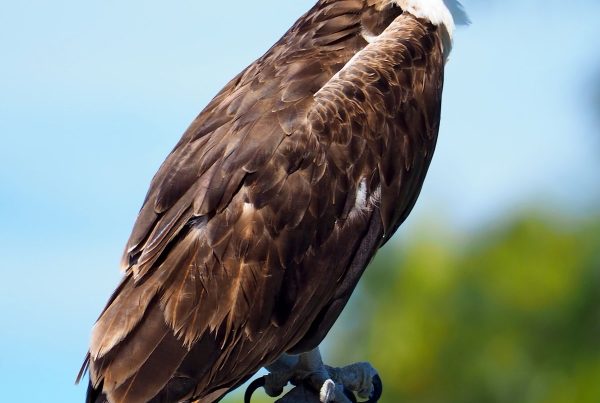

The Peregrine Falcon is the fastest animal on Earth. Not the fastest bird — the fastest animal, full stop. In a hunting stoop, a Peregrine can exceed 240 mph. No cheetah, no sailfish, no other creature on the planet moves faster under its own power.
That single fact sets the context for everything else about this bird.
Identification
Overall impression: A compact, powerful falcon with long pointed wings and a relatively short tail. In flight, the silhouette is distinctive — swept-back wings giving an anchor or crossbow shape that separates falcons from hawks at distance.
Key field marks:
- Dark “helmet” — Black cap extending down through the cheek as a wide dark stripe (the malar stripe), giving the bird the appearance of wearing a mask or helmet. This is the single most reliable field mark.
- Barred underparts — Adults have white to pale buff underparts with fine horizontal dark barring across the chest and belly. The barring is finer and more regular than other large falcons.
- Blue-gray upperparts — Dark slate-blue above, darker on the wings.
- Yellow eye-ring and cere — The bare skin around the eye and at the base of the bill is bright yellow in adults, providing color contrast against the dark head.
Size: 14–19 inches long, wingspan 39–43 inches. Females are noticeably larger than males — typical in raptors, where reverse sexual size dimorphism is the norm.
Basic Facts
| Feature | Detail |
|---|---|
| Scientific name | Falco peregrinus |
| Family | Falconidae (falcons) |
| Length | 14–19 inches |
| Weight | 18.7–56.4 oz (530–1,600g) — females much heavier |
| Wingspan | 39–43 inches |
| Lifespan | Up to 19 years in wild; typically 7–15 years |
| Eggs per clutch | 3–4, white to buff with reddish-brown markings |
| Incubation | 29–32 days |
| Conservation status | Least concern — one of conservation’s greatest success stories |
How Fast Is the Peregrine Falcon Really?
The speed record — 242 mph (389 km/h) — was recorded in a controlled study in 2005 by Ken Franklin, who trained a Peregrine named “Frightful” and tracked her dives with a specially designed computer and altimeter. This is the most rigorously documented speed ever recorded for a living animal.
To understand what 240 mph actually means for a bird the size of a crow:
- A Peregrine in full stoop covers roughly 350 feet per second
- At that speed, the falcon is moving faster than many small aircraft
- The G-forces experienced during pullout from a stoop have been estimated at 25–27 G — more than enough to cause a human to lose consciousness instantly
- The falcon’s eyes have a special membrane (nictitating membrane) that protects them at speed and may help maintain moisture against the wind blast
Peregrines also have baffles in their nostrils — small bony projections that deflect the air pressure wave created at high speed, allowing them to breathe normally during a stoop. Without these, the air pressure at 200+ mph would make breathing impossible.
The Hunting Stoop
The stoop is the defining behavior — a near-vertical dive from altitude onto prey below. The sequence:
- The falcon gains altitude, often soaring on thermals to 1,000 feet or more
- It locates prey — typically a bird in flight — and positions itself above and upwind
- It folds its wings and drops, accelerating through the dive while making small adjustments to track the prey’s position
- At the moment of impact, the falcon strikes with a closed fist (the rear talon) rather than grabbing — the impact at speed is sufficient to stun or kill instantly
- The prey is then caught in the air or followed to the ground
The strike velocity is what makes the stoop lethal. A bird hit by a Peregrine at 150+ mph receives an impact comparable to being struck by a car. Death is nearly instantaneous. The falcon then circles back to collect the prey.
Prey and Diet
Peregrines eat almost exclusively birds caught in flight — approximately 450 bird species have been documented as prey in North America alone. Preferred prey varies by location and season:
- Urban populations eat primarily pigeons (Rock Pigeons) and European Starlings, which are abundant year-round in cities
- Coastal populations eat shorebirds — sandpipers, plovers, dunlin — during migration when these concentrate in large numbers
- Arctic breeding populations eat ptarmigan, shorebirds, and ducks
- During migration, Peregrines follow concentrations of migratory birds and take whatever is most available
Peregrines rarely take mammals or anything from the ground. They are aerial hunters almost exclusively.
Range and Habitat
The Peregrine Falcon has the widest natural distribution of any bird in the world — found on every continent except Antarctica, in habitats ranging from Arctic tundra to tropical rainforest edges to city centers. The word “peregrinus” means “wanderer” or “pilgrim” in Latin.
In North America, Peregrines breed across the Arctic and subarctic, along both coasts, in mountain ranges, and increasingly in cities. Urban environments have become important breeding habitat — skyscrapers replicate the cliff faces Peregrines historically nested on, and the abundance of pigeons provides a reliable food source.
One of Conservation’s Greatest Success Stories
By the 1960s, Peregrine Falcons had been eliminated from the entire eastern United States as a breeding species. The cause: DDT. The pesticide accumulated in the food chain and caused eggshell thinning so severe that eggs broke under the weight of incubating adults. By 1964, not a single Peregrine nest could be found east of the Mississippi.
What followed was one of the most intensive conservation efforts ever undertaken for a wild bird:
- 1972 — DDT banned in the United States
- 1974 — The Peregrine Fund established, beginning captive breeding programs
- 1975–1991 — Over 6,000 captive-bred Peregrines released across North America through a technique called hacking (placing young birds at release sites and supporting them until independent)
- 1999 — Removed from the federal Endangered Species List
- Today — Over 3,000 nesting pairs in North America, including dozens of pairs nesting on bridges and skyscrapers in major cities
The Peregrine recovery is one of the clearest proofs that endangered species can be brought back when the right interventions are made at the right time.
Urban Peregrines: How to Find One Near You
The easiest place to see a Peregrine Falcon in North America is in a city. Major bridges and tall buildings in urban areas across the US and Canada now host nesting pairs. Cities including New York, Chicago, Boston, San Francisco, and many others have active Peregrine nest sites on bridges and skyscrapers, often with public nest cameras that stream live during the breeding season.
Outside cities, look for Peregrines hunting over open water, mudflats, and coastal areas during migration. They’re most conspicuous in fall when shorebird concentrations attract hunting Peregrines to coastal sites.
FAQ: Peregrine Falcon
How fast is a Peregrine Falcon?
Up to 242 mph (389 km/h) in a hunting stoop — the fastest speed ever recorded for any animal under its own power.
What does a Peregrine Falcon eat?
Almost exclusively birds caught in flight. Urban Peregrines eat primarily pigeons; coastal birds eat shorebirds; Arctic breeders eat ptarmigan and ducks.
Are Peregrine Falcons endangered?
No longer. After near-extinction in the eastern US due to DDT, an intensive recovery program returned them to Least Concern status. Over 3,000 nesting pairs now exist in North America.
How do you identify a Peregrine Falcon?
The dark “helmet” — black cap and wide dark stripe down the cheek — is the fastest field mark. Combined with the barred underparts and swept-back anchor wing shape in flight, it’s distinctive.
For more on raptors, see our guides on juvenile Red-tailed Hawk identification, Cooper’s vs Sharp-shinned Hawk, and Barn Owl hunting in complete darkness.

MD Imdadul Haque is the founder of BirdzFly, a research-backed resource on North American backyard birds. Drawing on years of independent study into bird identification, behavior, and migration patterns, he writes in-depth guides designed to help US birders understand the species in their own backyards — from common feeder visitors to seasonal migrants passing through.