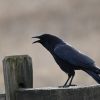

When crows find one of their own dead, they don’t simply move on. Dozens of birds converge, filling the trees, calling loudly, sometimes for several minutes straight. People have called it a “crow funeral” for years — and it’s a real, well-documented behavior. What it actually is, according to over a decade of controlled field research, isn’t grief. It’s a threat-assessment meeting.
The Researcher Who Actually Tested This
Kaeli Swift, then a graduate researcher at the University of Washington’s Avian Conservation Laboratory working under ornithologist John Marzluff, set out to test what these gatherings were actually for, rather than simply describing them. Her method was direct: she and volunteers wearing distinct masks would present wild crow populations with a dead crow (preserved through taxidermy) and record exactly how nearby crows responded.
The reaction was consistent and dramatic. The first crow to spot the dead bird gave a loud, repetitive alarm call. Within seconds, other crows within hearing range converged, mobbing and screaming at the person holding the body. After a few minutes, the group would quiet down and disperse — but the effects of that encounter lasted far longer than the gathering itself.
What the Experiments Actually Showed
Swift’s published research, conducted with wild American crows in real neighborhoods, tested several specific combinations to isolate exactly what triggered the mobbing response:
- An unfamiliar person alone (baseline)
- An unfamiliar person holding a dead crow
- An unfamiliar person holding a red-tailed hawk (a known crow predator)
- An unfamiliar person holding both a hawk and a dead crow together
- An unfamiliar person holding a dead pigeon, as a control for “any dead bird” versus specifically a dead crow
The dead pigeon triggered no unusual response at all — confirming crows weren’t reacting simply to death in general, but specifically to the death of another crow. Pairing a person with a dead crow, a hawk, or both together all reliably triggered mobbing and reduced foraging activity in the area for the following days. The response was strongest of all when crows saw a hawk paired directly with a dead crow — the clearest possible signal of an active predation threat.
Crows Remember the Person, Not Just the Place
The most striking finding involved what happened weeks after the initial “funeral.” Crows that had seen a specific masked person handling a dead crow continued to scold, mob, and alarm-call at that same masked individual for as long as six weeks afterward — even when that person returned with no dead bird at all, just walking past normally. The crows had formed a lasting association between that person’s face and danger, based on a single encounter.
This finding lines up with previous, separately documented research confirming crows can recognize and remember individual human faces for years, and can even communicate that recognition to other crows who never witnessed the original event — a form of social learning that extends the value of a single dangerous encounter across an entire local population.
So Is It Grief, or Isn’t It?
Swift and other researchers studying this behavior are careful not to claim the mobbing response definitively rules out any form of grief or emotional response — that remains a genuinely open scientific question, difficult to test directly in a non-human animal. What the research does show clearly is that the behavior serves a concrete, measurable survival function: crows use the sight of a dead crow, especially near a potential predator, to learn about danger, and they act on that information by avoiding the area and remembering the threat for weeks afterward.
Whether an emotional response coexists alongside that practical function is a separate question the mobbing experiments weren’t designed to answer — but the “funeral” label, while catchy, may be doing more work implying human-style grief than the confirmed science actually supports.
Why This Matters Beyond Crows
Reacting to the death of another member of your own species with this kind of organized, threat-assessing behavior is genuinely rare in the animal kingdom — documented in only a small number of species, including some primates, elephants, and cetaceans, alongside corvids like crows. That crows show this level of social learning and individual facial recognition places them among the more cognitively sophisticated animals studied, reinforcing decades of separate research on corvid intelligence, tool use, and problem-solving.
FAQ: Crow “Funerals”
Do crows really hold funerals for their dead?
They gather around dead crows and engage in loud group mobbing behavior, a real and well-documented phenomenon — but research by Kaeli Swift at the University of Washington indicates the function is threat assessment and social learning about danger, not confirmed grief.
Why do crows only react this way to dead crows and not other dead birds?
Controlled experiments found dead pigeons triggered no unusual crow response, while dead crows reliably did — confirming the reaction is specific to their own species rather than a general response to death.
Can crows really remember a specific person for weeks?
Yes — crows that witnessed a masked individual holding a dead crow continued to mob and scold that same person for up to six weeks afterward, even without any dead bird present, demonstrating lasting individual facial recognition tied to a single dangerous encounter.
For more on corvids, see our guides on Raven vs Crow identification, Common Grackle, and bird self-recognition and intelligence. Read the original 2015 study, “Wild American crows gather around their dead to learn about danger,” in the journal Animal Behaviour (Swift & Marzluff, 2015).

MD Imdadul Haque is the founder of BirdzFly, a research-backed resource on North American backyard birds. Drawing on years of independent study into bird identification, behavior, and migration patterns, he writes in-depth guides designed to help US birders understand the species in their own backyards — from common feeder visitors to seasonal migrants passing through.