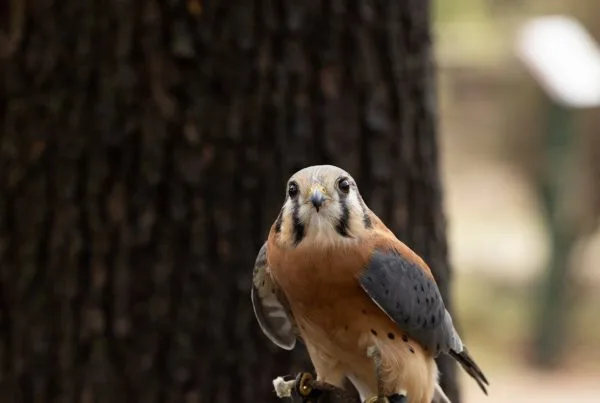

Hawks are among the most visible raptors in North America — large enough to notice, common enough to encounter regularly, and varied enough that identifying them correctly takes some practice. Here is the complete guide: what hawks are, the most common species, what they eat, and the spiritual meaning that many people associate with hawk sightings.
What Is a Hawk?
“Hawk” is a common name applied to two distinct groups of raptors in North America:
- Accipiters — woodland hawks with short rounded wings and long tails, built for fast maneuvering through trees. Examples: Cooper’s Hawk, Sharp-shinned Hawk, Northern Goshawk.
- Buteos — soaring hawks with broad wings and short tails, built for hunting open country. Examples: Red-tailed Hawk, Red-shouldered Hawk, Broad-winged Hawk.
Falcons (Peregrine, Merlin, American Kestrel) are sometimes called hawks in casual conversation but belong to a separate family (Falconidae) and are not true hawks. The Northern Harrier is also sometimes grouped with hawks but is in a separate subfamily.
The 5 Most Common Hawks in North America
Red-tailed Hawk
The default “hawk” in most of North America — the bird on that highway fence post is almost certainly this species. Adults have a distinctive brick-red tail visible from above and a dark belly band across white underparts. Found in open country, roadsides, farmland, and suburban areas. Feeds primarily on small mammals. The call — a raspy, descending scream — is so recognizable it’s used in almost every movie and TV show that needs a “hawk sound,” including for Bald Eagles (whose real call is much weaker).
Cooper’s Hawk
A medium-sized accipiter that has become one of the most common backyard hawks across the US. Rounded tail, blue-gray back in adults, reddish barring on the chest. Specializes in hunting birds — the most likely hawk to appear at your feeder and scatter the songbirds. Often confused with the smaller Sharp-shinned Hawk: the tail shape (rounded in Cooper’s, squared-off in Sharp-shinned) is the most reliable field mark.
Sharp-shinned Hawk
The smallest hawk in North America. Nearly identical to a small Cooper’s Hawk — same species pairing that causes more identification headaches than almost any other in North American birding. Notched or square tail tip vs the Cooper’s rounded tip. Heavily migrates along ridgelines in fall — counts of thousands per day pass hawk watch sites in September.
Red-shouldered Hawk
Forest hawk associated with wet woods and stream corridors. Adults have orange-barred underparts and translucent pale crescents near the wingtip visible in flight. Extremely vocal — the repeated descending “kee-yer” call is one of the most commonly heard hawk sounds in eastern woodlands. Often imitated by Blue Jays.
Broad-winged Hawk
Small buteo of eastern deciduous forests, famous for mass migration in mid-September. Thousands to tens of thousands concentrate into “kettles” — spiraling columns on thermals — along established hawk-watch ridges including Hawk Mountain in Pennsylvania. One of the most spectacular wildlife events in eastern North America, reliably occurring in a very narrow window around September 15-20 each year.
How to Identify Hawks in Flight
Four things to check when a hawk flies over:
- Wing shape — Accipiters have short rounded wings; buteos have long broad wings
- Tail shape — Round, square, fanned, or notched; length relative to body
- Flight style — Accipiters flap-flap-glide; buteos soar on flat or slightly raised wings; harriers fly low with tilting, buoyant flight
- Underwing pattern — Pale, dark, or patterned flight feathers visible from below
What Do Hawks Eat?
Diet varies by species and group:
- Buteos (Red-tailed, Red-shouldered) — primarily small mammals: voles, mice, squirrels, rabbits; also snakes, lizards, frogs
- Accipiters (Cooper’s, Sharp-shinned) — primarily birds, caught in ambush at speed; some small mammals
- Northern Harrier — small rodents and birds, hunted low over marsh and grassland using hearing as well as sight
Hawk Migration
Fall hawk migration is one of the great birding spectacles in North America. Hawks are funneled along mountain ridges and coastlines where geography concentrates them into counting sites. Peak species and timing:
- Broad-winged Hawk — mid-September, huge kettles
- Sharp-shinned Hawk — late September through October
- Cooper’s Hawk — October
- Red-tailed Hawk — October–November
- Golden Eagle — November
Hawk Mountain Sanctuary in Pennsylvania and Cape May in New Jersey are the most famous eastern watch sites. The Texas coast near Corpus Christi is the major Gulf corridor.
Hawk Spiritual Meaning
Hawks carry consistent symbolic weight across traditions. The core associations reflect the bird’s actual qualities — exceptional vision, precision, and the ability to see from great heights.
Vision and perspective — The hawk sees what others miss. In spiritual terms, a hawk sighting is widely interpreted as a call to clarity: see the situation from a higher perspective before acting.
Focus and precision — Hawks don’t hesitate. A hawk hunting doesn’t second-guess the strike. Symbolically, this represents decisiveness and commitment to a chosen path.
Messenger — In many Native American traditions, hawks are considered messengers — birds that move between the physical and spiritual worlds, carrying information between them.
When you see a hawk — The most consistent interpretation across traditions: pay attention. The hawk’s appearance is a signal to focus on something you’ve been overlooking or avoiding.
For a deeper look at hawk symbolism by type and encounter context, see our full guide on hawk spiritual meaning.
Hawks and the Law
All hawks in North America are protected under the Migratory Bird Treaty Act. It is illegal to harm, harass, possess, or kill any hawk. If a hawk is taking birds from your feeder, temporarily removing the feeder for a few days typically disrupts the pattern — hawks hunt by pattern recognition, and removing the easy food source causes them to move on.
FAQ: Hawks
What is the most common hawk in North America?
The Red-tailed Hawk — the large hawk on highway fence posts and power poles across the US. The most widespread and adaptable buteo on the continent.
How do you tell a Cooper’s Hawk from a Sharp-shinned Hawk?
Tail shape is the most reliable mark. Cooper’s has a rounded tail tip; Sharp-shinned has a squared or notched tail. Size alone is unreliable because female Sharp-shinneds overlap male Cooper’s in size. See our complete Cooper’s vs Sharp-shinned identification guide.
What does it mean spiritually when you see a hawk?
Across most traditions, a hawk sighting signals heightened awareness — a call to pay attention, gain perspective, and act with clarity. See our full hawk spiritual meaning guide.
For more on raptors, see our guides on juvenile Red-tailed Hawk identification, Osprey vs Eagle, Peregrine Falcon, and Barn Owl.

MD Imdadul Haque is the founder of BirdzFly, a research-backed resource on North American backyard birds. Drawing on years of independent study into bird identification, behavior, and migration patterns, he writes in-depth guides designed to help US birders understand the species in their own backyards — from common feeder visitors to seasonal migrants passing through.