
The Great Horned Owl earns its reputation as one of North America’s most formidable predators through a combination of adaptations working together — silent flight, powerful grip strength, and a hunting range that covers nearly every habitat on the continent. Here are 10 facts that explain what makes this owl so effective.
1. The “Horns” Aren’t Horns or Ears
The tufted feathers on top of the head that give the species its name are called plumicorns — they have nothing to do with hearing or horns. The current best understanding is that plumicorns serve a camouflage function, breaking up the owl’s silhouette against tree bark and branches, and may also play a role in visual communication between owls signaling mood or intent to potential mates and rivals.
2. Silent Flight Comes From Serrated Feathers
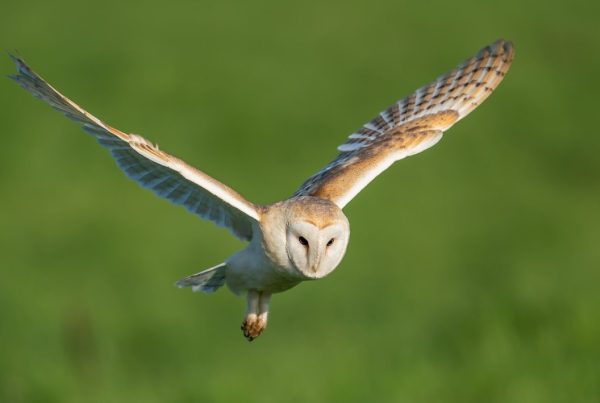
Fine, comb-like serrations along the leading edge of the primary wing feathers break up turbulence and disrupt the airflow that would normally create wing noise. This adaptation allows the owl to approach prey without the sound of its own flight giving away the attack — a critical advantage for a predator that relies heavily on hearing to locate prey in darkness and needs its own flight to stay silent enough not to mask that hearing.
3. Grip Strength Rivals a Bald Eagle
Great Horned Owl talons exert a crushing grip of roughly 200 to 500 pounds per square inch — comparable to a Bald Eagle’s, despite the owl being considerably smaller and lighter. This grip strength lets the species kill prey instantly and take animals that outweigh the owl itself, including skunks, large rabbits, and occasionally other raptors.
4. Diet Spans Nearly Every Size Class
Few predators in North America have as broad a prey list. Great Horned Owls take mice and voles at the small end and adult Great Blue Herons, Canada Geese, and other raptors — including Ospreys — at the large end, along with skunks, rabbits, reptiles, amphibians, and large insects in between. The willingness to take skunks specifically reflects the owl’s very limited sense of smell, making the skunk’s main chemical defense largely ineffective against it.
5. Males and Females Call at Different Pitches
Despite females being physically larger than males (typical across most owl and raptor species), male Great Horned Owls have deeper, more resonant hoots. This pitch difference allows individual owls to identify each other by voice alone, and it’s part of how a mated pair recognizes and locates one another across a territory in complete darkness.
6. Pairs Often Stay Together for Life
Great Horned Owls are generally monogamous, with pairs returning to the same nesting territory across multiple breeding seasons when both partners survive. Courtship includes bowing displays, mutual hooting duets, and preening between partners, which strengthens the pair bond ahead of the breeding season. If one partner dies, the survivor will actively call to attract a new mate, a process that can take anywhere from a few weeks to several months depending on the season and local population density.
7. Nesting Begins in the Dead of Winter
Great Horned Owls are the earliest-nesting large bird in North America, often laying eggs in January while snow still covers the ground. This timing means owlets reach independence by the time spring’s surge in small-mammal prey peaks — an early start that gives young owls the best possible conditions to learn hunting.
8. They Don’t Build Their Own Nests
Rather than constructing a nest from scratch, Great Horned Owls take over existing structures — old hawk, crow, or heron nests, natural tree cavities, cliff ledges, or occasionally ground sites. This behavior lets them begin breeding earlier than species that need time to build, contributing directly to their unusually early nesting schedule.
9. Adaptable Enough to Live Near Airports and Cities
Great Horned Owls occupy an exceptionally wide range of habitats, from wilderness forest to suburban parks to areas immediately adjacent to airports, where their presence can pose a genuine risk to aircraft. Wildlife management programs near airports typically use non-lethal methods — habitat modification and relocation — to reduce these encounters while protecting the owls.
10. Human Conflict Is Real But Manageable
Because Great Horned Owls will occasionally take poultry or small pets left outdoors at night, some landowners view them as a nuisance, while others value their role controlling rodent populations. In practice, secure housing for small livestock and pets at night resolves most conflicts without requiring any action against the owl itself, which is a federally protected species under the Migratory Bird Treaty Act.
FAQ: Great Horned Owl
How strong is a Great Horned Owl’s grip?
Roughly 200 to 500 pounds per square inch — comparable to a Bald Eagle’s, despite the owl’s smaller size.
Do Great Horned Owls mate for life?
Generally, yes — pairs typically remain together and reuse the same territory across multiple breeding seasons as long as both partners survive.
Why do Great Horned Owls nest so early in the year?
Eggs are often laid in January, timed so that owlets reach independence when spring’s peak in small-mammal prey gives young owls the best possible start.
For the complete species guide, see our Great Horned Owl identification and behavior guide. For more on owls, see our guides on Barn Owl, Snowy Owl, and Barred Owl.

MD Imdadul Haque is the founder of BirdzFly, a research-backed resource on North American backyard birds. Drawing on years of independent study into bird identification, behavior, and migration patterns, he writes in-depth guides designed to help US birders understand the species in their own backyards — from common feeder visitors to seasonal migrants passing through.