
Bluebird Houses
Bluebird populations crashed in the 20th century. The main reason wasn’t habitat loss or pesticides — it was competition for nest cavities from two introduced species: European Starlings and House Sparrows.
The recovery that happened afterward was largely driven by people putting up nest boxes and managing them. Volunteer bluebird trail operators across North America are, at this point, meaningfully responsible for the Eastern Bluebird population remaining stable. That’s an unusual situation — a wild bird that depends on a network of volunteer stewards to maintain its breeding habitat.
Setting up a bluebird house well is straightforward. The details matter though.
Entrance Hole Size: The Most Important Detail
A 1.5-inch diameter entrance hole is the standard for Eastern Bluebirds. Bluebirds fit through it; European Starlings do not. That single measurement does more for bluebird conservation than anything else you can do.
Mountain Bluebirds and Western Bluebirds use the same 1.5-inch hole.
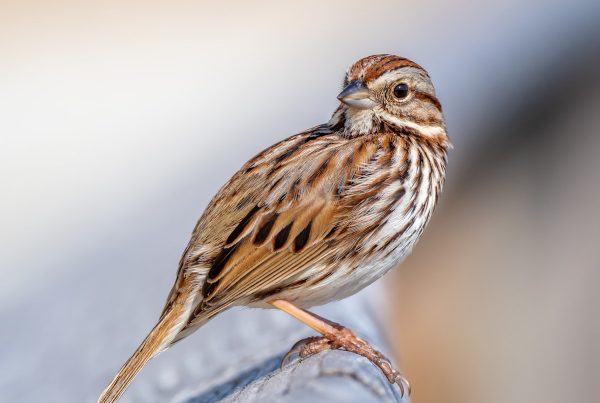
House Sparrows are small enough to fit through a 1.5-inch hole — they’re a separate problem, addressed through monitoring rather than hole size.
Do not use boxes with perches below the entrance hole. Perches help House Sparrows harass and evict bluebirds. Bluebirds don’t need them — they cling to the hole edge naturally.
Placement
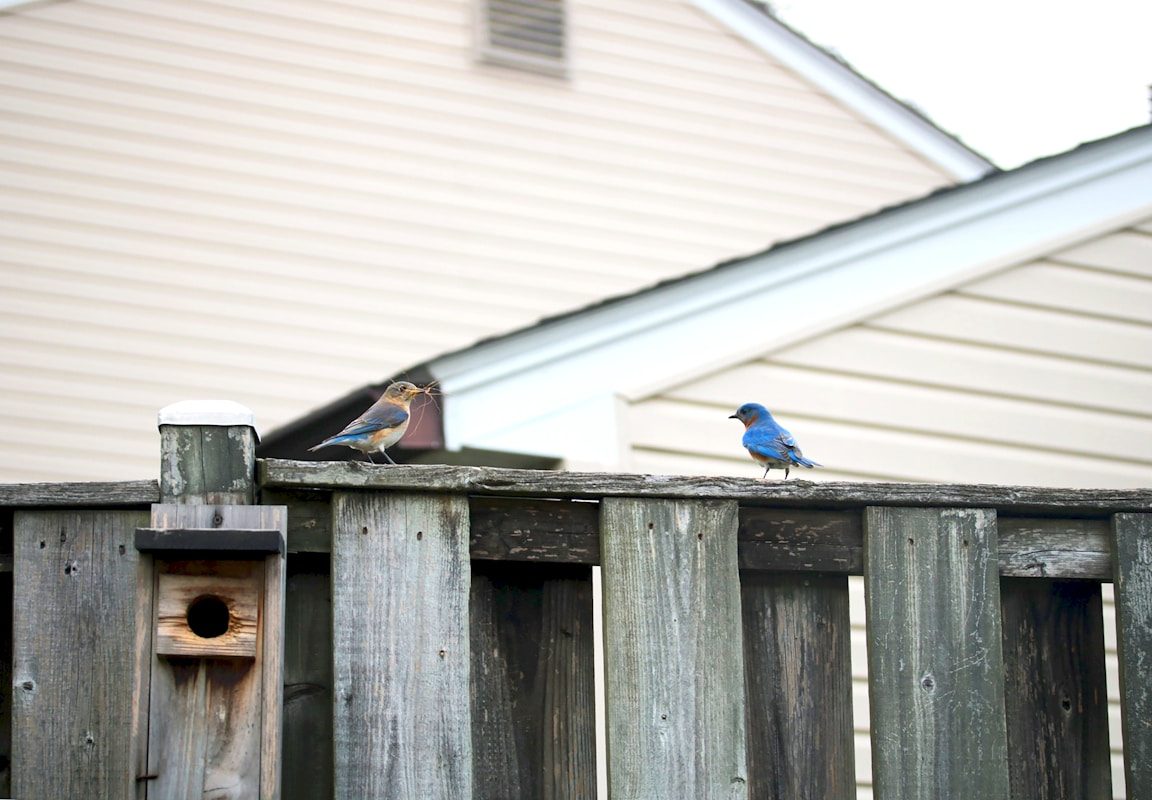
Bluebird Houses
Open habitat is essential. Bluebirds are birds of open areas — fields, meadows, golf courses, roadsides, suburban yards with open lawns. They need clear sightlines to the ground to spot insects from a perch.
Mount the box on a pole — not a tree. Tree-mounted boxes are accessible to predators and give House Sparrows advantages that pole-mounted boxes don’t. A metal pole with a predator baffle (a cone or cylinder that prevents climbing) is the setup that works.
Height: 4–6 feet off the ground. Higher isn’t better — it makes monitoring harder and doesn’t improve occupancy.
Face the entrance hole east or southeast if possible. This avoids the hottest afternoon sun and gives the bluebirds a warm morning interior, which they seem to prefer. It also tends to face away from prevailing weather in most of North America.
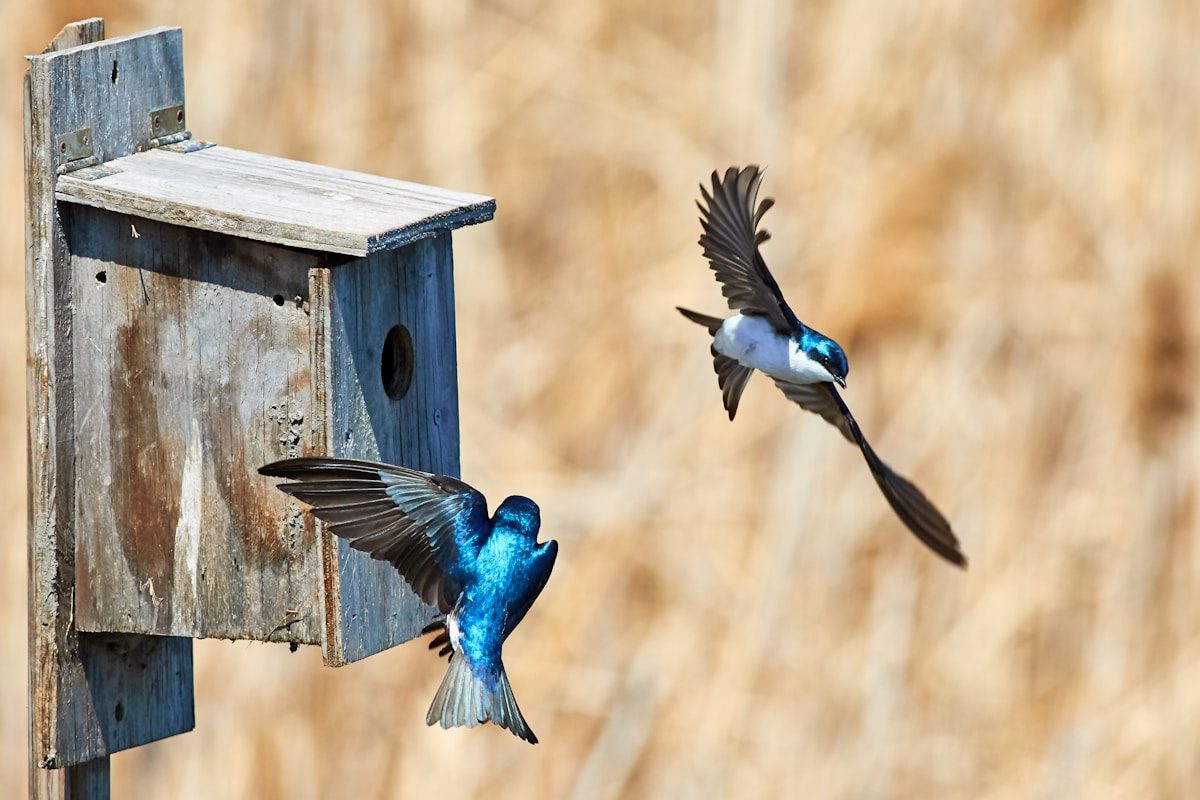
Keep at least 100 yards between boxes if you’re putting up multiple — bluebirds are territorial and won’t nest closer than that. If you want to pair boxes, the exception is placing two boxes 15–20 feet apart (a “bluebird trail pair”), which allows a bluebird to occupy one and a Tree Swallow to occupy the other — they tolerate each other at close range and the swallow helps deter House Sparrows.
Box Construction
Unpainted cedar or pine is the best material. It weathers naturally, insulates reasonably well, and doesn’t require paint that might off-gas in hot weather. If you paint, use a light exterior color only on the outside — never the interior.
The box should have:
- Drainage holes in the floor — a wet nest fails
- Ventilation gaps or holes near the top — overheating kills chicks
- A hinged or removable side panel for monitoring and cleaning
- Rough interior wood below the entrance hole — bluebirds grip the inside of the entrance when entering and leaving
Interior dimensions: roughly 4×4 inches floor, 8–10 inches deep from floor to bottom of entrance hole.
Monitoring: Why It Matters
A box without monitoring tends to become a House Sparrow box within one or two seasons.
Check weekly from late February through August. Open the box, look inside, note what you see. What you’re doing:
- Removing House Sparrow nests before eggs are laid — deterring them effectively requires consistent removal, not a one-time effort
- Watching for signs of bluebird activity — nest building, eggs, chicks
- Identifying problems early — parasites, predator damage, flooding
House Sparrow nests are messy and loosely built, often with feathers and trash woven in. Bluebird nests are neat cups of fine dry grass, sometimes with pine needles. Tree Swallow nests have white feathers woven in throughout. Knowing what each looks like lets you respond correctly.
Stop opening the box once chicks are 12 days old — disturbing them after this point can cause premature fledging.
When Bluebirds Use the Box
Early. Bluebirds start scouting nest sites in late February or early March in most of the US — well before most people think to put boxes up. Have yours up and open by February 15th in the South, by March 1st across most of the mid-Atlantic and Midwest.
They may raise two or three broods in a single season using the same box. After each brood fledges, clean out the old nest material. A fresh clean box improves the chances of a second clutch.
FAQ
What size hole does a bluebird house need?
1.5 inches exactly. This fits Eastern, Mountain, and Western Bluebirds while excluding European Starlings — the most important single dimension in bluebird nest box design.
Where should I put a bluebird house?
In open habitat on a metal pole with a predator baffle, 4–6 feet high, facing east or southeast, at least 100 yards from any other bluebird box.
Do I need to monitor a bluebird box?
Yes. Weekly monitoring to remove House Sparrow nests and check for bluebird activity is what makes the difference between a successful box and one that gets taken over.
When do bluebirds start using nest boxes?
Late February to early March in most of the US. Have boxes up by mid-February in the South, by March 1st in the mid-Atlantic and Midwest.
For more on attracting bluebirds, see our guides on female Eastern Bluebird identification and what colors attract birds to your yard.

MD Imdadul Haque is the founder of BirdzFly, a research-backed resource on North American backyard birds. Drawing on years of independent study into bird identification, behavior, and migration patterns, he writes in-depth guides designed to help US birders understand the species in their own backyards — from common feeder visitors to seasonal migrants passing through.