A male Scarlet Tanager in breeding plumage is arguably the most vivid red of any North American bird — more saturated than a cardinal, closer to the color of fresh blood than orange-red. And yet most people who live within the bird’s breeding range have never seen one, because it spends nearly all its time high in the forest canopy, rarely coming low enough to be noticed against the leaves.
Identification
Breeding male: Unmistakable if seen clearly — brilliant scarlet red body with jet-black wings and tail. No other North American songbird combines this exact color pattern. The contrast between the red body and black wings is total; there’s no blending or gradient.
Female and non-breeding male: Olive-yellow overall with darker olive-brown wings — completely different from the breeding male and easily mistaken for other olive songbirds like female orioles or vireos. After breeding season, males molt out of the scarlet plumage into a yellow-green pattern similar to females, retaining only the black wings as a distinguishing feature during the transition.
Size: 6.3–6.7 inches long, wingspan 9.8–11.4 inches. A medium-small songbird, similar in size to a large sparrow or small oriole.
Basic Facts
| Feature | Detail |
|---|---|
| Scientific name | Piranga olivacea |
| Family | Cardinalidae (cardinals, grosbeaks, and allies) |
| Length | 6.3–6.7 inches |
| Weight | 0.8–1.3 oz (23–38g) |
| Wingspan | 9.8–11.4 inches |
| Lifespan | Up to 10 years on record |
| Eggs per clutch | 2–5, pale blue-green with brown spots |
| Incubation | 12–14 days |
| Conservation status | Least concern, though declining due to forest fragmentation |
Why It’s So Rarely Seen Despite the Color
The vivid red plumage should make this bird easy to spot, but three factors work against it:
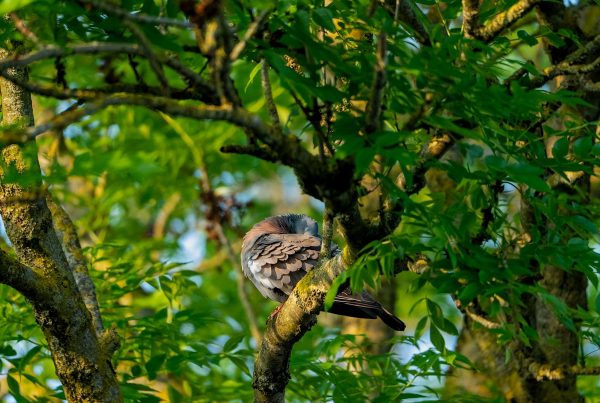
- Canopy habitat — Scarlet Tanagers spend the overwhelming majority of their time in the upper forest canopy, 30-60+ feet up, well above where most people naturally look while walking through woods.
- Camouflage against foliage — Counterintuitively, bright red can actually blend into dappled forest light and shadow more effectively than expected, especially when the bird is motionless.
- Quiet, deliberate movement — Unlike many songbirds, Scarlet Tanagers move slowly and deliberately through foliage while foraging, without the constant flitting that draws the eye to smaller, duller birds.
The result is a bird that experienced birders specifically seek out by sound rather than sight — learning the song and scanning the canopy when it’s heard is a far more effective strategy than hoping to spot the color against green leaves.
The Song: “A Robin With a Sore Throat”
The Scarlet Tanager’s song is frequently described by birders using a specific comparison: it sounds like an American Robin’s song, but hoarser and more burry — “a robin with a sore throat” is the standard description used in field guides and birding communities. The phrasing helps because the song structure is genuinely similar to a robin’s — a series of short phrases — but the raspier tone quality separates it once you’ve heard both side by side.
The call note is also distinctive: a sharp, dry “chip-burr” or “chick-brrr,” quite different from the song and often the first clue that a tanager is present nearby.
Diet
Scarlet Tanagers are primarily insectivorous, gleaning insects from foliage in the canopy — caterpillars, beetles, moths, and other invertebrates make up the bulk of the diet during breeding season. They are notably effective at eating gypsy moth caterpillars and other forest pest species, giving them real ecological value in forest health.
In late summer and during migration, the diet shifts to include more fruit — wild cherries, blackberries, mulberries, and other soft fruits become important as insect availability changes and the birds build fat reserves for migration.
Migration
Scarlet Tanagers are long-distance migrants, wintering in the forests of Colombia, Venezuela, Ecuador, Peru, and Bolivia in South America — one of the longer migration routes among eastern North American songbirds. Spring arrival in the breeding range typically occurs in late April to early May, with the birds arriving already in full breeding plumage.
Migration happens primarily at night, like most songbirds, with tanagers sometimes appearing at lower levels — even at ground level in parks and yards — during migration stopovers when they need to rest and refuel, offering a rare chance to see one at close range outside the breeding season canopy habitat.
Habitat and Conservation
Scarlet Tanagers require large, contiguous tracts of mature deciduous forest for breeding — they are considered an “area-sensitive” species, meaning they generally avoid small forest fragments even if the habitat quality within the fragment looks suitable. This makes them a useful indicator species for forest health and connectivity.
Population trends show gradual decline linked to forest fragmentation across the breeding range, along with increased nest predation and cowbird brood parasitism in fragmented forest edges compared to unbroken forest interior.
How to Actually See One
The best strategy: learn the song first, then look up when you hear it. Scarlet Tanagers are most detectable in late spring (May) during the height of singing activity, in mature deciduous forest with a closed canopy. Scanning the mid-to-upper canopy of large oaks and other mature trees, particularly where sunlight creates gaps in the foliage, gives the best chance of a visual on a bird that otherwise stays frustratingly out of sight.
During migration, checking parks and wooded areas at dawn — especially after a night of favorable migration weather — can produce lower, more accessible sightings than the breeding season canopy habitat allows.
FAQ: Scarlet Tanager
Why don’t I ever see Scarlet Tanagers even though they’re supposed to be common?
They spend nearly all their time in the upper forest canopy, well above typical sightlines, and move quietly rather than flitting conspicuously. Most sightings come from birders specifically scanning the canopy after hearing the song.
What does a Scarlet Tanager sound like?
Often described as “a robin with a sore throat” — similar phrasing to a robin’s song but with a hoarser, burrier tone quality.
Why does the male turn yellow-green after breeding season?
Scarlet Tanagers molt out of the vivid red breeding plumage into a duller yellow-green pattern similar to females before migrating south — a common pattern among tanagers and several other songbird families.
Where do Scarlet Tanagers spend the winter?
The forests of northwestern South America — Colombia, Venezuela, Ecuador, Peru, and Bolivia — one of the longer migration routes of any eastern North American songbird.
For more on brightly colored songbirds, see our guides on Northern Cardinal and Indigo Bunting.

MD Imdadul Haque is the founder of BirdzFly, a research-backed resource on North American backyard birds. Drawing on years of independent study into bird identification, behavior, and migration patterns, he writes in-depth guides designed to help US birders understand the species in their own backyards — from common feeder visitors to seasonal migrants passing through.