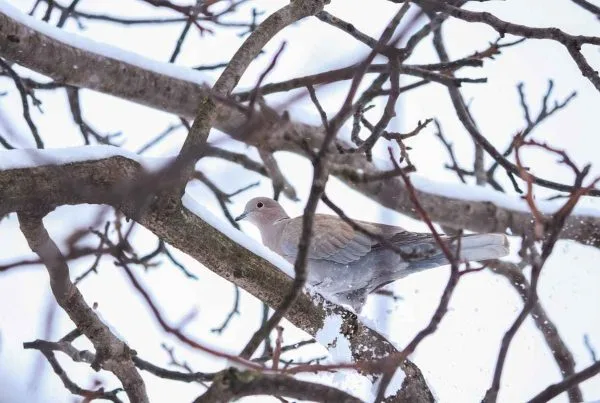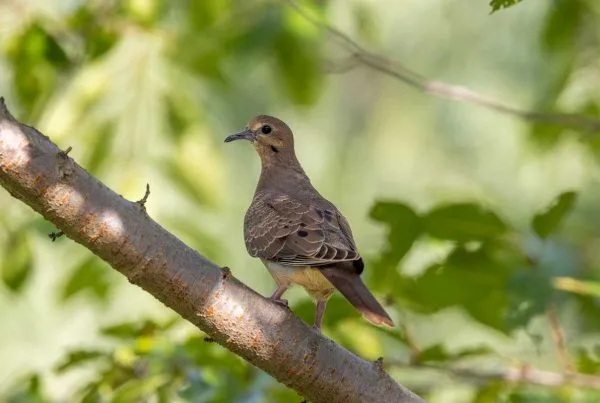

In August, Mourning Doves seem to be everywhere — slender gray-brown bodies on telephone wires, in backyards, fields, and along overgrown roadsides. By late September, flocks of 10 to 20 birds take flight southward, their underside feathers catching the faded gold of late-summer sunlight. When the flocks start moving, fall is on the way.
Identification and Biology
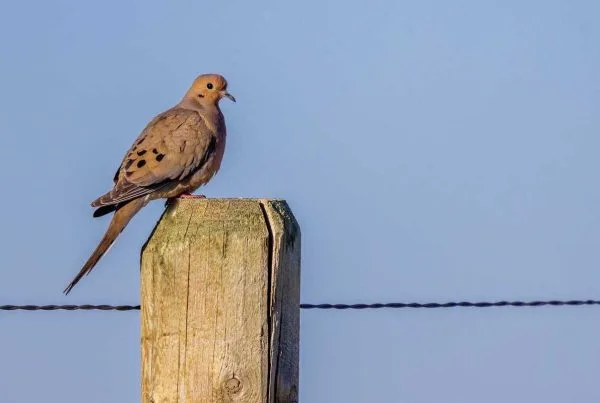
The Mourning Dove (Zenaida macroura) is a member of the pigeon and dove family (Columbidae) and is one of the most widespread and abundant birds in North America. An adult weighs 100–140 grams and measures 25–33 centimeters from beak to tail — smaller and more streamlined than a city pigeon, with long pointed tails and tapered wings spanning 17–19 inches.
They have long necks, small heads, and thin black beaks. The back, rump, and central tail feathers are grayish-brown; the outer tail feathers are bluish-gray with black bands and white tips that flash visibly in flight. Young birds are mottled tan and brown. Adult females are olive to brown overall. Adult males show a soft pink wash on the chest, slate-gray crown and nape, an olive back, and often iridescent patches on the neck. Both sexes typically have a small black spot below the cheek.
The Call
The species gets half its name from its distinctive call — a hollow, mournful “coo-OO-oo-oo-oo,” often heard as just the final three notes depending on distance. Males use it to attract mates, to bond with a partner after mating, and to warn off rival males. Females sometimes respond with a much weaker, often inaudible coo. The whistling sound made by their wings in flight is another distinctive identifier.
Diet
Mourning Doves are almost entirely seed-eaters — weed seeds and waste grain make up roughly 98% of their diet, plus occasional insects, snails, and slugs. They feed by pecking seed directly off the ground rather than clinging to plant stalks. Favorite wild foods include croton, foxtail, knotweed, ragweed, and various grass and sedge seeds, along with waste corn, wheat, oats, barley, rye, and buckwheat left behind by farm equipment.
At feeders, they readily take a wide variety of seed. Because their crop can hold an enormous quantity of small seed at once — sometimes thousands of individual seeds — a single feeding session can sustain them for hours. Like many seed-eating birds, they also ingest small grit (sand, fine gravel) to help grind food in the digestive tract, which is why doves are often seen along roadsides picking at sand. They need water daily and typically visit streams, ponds, or other water sources at dawn and dusk.
Nesting
Mourning Doves return to breeding range in early spring — small flocks arriving in early March across much of the eastern US, with most arriving by mid-March to April. Some individuals overwinter in the same areas if conditions aren’t severe, a pattern that appears to be increasing, likely tied to greater food availability from human activity.
Males select and defend a nest site, calling to attract a female and performing a looping courtship flight. Once paired, the birds build a simple stick nest over 4–6 days — sometimes reusing an old robin, mockingbird, or grackle nest as a base. Nests are typically 10–25 feet up in coniferous branch forks, though doves will also nest in shrubs, vines, on the ground, or increasingly on man-made structures like porches and decks.
The female lays the first egg 2–3 days after the nest is finished, with a second egg following two days later (a third is rare). Eggs are white, unmarked, and oval. Both parents share incubation — the male during the day, the female at night — for 14–15 days. Hatchlings are blind and naked, fed initially on “pigeon milk,” a nutrient-rich secretion regurgitated by both parents, before transitioning to seeds. Chicks leave the nest around 14 days old.
The full nesting cycle — from egg-laying through independence — takes just over a month, and pairs may attempt up to five nests in a single season, which typically runs March through August (sometimes as early as late February or as late as early October). On average, about half of eggs laid result in a chick that leaves the nest successfully, yielding roughly 4–6 surviving young per pair per season.
Survival and Mortality
Mourning Doves face heavy losses, especially in their first year. Storms with strong wind can knock nests, eggs, and chicks out of trees; heavy rain and hail kill both chicks and adults. Common nest predators include Blue Jays, European Starlings, crows, squirrels, snakes, and house cats, while hawks and owls take adult birds. Roughly 70–80% of newly hatched doves do not survive their first year — meaning of 100 chicks hatched in a given summer, only about 20–30 typically survive to the next. Mortality slows somewhat after the first year, with adult annual mortality around 60%.
Migration
Migration ramps up from mid-September through early October, with flocks of 20 or more birds traveling together. A typical migration day follows a clear rhythm: morning flight, midday rest and feeding, afternoon flight, evening feeding, then rest overnight. As a migratory bird, the Mourning Dove is subject to federal regulation, with individual states setting hunting seasons and quotas within a framework set by the U.S. Fish and Wildlife Service.
FAQ: Mourning Dove
Why is it called a “mourning” dove?
For its call — a soft, drawn-out “coo-OO-oo-oo-oo” that sounds mournful or sorrowful to human ears.
What do Mourning Doves eat?
Almost entirely seeds — weed seeds and waste grain make up about 98% of their diet, supplemented by occasional insects and small grit for digestion.
How many broods do Mourning Doves raise per year?
Pairs can attempt up to five nests in a single breeding season, which generally runs from March through August.
For more on Mourning Doves, see our guides on what their nests look like and where they go in winter.

MD Imdadul Haque is the founder of BirdzFly, a research-backed resource on North American backyard birds. Drawing on years of independent study into bird identification, behavior, and migration patterns, he writes in-depth guides designed to help US birders understand the species in their own backyards — from common feeder visitors to seasonal migrants passing through.