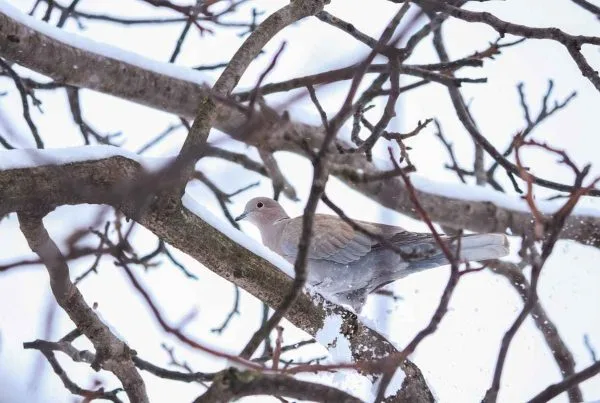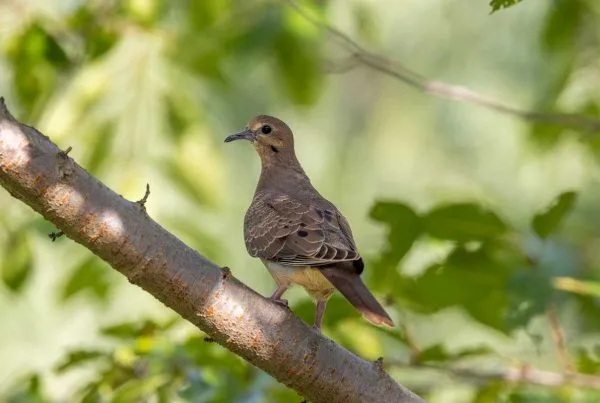

Mourning Dove Nesting Habits

Mourning Dove Nests
Most birds spend several days, or even up to two weeks, getting their home right. A pair of mourning doves builds a flimsy nest from scattered twigs. The construction crew may finish the work in a single morning or spread it out over a couple of days. The male is prone to interrupting the work to pursue the female. Pine needles, twigs, and grass make up a flimsy mourning dove nest.
Mourning dove nests are a well-known dorky thing. If you have ever come across one that was like “no way, this can’t hold any eggs,” you’re in the company of a lot of people — but they somehow do their job. An overview of the mourning dove nesting process is one way to understand a North American backyard bird so common it could be mistaken for not living anywhere else.
What the Nest Looks Like
A mourning dove nest will look like a loose, flat-platform of sticks, pine needles and maybe grasses — so thin that the eggs are in full view from underneath for most nests. It is almost the most unfinished nest, compared to the carefully constructed, cup-shaped nests of robins or the elegant woven pouches of orioles. Construction can be finished by a pair in one morning, however the work occasionally takes two or more days.
It gathers materials and offers them up to the female, who assembles them. This gives you a platform that is about 6 to 8 inches in depth. You are not lined with flannel, or mud reinforced or woven by soldiers. The centre containing a layer of eggs in a shallow depression.
It is a structural tactic (which appears to be shreddable) that somehow succeeds from time to time. The nest is made to be sacrificial — mourning doves breed many times a season, and building fast means they can afford for the nest to fall apart.
Where do mourning doves nest?
Suggest providing ideal nesting sites. Different bird species choose distinct settings for their nests.
“Doves often build on top of a horizontal fork in a tree.”
These birds also often choose protected spots on the ledges of houses for their twiggy nests. Mourning doves do not use nest boxes.
How Long Until Mourning Dove Eggs Hatch?
“A mourning dove built a nest near my front door. How long until the eggs hatch?” asks reader Aspasia Simeone of Long Beach, New York.
Kenn and Kimberly say, “After the pair builds the nest, which takes two to four days, the female usually lays the first egg within a couple of days.”” The second egg is laid a day or two later.” Both parents will take turns incubating the two eggs. The eggs hatch after 14 days. Parents nourish their offspring, and fledging occurs within a fortnight.”

Mourning Doves Sitting in Winter
Why do mourning doves build nests so early in spring?
A Birdzfly reader from Manahawkin, New Jersey, asked why these birds nest so early.
Kenn and Kimberly remark, “That’s a keen insight: they start nesting seasons beforehand. Even in the north, they may start their first nest as early as March. In southern states, doves may begin in February or even January. A pair of mourning doves makes repeated nesting attempts each year. They sometimes raise five broods between March and October. They produce a clutch of two eggs in a standard brood.”
Why the hurry? Kenn and Kimberly explain, “Mourning dove nests are so flimsy that the eggs or baby birds sometimes fall out.” So, the doves may instinctively try over and over. They raise enough young to keep the species going.”
What Time Of Year Do Mourning Doves Nest?
Mourning doves are flexible nesters. They will take advantage of horizontal fork in a broadleaf tree, a conifer branch, ledge on a building, window box, abandoned nest built by another species, thick shrubs or even the ground when there is low predator pressure. They don’t use nest boxes.
Heights vary widely. You can see a nest at 5 feet up in a young tree or 30 feet up to the top of another pine. They like places that have cover overhead but open coming in — places they can see threats from.
In rural, suburban, and urban areas mourning doves often nest on ledges of homes or in hanging planters, as well as on beams under porches or carports. They are especially uninterested in alerting you to your proximity and show fairly low fear levels of human activity when they have an occupied nest.
The Eggs
The mourning dove almost always lays precisely two eggs—seldom one, virtually never three. The eggs display no markings, the entire egg being simply plain white. The size is approximately an inch long, oval. If you see a nest with two small white eggs within the base of a loose twig platform, in a tree or on a ledge, there is an excellent chance it is sitting atop mourning dove.
Both parents incubate the eggs. Males usually have the daytime shift (about 8am to 5pm); females return to spin the night through. This division of labor is so consistent that if you observe someone nest for two or three days, you’ll see handoff pattern.
In fact, the incubation period lasts 12 to 14 days from the laying of the second egg. A day or two after the nest is finished, the first egg is laid; about 24 hours later it lays a second. The eggs hatch within one day of each other.
What Happens After Hatching?
The altricial chicks, or squabs here, are helpless on emergence with fairly sparse yellowish down and closed eyes For the first few days, both parents provide them with crop milk, a high-protein secretion from the parent birds’ crops. Squabs, unlike the insects most baby birds are fed, eat only this until they develop the ability to handle seeds.
Around 12 – 15 days, the squabs will get us enough feathers to “leave” the nest but are still not able to fly properly. They remain for a few more days on or near the ground, dependent upon the parents. This juvenile stage is when people most commonly find “abandoned” mourning dove chicks — they’re not abandoned, just going through the normal in-between phase.
How Many Broods Per Year?
Mourning doves are prolific breeders. In warmer regions there are five or six nesting cycles in a single season, but two to three is the more typical number over much of their range. Breeding ranges from March through October in much of the US.
Since they nest so regularly, a pair might reuse an older nest or build a new one close to an old one. Once you’ve had mourning doves nest in your yard, they frequently return to the same or nearby location the following year.
What To Do If You Find A Nest
Leave it alone. Mourning doves are covered under the Migratory Bird Treaty Act and it is illegal to disturb an active nest. If the nest is located somewhere less than ideal — in a hanging planter that must be watered, for instance — keep disturbance to a minimum during the incubation period (approximately two weeks) and again during the nestling period (another two weeks). You can either move or take the nesting structure down once all of the youngbirds have departed.
It’s OK to put eggs or chicks that have been blown out of the nest back in gently: Many birds, including mourning doves, won’t abandon their young if humans touch them (it’s a myth that they will).
Why the Nest looks too weak
The low twig form always baffles people. However, mourning doves have been employing this technique with great success for millenia. The shallow depression at the center is naturally where the eggs and chicks settle, and both parents are diligent sitters. Chick blocking due to structural collapse is not as common as you might think. The larger threats are predation (crows, jays, raccoons, outdoor cats) and inclement weather.
Building a weaker nest takes less time — which allows the birds to breed more often in one season. If you are a species that loses 80% of its nests to predation, then quantity is an appropriate tactic.

MD Imdadul Haque is the founder of BirdzFly, a research-backed resource on North American backyard birds. Drawing on years of independent study into bird identification, behavior, and migration patterns, he writes in-depth guides designed to help US birders understand the species in their own backyards — from common feeder visitors to seasonal migrants passing through.