Baby Robins
Robin eggs take about 13 days to hatch. The chicks that emerge are essentially helpless — eyes sealed shut, sparse gray down, heads too heavy to hold up for more than a second or two. They weigh about 5.5 grams.
Thirteen days later, most of them leave the nest and never return to it.
What happens in between is worth knowing, partly because it’s fast, and partly because many people find a nest and don’t know what they’re looking at or whether to intervene.
Hatching
Robin eggs hatch after 12–14 days of incubation. The chick uses a small egg tooth on the tip of its bill to pip — crack through the shell. This takes several hours to a full day. The female removes the empty shell halves from the nest and drops them away from the nest site, which keeps the nest clean and reduces the visual cue for predators.
In a clutch of four eggs, hatching usually spans 1–2 days — the eggs were laid over several days and incubation started before all were laid, so hatching isn’t perfectly synchronized.
Days 1–4: Hatchlings
The chicks hatch with eyes closed and sparse gray down on the head and back. The skin is pink and visible. They can barely lift their heads but will gape — open the mouth wide — in response to the nest vibrating when the parent lands.
Both parents feed the chicks from the first day. Earthworms are the main food, delivered in pieces. The female broods the chicks — sits over them to keep them warm — for most of the day and night during this first week.
The parents also remove fecal sacs from the nest. Chick droppings come in a neat membrane that adults carry away and drop at a distance. The nest stays clean. If you’re watching a nest and see an adult fly away with something white, that’s what’s happening.
Days 5–9: Eyes Open, Feathers Emerging
Eyes begin to open around day 5. Pin feathers push through the skin on the wings and back — the chick starts to look less naked. The gaping response becomes more active, and the chicks are more aware of their surroundings.
Feeding frequency increases as the chicks grow. Both parents are now foraging constantly — earthworms, insects, berries — and returning to the nest every few minutes during daylight hours. Each chick needs roughly its own weight in food every day during peak growth.
Days 10–13: Feathers Unfurling
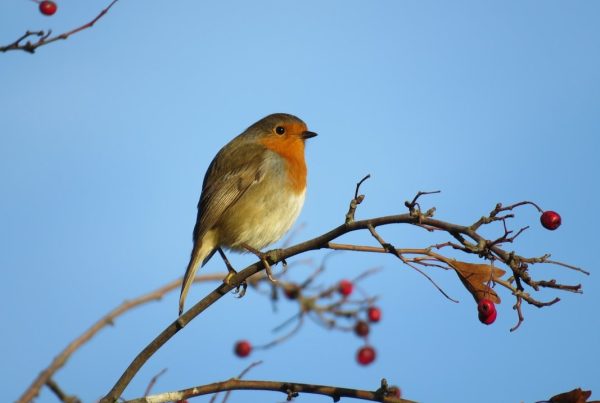
The pin feathers open and the chick starts to look like a bird. The orange-red breast color begins to show through the streaking — baby robins have spotted breasts rather than the solid orange-red of adults, which helps identify them as juveniles after they leave the nest.
By day 10–12, the chicks are moving around the nest actively, sometimes climbing up to the rim. They exercise their wings by flapping while perched on the nest edge. The nest, which was adequate for four eggs, is getting crowded with four rapidly growing chicks.
Days 13–16: Fledgling
Robin chicks typically leave the nest at 13–15 days old — before they can fly well, but capable of short hops and glides. This is intentional. Leaving the nest early reduces the risk of a single predation event killing all four chicks at once. Once they’re spread out, they’re harder to find.
The fledglings spend 2–3 weeks on the ground and in low vegetation, hopping around and calling. The spotted breast is visible and distinctive — if you see a robin-shaped bird with a spotted chest, it’s a juvenile.
The parents continue feeding them during this period. The female often begins building a new nest for the next clutch while the male takes over primary feeding of the fledglings from the first brood.
What to Do If You Find a Baby Robin

Baby Robins
The answer depends on age and condition.
Hatchling or nestling (no feathers, or pin feathers only): It has fallen from the nest. Find the nest above and return the chick to it if you can reach it safely. The parents will continue to care for it. The “human smell” rejection is a myth — birds have a limited sense of smell and parental behavior is not disrupted by brief human handling.
Fledgling (feathered, hopping on ground): This is normal. The bird is not lost or injured — it’s exactly where it should be at this stage of development. Leave it alone. Watch from a distance and you’ll likely see a parent feeding it. Move it only if it’s in immediate danger (a road, a cat watching it) and only to nearby cover — don’t relocate it far from where you found it.
Injured bird: If the bird is obviously injured — unable to hop, laying on its side, unresponsive — contact a licensed wildlife rehabilitator. Don’t attempt to feed it.
Growth Summary
| Age | Stage | Key Developments |
|---|---|---|
| Day 0 | Hatchling | Eyes closed, bare skin, ~5.5g |
| Days 5–7 | Nestling | Eyes opening, pin feathers emerging |
| Days 10–12 | Late nestling | Feathers unfurling, spotted breast visible |
| Days 13–15 | Fledgling | Leaves nest, hopping on ground |
| Days 16–28 | Juvenile | Learning to fly, parents still feeding |
FAQ
How long until baby robins leave the nest?
About 13–15 days after hatching. They leave before they can fly well — this is normal and intentional behavior.
What do baby robins look like?
Hatchlings are nearly naked with sparse gray down and closed eyes. By fledging, they’re fully feathered with spotted orange-red chests — the spotted breast distinguishes juveniles from adults.
Do both robin parents feed the chicks?
Yes. Both parents feed from hatching through the fledgling period. The male often takes over when the female starts the next clutch.
Should I help a baby robin on the ground?
Only if it’s visibly injured. A feathered robin hopping on the ground is a normal fledgling and doesn’t need assistance. A naked or pin-feathered chick has fallen from the nest and should be returned to it if possible.
For more on robins, see our guides on robin nests and robin symbolism.

MD Imdadul Haque is the founder of BirdzFly, a research-backed resource on North American backyard birds. Drawing on years of independent study into bird identification, behavior, and migration patterns, he writes in-depth guides designed to help US birders understand the species in their own backyards — from common feeder visitors to seasonal migrants passing through.