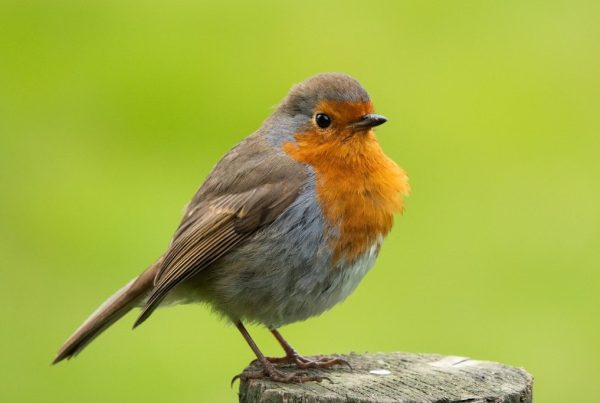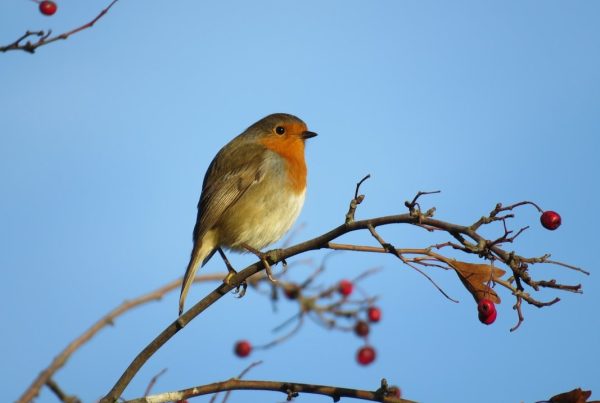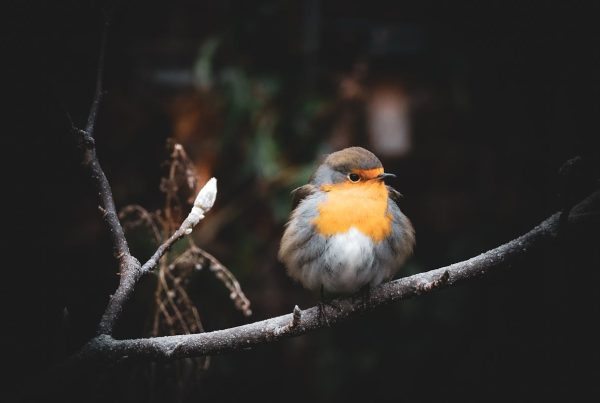
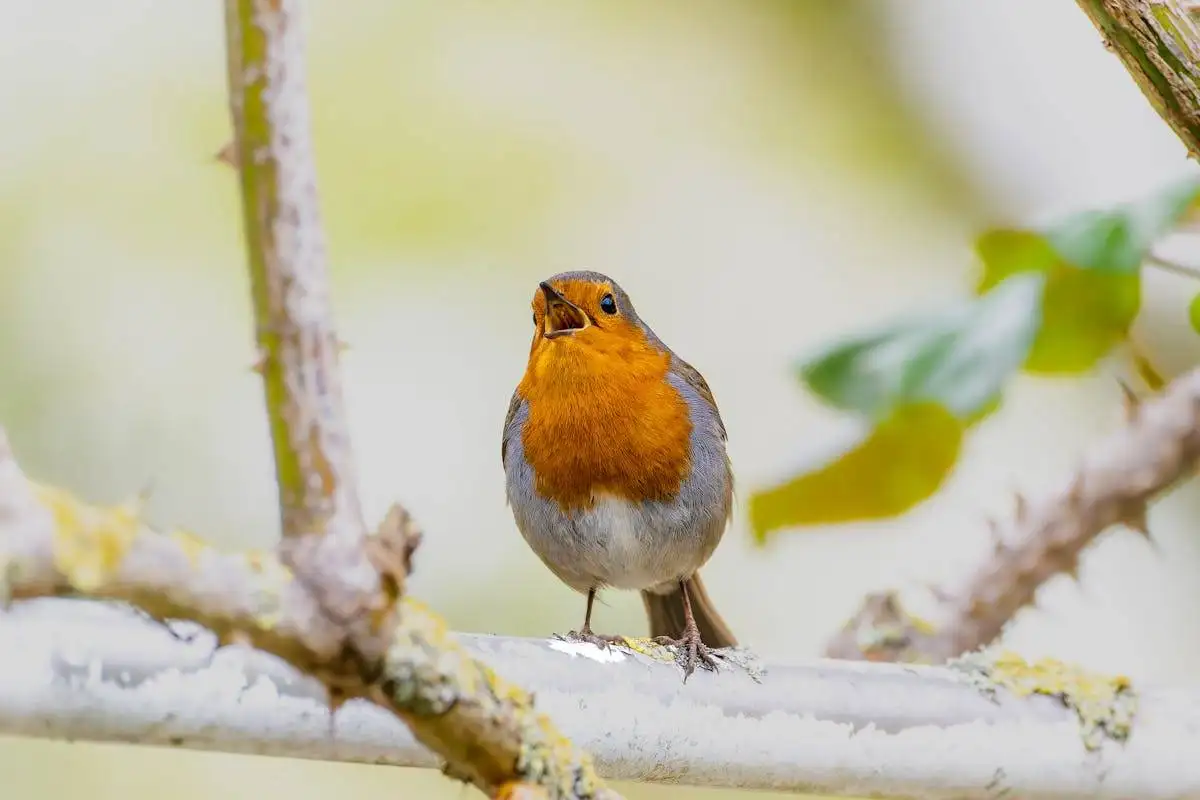
The American Robin starts singing before any other bird in the morning — often 40 minutes before sunrise, while it is still dark enough that you need a flashlight to walk outside. This is not an accident. The robin’s early start is one of the most studied behaviors in songbird biology, and the science behind it is more interesting than it first appears.
What Does a Robin Sound Like?
The robin’s song is a rolling series of short phrases, delivered continuously with brief pauses between phrases. The phrases have a clear, flute-like quality — rich and melodious rather than sharp or buzzy. Birders often describe the pattern as: cheerily, cheer up, cheer up, cheerily, cheer up — a helpful mnemonic even if it’s an approximation.
Each phrase lasts about a second. The robin pauses for roughly half a second, then delivers the next phrase. A singing male can keep this up for 20–30 minutes without stopping, which is part of why the morning robin chorus is so noticeable — it’s not a few calls, it’s an extended performance.
Beyond the main song, robins make several other sounds:
- Alarm call — A sharp, rising “tseep” given when a predator is spotted. Often the first sound you hear when a hawk enters the yard.
- Chuckle call — A rapid “tut-tut-tut-tut” series, lower and more rapid than the alarm. Used in mild disturbance situations — a cat nearby, a person approaching the nest.
- Flight call — A thin, high “see” note given during migration, mostly at night. One of the sounds radar ornithologists use to track nocturnal migration.
- Nestling begging call — A loud, insistent “cheep” from chicks in the nest demanding food. Audible from several feet away and surprisingly loud for such small birds.
Why Robins Sing Before Sunrise
The robin is consistently the first bird to begin singing in the dawn chorus across most of North America. The reason comes down to light sensitivity.
Naturalist Aldo Leopold documented in the 1930s that a robin will begin singing at a light level of approximately 0.01 footcandles — roughly the brightness of a crescent moon reflected on snow. This is an order of magnitude dimmer than the threshold for most other songbirds. In practical terms, robins start singing in what most humans would call complete darkness.
Why this extreme light sensitivity evolved is still debated. Current thinking involves several factors:
Territory advertisement at low competition cost. At 4 AM, there are no other birds singing and no foraging to do — it’s too dark to spot earthworms on the ground. Singing at this hour is essentially free advertising. The male establishes his presence and quality without competing against the noise of 20 other species.
Female assessment. Research suggests females pay close attention to the early dawn chorus when evaluating males. The first male singing, the one singing longest, and the one with the most varied phrase repertoire all signal condition and experience. Beginning early is a competitive advantage.
Light pollution amplification. Urban and suburban robins begin singing even earlier than their rural counterparts because streetlights and ambient light pollution trigger their light-sensitivity threshold hours before natural dawn. A robin near a well-lit parking lot may begin singing at 2 or 3 AM. This is one of the best-documented behavioral effects of artificial light on urban wildlife.
When Robins Sing: Seasonal Patterns
Robins sing most intensively in spring — from the first territorial establishment in late February through the end of breeding season in July. The pattern through the year:
| Period | Singing Behavior |
|---|---|
| Late February–March | Males arrive on territory, begin intense dawn singing to establish boundaries |
| April–May | Peak song intensity — breeding season, maximum territorial competition |
| June–July | Song continues but decreases as nesting activity stabilizes |
| August | Song largely stops as adults begin pre-migration molt |
| September–January | Almost no song — occasional soft singing near winter roosts |
The silence of late summer is one reason people think robins have left. The birds are often still present — they’ve just stopped singing, and silent robins in berry-producing shrubs are much harder to notice than singing males on lawn-edge perches.
Male vs Female Robin Song
Only male robins sing the full territorial song. Females are largely silent, producing only calls — the alarm “tseep” and chuckle notes — rather than extended songs. This is typical of temperate-zone songbirds where only males hold and advertise territories.
One useful field trick: if you see a robin singing from a prominent exposed perch with its bill pointed upward and throat visibly moving, it is a male. Females rarely adopt this posture.
The Dawn Chorus: How Robins Fit In
The dawn chorus — the layered singing of multiple species beginning before sunrise — follows a consistent sequence across North America. Robins reliably go first. The sequence generally follows light sensitivity thresholds, with the most light-sensitive species singing earliest:
- American Robin — begins at near-total darkness
- Wood Thrush and other thrushes — just before nautical twilight
- Song Sparrow, Carolina Wren — as light begins to appear
- Most other songbirds — at civil twilight and after
On a still spring morning, the robin’s voice is genuinely striking at 4:30 AM when everything else is silent. It’s one of those natural events that rewards waking up for.
Where to Hear Robin Song
The best free resource for hearing the American Robin’s calls and song is the Cornell Lab of Ornithology’s All About Birds website — allaboutbirds.org — which has recorded examples of every call type. The Merlin Bird ID app (free, from Cornell Lab) also includes audio identification and will confirm an ID based on recordings made on your phone.
FAQ: Robin Song and Sounds
What does a robin song sound like?
A rolling series of flute-like phrases — rich, melodious, and continuous. Often described as “cheerily, cheer up, cheer up, cheerily.” One of the most recognized bird songs in North America.
Why do robins sing before sunrise?
Robins have an extremely sensitive light threshold — they begin singing at light levels 10 times dimmer than most other songbirds. This allows them to start territorial advertisement before competitors can. Urban robins near streetlights may begin as early as 2–3 AM.
Why do robins sing at night?
Usually because of light pollution. Artificial light triggers the robin’s dawn response at any hour. A robin near a well-lit area may sing through the night. See our full guide on why birds sing at night.
When do robins stop singing?
Song intensity drops sharply in August as breeding ends and molt begins. Most robins are essentially silent from August through January, resuming in late February when males return to breeding territories.
For more on bird symbolism, see our guides on hawk spiritual meaning, cardinal visit meaning, mourning dove symbolism, blue jay spiritual meaning, and what it means when a bird hits your window.

MD Imdadul Haque is the founder of BirdzFly, a research-backed resource on North American backyard birds. Drawing on years of independent study into bird identification, behavior, and migration patterns, he writes in-depth guides designed to help US birders understand the species in their own backyards — from common feeder visitors to seasonal migrants passing through.