
Hummingbirds are genuinely unusual animals. Not just fast or colorful — they operate at physiological extremes that make them unlike almost anything else in the vertebrate world. Here are 25 facts worth knowing.
Size and Weight
1. The smallest hummingbird is the Bee Hummingbird of Cuba — 2.2 inches long and weighing 0.06 ounces. It is the smallest bird and the smallest warm-blooded animal on Earth.
2. The largest North American hummingbird is the Giant Hummingbird of South America — about 8 inches long. Most North American species fall between 3 and 5 inches.
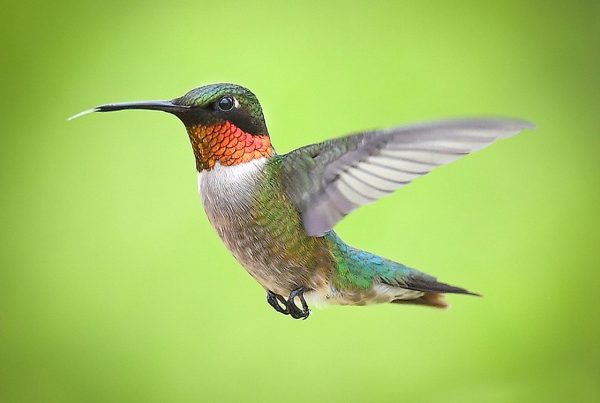
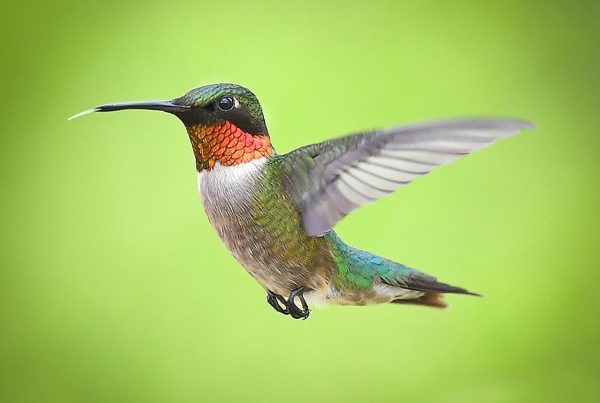
3. A Ruby-throated Hummingbird weighs about 3–4 grams — roughly the weight of a penny.
Flight
4. Ruby-throated Hummingbirds beat their wings about 53 times per second during normal flight. During high-speed courtship dives, some species exceed 80 beats per second.
5. Hummingbirds are the only birds that can fly backwards — and sideways, straight up, and straight down. The figure-8 wing stroke allows thrust in any direction.
6. They can reach 60 mph during courtship dive displays. Normal travel flight is closer to 20–30 mph.
7. In courtship dives, male hummingbirds experience G-forces of 9–10 G — more than fighter pilots typically experience in combat maneuvers.
8. Hummingbirds can hover indefinitely because they generate lift on both the upstroke and downstroke of their wing cycle — unlike virtually every other bird, which generates lift primarily on the downstroke.
Metabolism and Energy
9. Hummingbirds have the highest metabolic rate of any warm-blooded animal relative to body size. Their hearts beat up to 1,260 times per minute in flight.
10. They eat roughly half their body weight in food every day — primarily nectar for energy and insects for protein.
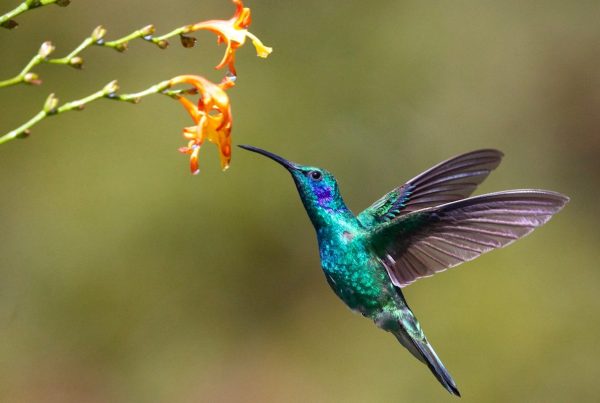
11. A hummingbird visits 1,000–2,000 flowers per day. Each visit takes only a few seconds.
12. They enter torpor every night — a state where heart rate drops from 1,200 to around 50 beats per minute and body temperature falls near ambient. A hummingbird in torpor uses roughly 50 times less energy than one in flight. Without torpor, they would not survive a cold night.
13. Before migrating south, hummingbirds nearly double their body weight in 1–2 weeks of intensive feeding, building fat reserves to fuel the migration flight.
The Tongue
14. A hummingbird’s tongue is longer than its bill. It wraps around the back of the skull when fully retracted, coiling behind the eye.
15. The tongue doesn’t suck nectar like a straw — it traps nectar through an elastic shape-change mechanism. The forked tip flattens as it enters nectar, then springs back to its round shape, actively pulling liquid in. The tongue moves at 15–20 cycles per second.
Migration
16. Ruby-throated Hummingbirds cross the Gulf of Mexico nonstop. Up to 500 miles of open water, with no food and no rest. The crossing takes 18–24 hours.
17. The Rufous Hummingbird makes the longest migration relative to body size of any North American bird — roughly 3,900 miles one way from Alaska to western Mexico.
18. Hummingbirds migrate alone, not in flocks. Each bird navigates independently, following an innate directional sense on the first migration and learned landmarks on subsequent ones.
19. Individual hummingbirds return to the same feeder in the same week in subsequent years — navigating to within a few hundred meters of a specific point after thousands of miles of travel.
Reproduction
20. Hummingbirds do not mate for life. Males mate with multiple females in a season and provide zero parental care. The female builds the nest, incubates the eggs, and raises the young entirely alone.
21. A hummingbird nest is about the size of a large thimble. Built from plant down and spider silk, it expands as the chicks grow. The eggs are roughly the size of a coffee bean.
22. Hummingbird chicks go from blind, featherless hatchlings to first flight in about 21 days.
Vision and Senses
23. Hummingbirds can see ultraviolet light — they perceive wavelengths invisible to humans. Many flowers have UV patterns that guide hummingbirds directly to nectar.
24. The color red is not innate to hummingbirds — it is learned. Hummingbirds are attracted to any color that has previously rewarded them with nectar. Red is associated with high-nectar flowers in their environment, which is why they investigate red feeders, but it’s experience rather than hardwired preference.
Lifespan
25. Most hummingbirds live 3–5 years in the wild. The oldest documented wild hummingbird was a Broad-tailed Hummingbird — at least 12 years old when last captured at a banding station in Colorado.
FAQ: Hummingbird Facts
What is the most amazing fact about hummingbirds?
Probably the Gulf of Mexico crossing — a 3-gram bird flying 500 miles of open ocean nonstop in under 24 hours. Or the nightly torpor that drops their heart rate from 1,200 to 50. Either one is genuinely extraordinary.
How fast does a hummingbird’s heart beat?
Up to 1,260 beats per minute in active flight. At rest, around 250. In torpor at night, as low as 50.
How long do hummingbirds live?
Most wild hummingbirds live 3–5 years. The record for a wild bird is at least 12 years.
For more detail on specific topics, see our guides on how fast hummingbirds fly, how a hummingbird’s tongue works, how hummingbird migration works, how long hummingbirds live, and baby hummingbird facts.

MD Imdadul Haque is the founder of BirdzFly, a research-backed resource on North American backyard birds. Drawing on years of independent study into bird identification, behavior, and migration patterns, he writes in-depth guides designed to help US birders understand the species in their own backyards — from common feeder visitors to seasonal migrants passing through.