
Hummingbirds Fly
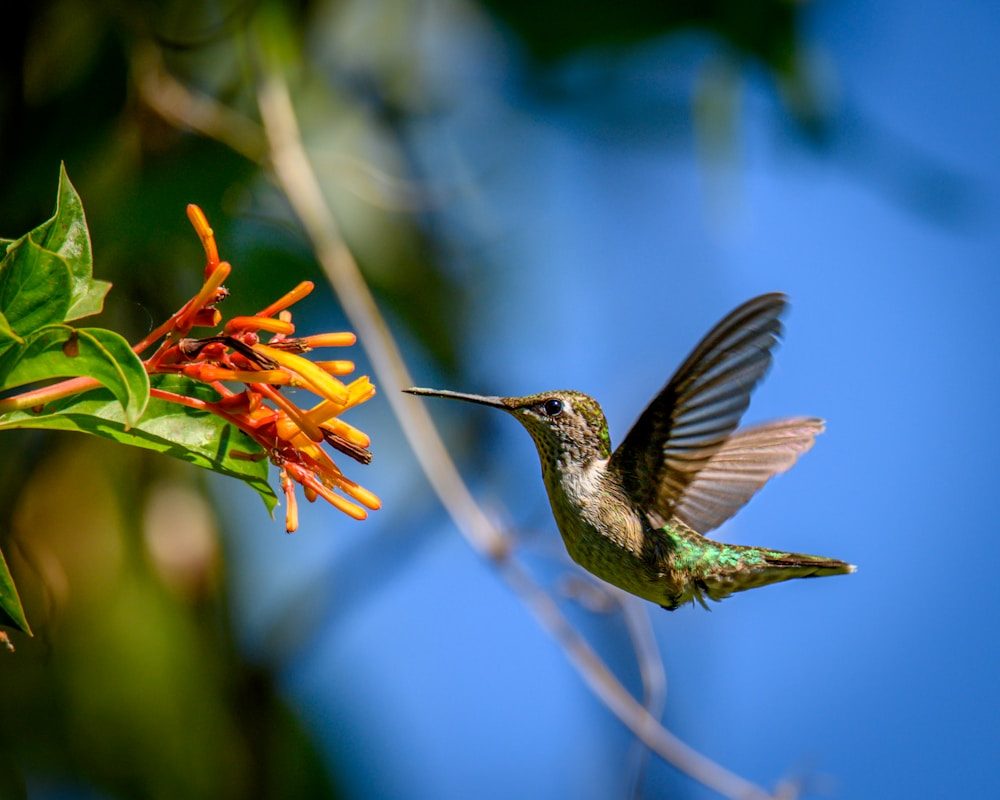
Normal hummingbird flight — moving from feeder to feeder, hovering, feeding — happens at around 20–30 mph. That’s fast for a bird this size, but not dramatically so.
During courtship dive displays, males reach 50–60 mph in the steep U-shaped dives they perform to impress females. That’s the speed people usually quote. It’s real, but it represents a brief, specific behavior, not how hummingbirds fly most of the time.
What makes hummingbird flight genuinely unusual isn’t the top speed — it’s the mechanics.
Wing Beat Rate
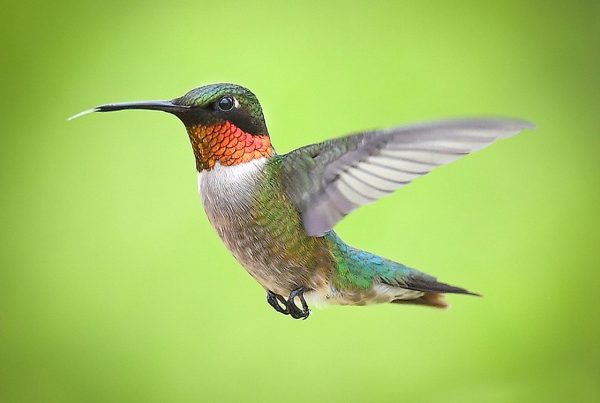
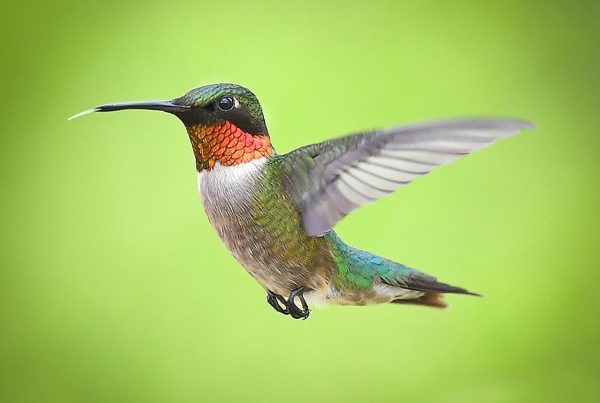
A Ruby-throated Hummingbird beats its wings about 53 times per second during normal flight. During courtship dives, the rate increases — some species reach 80 or more wing beats per second at peak speed.
For comparison, a large bird like a heron beats its wings about 2 times per second. A starling: around 14 per second. A hummingbird at 53 is doing something mechanically different from any other bird in North America.
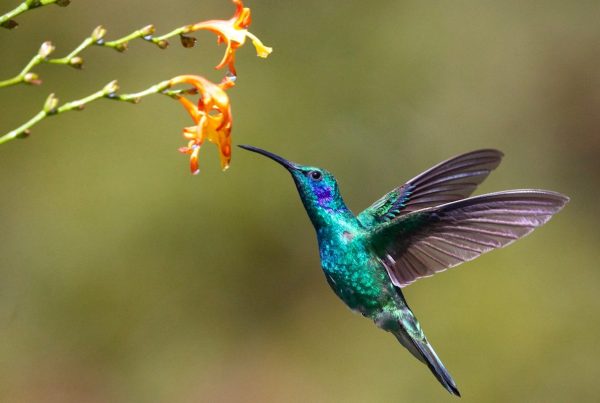
The blur you see when a hummingbird hovers is the wings moving faster than your eye can resolve as individual beats. A single wing beat takes about 19 milliseconds.
The Figure-8 Wing Stroke
Most birds generate lift only on the downstroke. The upstroke is a recovery movement — it produces drag but minimal lift.
Hummingbirds are different. Their wing joint is rotated to allow the wing to produce lift on both the downstroke and the upstroke. The wing traces a figure-8 pattern in the air rather than a simple up-down arc. This means they generate lift continuously — not in pulses — which is what allows hovering in place.
The upstroke contribution to lift is roughly 25–30% in hovering hummingbirds, compared to near-zero in most other birds. That asymmetry is why hovering is possible at all — you need near-continuous lift generation to stay stationary in the air.
Hovering: The Energy Cost
Hovering is the most energetically expensive form of bird flight. A hummingbird hovering at a flower is burning energy at a rate roughly 10 times higher than a similarly-sized mammal running at full speed.
This is why hummingbirds spend significant time perching between feeding bouts. The perching isn’t laziness — it’s metabolic recovery. Flight is costly enough that resting between intensive feeding sessions is necessary, not optional.
It’s also why feeder placement matters. A feeder that requires a hummingbird to hover for a long time to reach the port, or one where the perches are broken or absent, costs the bird more per visit than a well-designed feeder with comfortable perches.
Backward Flight
Hummingbirds are the only birds capable of sustained backward flight. This is a direct consequence of the figure-8 wing stroke — by adjusting the angle of the wing stroke, they can redirect thrust in any direction. Forward, backward, sideways, straight up, straight down.
The practical use of backward flight is primarily at flowers — backing out of a bloom after feeding rather than turning around. It’s efficient. A hummingbird backing away from a flower and moving to the next one without reorienting saves small amounts of time and energy on each visit, which adds up across hundreds of visits per day.
Speed by Flight Type
| Flight type | Approximate speed |
|---|---|
| Normal travel flight | 20–30 mph |
| Feeding / hovering | 0 mph (stationary) |
| Courtship dive (male) | 50–60 mph |
| Escape flight | Up to 40 mph |
| Migration | 20–25 mph sustained |
Wing Size and Body Ratio
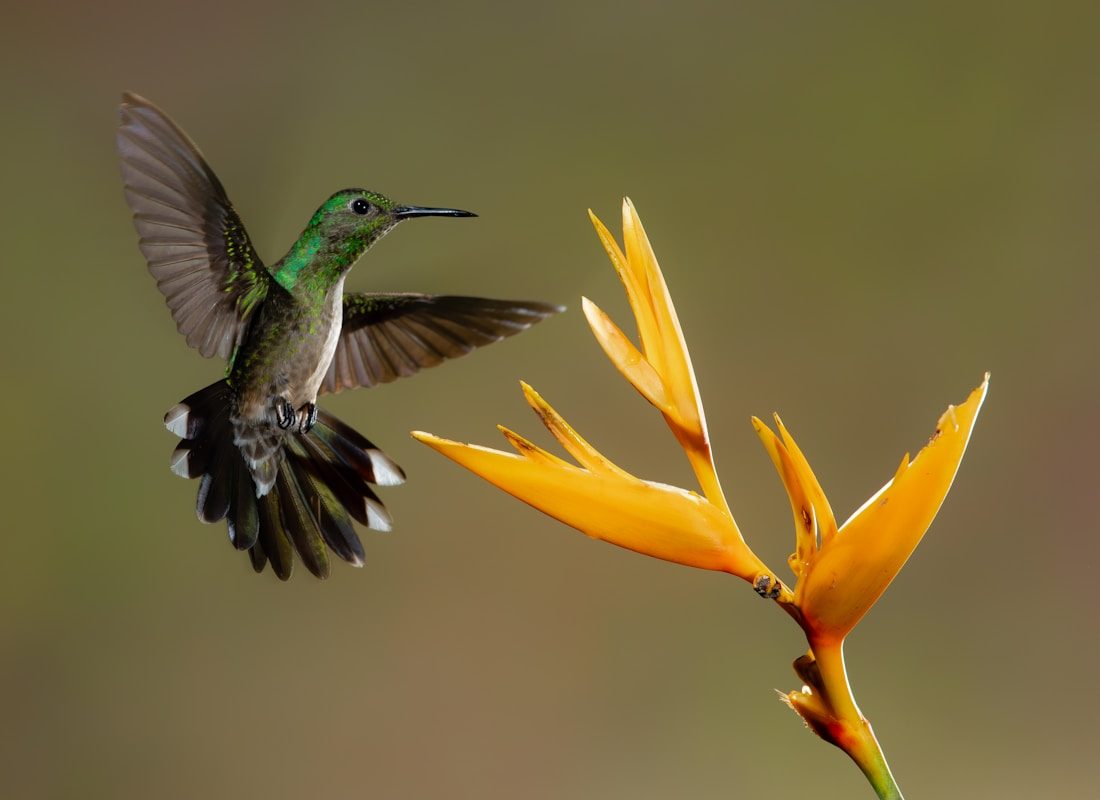
Hummingbird wings are large relative to body size — the wing area-to-body mass ratio is high, which is part of what allows hovering. The wings are also relatively stiff compared to other birds. Most of the movement in a hummingbird wing stroke comes from the shoulder joint, not the wrist or elbow — the opposite of most birds, where the wrist contributes heavily to the wing arc.
This stiff wing design with a highly mobile shoulder joint is what enables the full rotation that produces the figure-8 stroke.
FAQ
How fast can a hummingbird fly?
About 20–30 mph in normal travel flight. Up to 60 mph during courtship dive displays. Migration sustained at roughly 20–25 mph.
How many times per second do hummingbirds flap their wings?
About 53 times per second for Ruby-throated Hummingbirds in normal flight. Up to 80+ per second during high-speed dives.
Can hummingbirds fly backwards?
Yes — the only birds that can. The figure-8 wing stroke allows them to generate thrust in any direction, including backward and sideways.
Why can hummingbirds hover?
Because their wings produce lift on both the upstroke and downstroke, generating near-continuous lift rather than the pulsed lift of other birds. The figure-8 wing stroke makes this possible.
For more on hummingbird flight and biology, see our guides on why hummingbirds can fly backwards, how a hummingbird’s tongue works, what hummingbirds eat, how hummingbird migration works, and 25 surprising hummingbird facts.

MD Imdadul Haque is the founder of BirdzFly, a research-backed resource on North American backyard birds. Drawing on years of independent study into bird identification, behavior, and migration patterns, he writes in-depth guides designed to help US birders understand the species in their own backyards — from common feeder visitors to seasonal migrants passing through.