
Birds with Red Heads
A bird with a red head is hard to ignore. The color jumps out against almost any background. The problem is that “red-headed bird” describes a lot of different species — the red can mean a completely red head, just a cap, a crest, or a small patch at the back. Here are 10 you’re likely to encounter in North America, with the details that actually separate them.
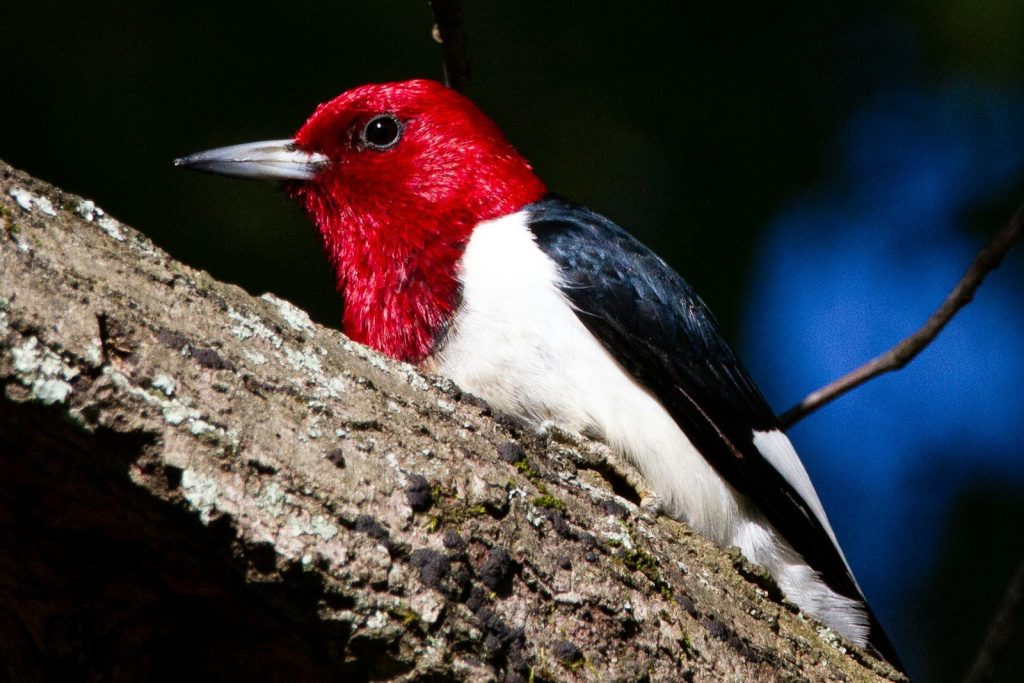
1. Red-Headed Woodpecker
The one with a completely red head — not a cap, not a patch, the whole head. Deep crimson-red from bill to nape. The body is sharply black and white with large white wing patches. Hard to confuse with anything once you’ve seen one, but this species is less common than it used to be, so the sighting feels like something when it happens.
Range: Eastern and central North America, open woodlands and oak savannas.
2. House Finch (Male)
The most common red-headed bird at North American feeders by a wide margin. Red face, forehead, and chest — rest of the bird is brown and streaky. The red varies quite a bit between individuals: some are tomato-red, some are orange, some almost yellow, depending on diet during molt. Very common, very widespread, easy to get familiar with.
Key ID: Small, finch bill, streaky brown body.
3. Purple Finch (Male)
Similar to House Finch but the red is deeper and richer — raspberry rather than tomato. The color extends more broadly onto the back and is less isolated on the face. Often described as looking like a bird dipped in raspberry juice, which is actually a pretty useful description. Less common at feeders than House Finch.
Key ID: Richer color, less obvious streaking on sides.
4. Downy Woodpecker (Male)
Tiny. The smallest woodpecker in North America. Males have a small red patch on the nape — just the back of the head, not the whole head. Black and white body with a white back stripe. Very common at suet feeders. The red patch is modest but visible at close range.
Range: All of North America in forested areas, year-round.
5. Hairy Woodpecker (Male)
Looks like an enlarged Downy, same red nape patch on males. The reliable separator is bill length: Downy’s bill is stubby, roughly half the head length; Hairy’s bill is long, roughly equal to the head length. Also no dark spots on the outer white tail feathers, unlike the Downy. Less common at feeders than Downy.
Birds with Red Heads
6. Red-Bellied Woodpecker
Despite the name, the red is on the head, not the belly. Males have a full red cap from bill to nape; females have red only on the nape. The belly has just a faint pinkish wash that’s rarely obvious in the field. Body is black-and-white barred on the back. Common at eastern feeders.
Key ID: Red cap, barred back, medium-large woodpecker.
7. Pileated Woodpecker
Crow-sized, unmistakable. The male has a full red crest, red mustache stripe, and red forehead. The female has a red crest but a black forehead and no red mustache. Body is mostly black with white facial stripes. The excavations they leave in dead trees — rectangular holes — are distinctive even when the bird isn’t present. Increasingly seen in suburban areas with large trees.
8. Common Redpoll (Male)
Small northern finch. The red is a bright forehead cap only — just the front of the head. Pink-red wash on the chest on breeding males. Brown and streaky overall. Winter visitor to the northern US, often in flocks at nyjer feeders. Appears in irruption years when birch seed crops fail farther north.
9. Ruby-Crowned Kinglet (Male)
Very small. The red crown is concealed most of the time — it’s only visible when the bird flares it during excitement or display. Olive-green body, two white wing bars, constant wing-flicking. Easy to overlook because of size and hyperactive movement. Spring and fall migrant through most of the US.
10. Anna’s Hummingbird (Male)
The only hummingbird in North America with a completely red head — iridescent rose-red to magenta covering the entire head and throat. In poor light it looks dark or almost black. Year-round resident on the Pacific Coast; doesn’t migrate. If you’re in California, Oregon, or Washington and you see a small bird with a fully red head, this is almost certainly it.
Quick ID Table
| Bird | Red Coverage | Body Pattern | Size |
|---|---|---|---|
| Red-headed Woodpecker | Entire head | Black/white | Robin-sized |
| House Finch | Face and chest | Brown streaky | Sparrow |
| Purple Finch | Head, back, chest | Brown, less streaky | Sparrow |
| Downy Woodpecker | Nape patch only | Black/white | Small |
| Red-bellied Woodpecker | Full cap (male) | Barred black/white | Medium |
| Pileated Woodpecker | Full crest | Black/white | Crow-sized |
| Common Redpoll | Forehead cap only | Brown streaky | Tiny |
| Anna’s Hummingbird | Entire head (iridescent) | Green | Tiny |
FAQ
What small bird has a red head?
House Finch males are the most common at feeders. Common Redpolls (winter, northern US) and Ruby-crowned Kinglets (migrants) are smaller with partial red. Anna’s Hummingbird has a full red head but only on the Pacific Coast.
What large bird has a red head?
Pileated Woodpecker — crow-sized, dramatic red crest. Red-headed Woodpecker is robin-sized with a completely red head.
Which woodpeckers have red heads?
Red-headed Woodpecker (entire head), Red-bellied Woodpecker (red cap), Pileated Woodpecker (red crest), Downy and Hairy Woodpeckers (red nape patch on males only).
For more ID guides, see our posts on 15 spring birds to watch for and what that black cardinal-like bird actually is.

MD Imdadul Haque is the founder of BirdzFly, a research-backed resource on North American backyard birds. Drawing on years of independent study into bird identification, behavior, and migration patterns, he writes in-depth guides designed to help US birders understand the species in their own backyards — from common feeder visitors to seasonal migrants passing through.