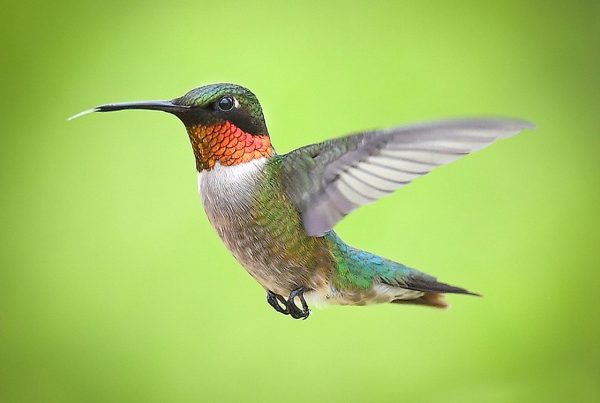


Hummingbird with Red Neck
Overview
The male Ruby-throated Hummingbird is often called the “hummingbird with a red neck.” This bird is the most widespread species in eastern North America. It gets its name from the iridescent gorget on the male’s throat. The female does not have this bright patch but has green backs and white or streaked throats.
Key Characteristics
Male Ruby-throated Hummingbird
-
Red throat (gorget): A bright patch of ruby red feathers.
-
The red can look bronze or even dull black from some angles.
-
-
Green back: The back and crown shimmer in emerald green.
-
Underparts: White or gray-white on the chest and below.
Female Ruby-throated Hummingbird
-
Throat without red: Whitish throat, lightly streaked with red.
-
Back and head: Emerald green backs and heads.
-
White underparts: White underparts.
The Charisma of Hummingbirds
Roger Tory Peterson once said, “Hummingbirds scarcely even need a description.” However, we love to describe them! The hummingbird family has 363 species exclusive to the American continent. The Ruby-throated Hummingbird enchants us with its beauty. This bird enjoys visiting backyard feeders and woodland wildflowers.

Ruby-throated Hummingbird
Fun Facts About Ruby-throated Hummingbirds
Here are 10 cool facts to help you get to know this tiny but tough bird:
-
A Ruby-throated Hummingbird flaps its wings at about 50 beats per second. Their unique wing movement allows them to hover for long periods.
-
They weigh no more than a penny. Males average 3 grams and females slightly more at around 3.5 grams.
-
For their size, they are endurance champions. Some make a nonstop, 500-mile crossing of the Gulf of Mexico from southeastern Canada to Costa Rica.
-
Hummingbirds run on flower power. Jewelweed, a native plant with orange blossoms, is essential for ruby-throats.
-
When they arrive at their breeding ground in spring, they feed on sap from Yellow-bellied Sapsucker wells.
-
No vertebrate has a faster metabolism by weight than the hummingbird. A Ruby-throat’s heart flutters at 20 times per second.
-
Ruby-throats conserve energy by going into a state called torpor during cold stretches or migration layovers.
-
Female Ruby-throated Hummingbirds are excellent nest makers. They build small cups from plant material and spiderwebs, hiding them in lichen.
-
Male Ruby-throated Hummingbirds are territorial during breeding season. They scare away larger birds and other males.
-
Males perform an elaborate courtship display to attract females with their colorful gorget and aerial maneuvers.
Conclusion
Ruby-throated Hummingbirds are not only beautiful; they are an intriguing species. Bird enthusiasts marvel at their unique characteristics and behaviors. If you want to follow their migration, visit Audubon’s Bird Migration Explorer.

MD Imdadul Haque is the founder of BirdzFly, a research-backed resource on North American backyard birds. Drawing on years of independent study into bird identification, behavior, and migration patterns, he writes in-depth guides designed to help US birders understand the species in their own backyards — from common feeder visitors to seasonal migrants passing through.