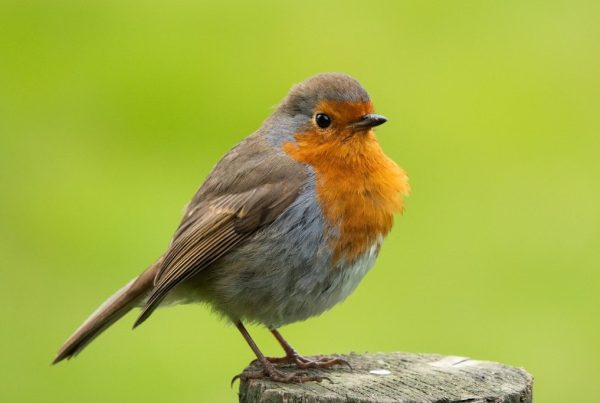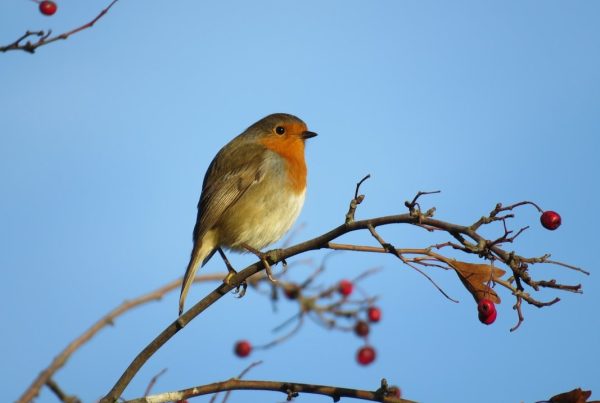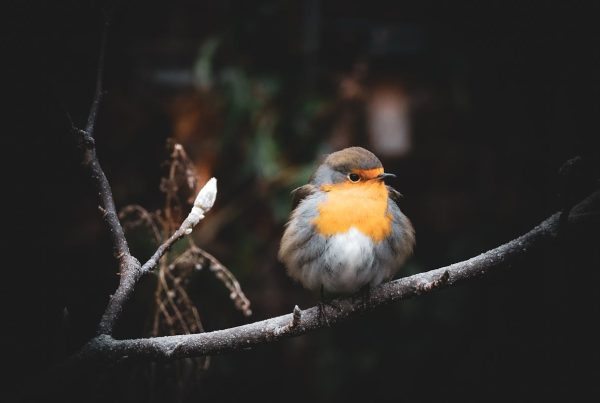

If you’ve ever been woken before sunrise by a bird that won’t stop singing, it was almost certainly an American Robin. Robins are famous for starting the dawn chorus earlier than any other songbird — often 40 minutes before sunrise, while it’s still too dark to see clearly outside.
What Does a Robin Sound Like?
The robin’s song is a rolling series of short, clear phrases delivered continuously with brief pauses. It has a flute-like, rich quality. The classic mnemonic birders use: cheerily, cheer up, cheer up, cheerily, cheer up — repeated in slightly varied patterns for 20–30 minutes at a stretch.
Beyond the main song, robins make several distinct sounds:
- Alarm call — A sharp, rising “tseep,” usually given when a predator like a hawk or cat is spotted nearby.
- Chuckle call — A rapid, lower “tut-tut-tut-tut,” used for milder disturbances.
- Flight call — A thin, high “see” note, often heard overhead at night during migration.
- Nestling begging call — A loud, insistent cheep from chicks demanding food, surprisingly loud for how small they are.
Why Robins Sing Before Sunrise
Naturalist Aldo Leopold documented in the 1930s that robins begin singing at light levels roughly ten times dimmer than the threshold for most other songbirds — around the brightness of a crescent moon reflected on snow. In practical terms, robins start singing in what most people would call total darkness.
The most likely explanation: singing that early comes at almost no competitive cost. At 4 AM, there’s no other birdsong to compete against and no foraging to do (it’s too dark to spot earthworms), so a robin can advertise his territory and quality to nearby females without interference. Urban and suburban robins, exposed to streetlights and other artificial light, often start even earlier than rural robins — sometimes singing through the night entirely.
Song vs. Call: The Real Difference
People often use “song” and “call” interchangeably, but they serve different purposes. Songs are typically longer, more complex, and performed mostly by adult males to attract a mate and defend territory — which is why singing is concentrated in spring and early summer and drops off sharply once breeding season ends. Calls are shorter and more functional: alarm calls warn of danger, contact calls keep a pair or flock in touch, and begging calls let nestlings signal hunger to their parents.
How Robins Learn to Sing
Robin song isn’t fully innate — young robins learn their song by listening to adults of their own species early in life. A robin that never hears other robins singing during this critical learning period won’t develop a normal song. This is why some species, including robins, develop regional dialects: small variations in song structure that spread locally, similar to how human accents form.
This learned-song pattern is common among songbirds generally but isn’t universal. Flycatchers, for example — including the Eastern Phoebe and Great Crested Flycatcher — develop their vocalizations instinctively rather than by learning, which matters because many flycatcher species look nearly identical and rely on voice to tell each other apart.
Do Female Robins Sing?
For decades, ornithologists assumed only male birds sang meaningfully. That assumption has been substantially revised — female song has now been documented in hundreds of species worldwide, particularly in tropical regions where many female birds sing regularly and pairs sometimes sing back and forth in coordinated duets. In temperate species like the American Robin, females sing far less often than males, but the old idea that female birdsong is rare or unimportant doesn’t hold up to current research.
When Robins Sing: The Seasonal Pattern
| Period | Singing Behavior |
|---|---|
| Late February–March | Males return to breeding territory, begin intense early singing |
| April–May | Peak song — height of breeding season and territorial competition |
| June–July | Singing continues but tapers as nesting stabilizes |
| August | Song mostly stops as adults begin molting |
| September–January | Largely silent |
This is part of why people think robins disappear in winter — they’re often still present, just no longer singing or visible on open lawns.
Where to Hear Robin Song
The Cornell Lab of Ornithology’s All About Birds website (allaboutbirds.org) has free recordings of every robin call type. The Merlin Bird ID app, also from Cornell Lab, can identify the species from a recording made on your own phone — useful for confirming what you’re hearing in your own yard.
FAQ: Robin Sounds
What does a robin sound like?
A rolling series of clear, flute-like phrases — often rendered as “cheerily, cheer up, cheer up.” One of the most recognizable songs in North American backyards.
Why do robins start singing before sunrise?
Robins have an unusually low light threshold for triggering song — roughly ten times dimmer than most other songbirds — letting them start advertising territory before any competing birdsong begins.
Do female robins sing?
Less often than males, but yes. Female song has been documented across hundreds of bird species worldwide, overturning the older assumption that only males sing meaningfully.
When do robins stop singing?
Song intensity drops sharply in August as breeding ends, and robins are largely silent from late summer through January, resuming in late February.
For more on robins, see our guides on American Robin identification, robin eggs and nests, and robin symbolism.

MD Imdadul Haque is the founder of BirdzFly, a research-backed resource on North American backyard birds. Drawing on years of independent study into bird identification, behavior, and migration patterns, he writes in-depth guides designed to help US birders understand the species in their own backyards — from common feeder visitors to seasonal migrants passing through.