
The European Robin is not the same bird as the American Robin. They share a name, share a red breast, and share a long association with Christmas — but they are unrelated species from different families that happened to converge on similar appearances. The American Robin is a thrush. The European Robin is in the flycatcher family.
The European Robin is one of the most familiar birds in Britain and much of Europe. It appears on Christmas cards, is the unofficial national bird of Britain, and has been studied extensively because of its accessibility — European robins will often follow gardeners to catch worms turned up by digging, sometimes coming within a few feet of a person’s hands.
What Does the European Robin Look Like?
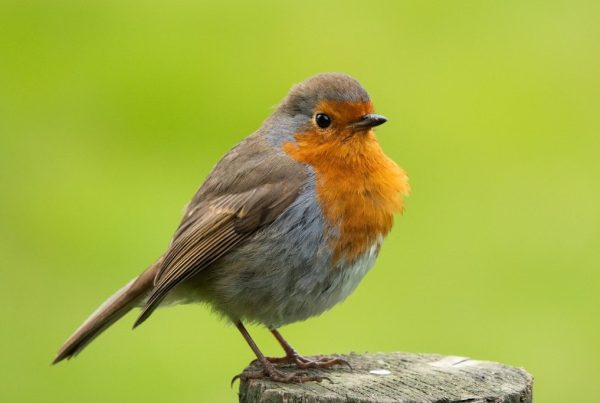
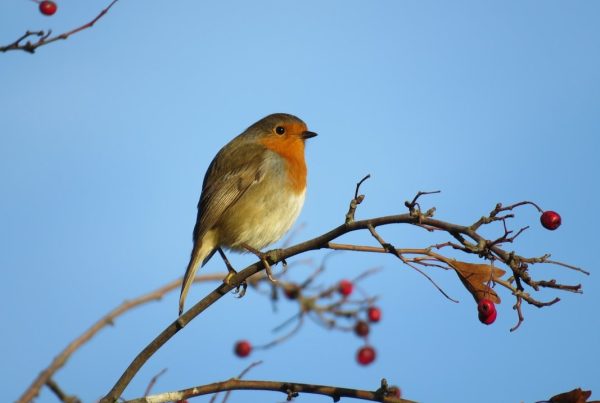
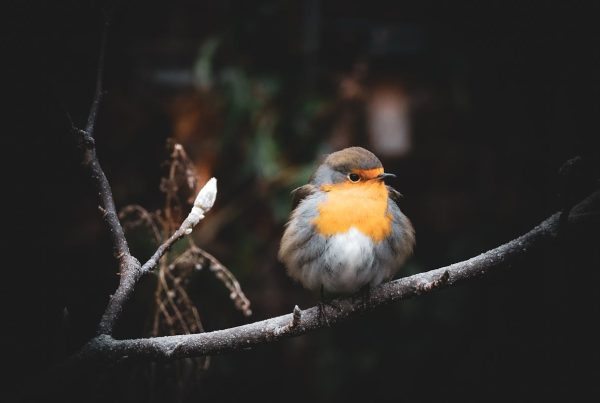
Small and round. Orange-red face and breast — not just the chest, the face too, which is one clear difference from the American Robin whose orange stops at the upper breast. Brown back, white belly, thin dark bill.
Size: about 5 inches long. Noticeably smaller than the American Robin (10 inches). Similar in size to a House Sparrow but rounder and with a more upright posture.
Both males and females have the same plumage — no sexual dimorphism in color. Juveniles are spotted brown without the red, developing adult plumage by late summer of their first year.
Key Facts
| Feature | Detail |
|---|---|
| Scientific name | Erithacus rubecula |
| Family | Muscicapidae (Old World flycatchers) |
| Length | 5–5.5 inches (12.5–14 cm) |
| Weight | 0.56–0.78 oz (16–22g) |
| Wingspan | 8–9 inches (20–22 cm) |
| Eggs per clutch | 4–6, white with red-brown freckles |
| Incubation | 13–14 days |
| Broods per year | 2–3 |
| Lifespan | Average 1.1 years; up to 8 years on record |
| Population | 130–201 million individuals |
| Conservation status | Least concern |
Range and Habitat
The European Robin lives across most of Europe and into western Asia and North Africa. In Britain and Ireland it is one of the most abundant and familiar birds — present in gardens, woodlands, parks, hedgerows, and farmland throughout the country year-round.
In continental Europe, robins are more migratory and wary of humans. British and Irish robins are notably tamer — a product of centuries of association with humans in a country where garden birds have been fed and protected. The same species in southern Spain or Turkey behaves much more like a shy woodland bird.
Habitat preference: shady, wooded areas with dense undergrowth and accessible bare ground for foraging. They need low vegetation for nest sites and open patches of soil for finding invertebrates. Gardens suit them well.
How the European Robin Behaves
Robins are highly territorial and aggressive for their size. Both males and females hold winter territories independently — females as well as males sing to defend winter feeding grounds, which is unusual among songbirds. In spring, males and females form pairs, but territorial aggression continues.
The robin’s response to a perceived rival is famous. They will attack a tuft of red feathers placed in their territory as readily as a real bird — the red breast is the trigger. Experiments demonstrated this in the 1940s and it has been replicated many times since.
Foraging behavior: perch-and-drop feeding. The robin sits on a low branch or garden stake, watches for invertebrate movement on the ground below, drops down to take it, and returns to the perch. They also follow large animals — badgers, deer, cattle, and humans digging in gardens — to catch invertebrates disturbed by the movement.
European Robin Song
One of the most complex and melodious of any European bird. The song is a flowing series of varied phrases, soft and wistful in quality — often described as melancholy. It is sung year-round, including through winter when most songbirds are silent. Males and females both sing in autumn to defend winter territories.
The winter song is one reason the European Robin became associated with Christmas in Britain — the bird singing in a silent, leafless garden in December is a memorable image, and the robin appeared on Victorian Christmas cards partly because of this association.
European Robin vs American Robin
| Feature | European Robin | American Robin |
|---|---|---|
| Scientific family | Muscicapidae (flycatchers) | Turdidae (thrushes) |
| Size | Sparrow-sized (5 inches) | Large songbird (10 inches) |
| Red/orange coverage | Entire face and breast | Chest and belly only |
| Back color | Warm brown | Dark gray-brown |
| Eggs | White with red-brown freckles | Turquoise blue, unmarked |
| Territory defense | Both sexes, year-round | Males in breeding season |
| Range | Europe and western Asia | North America |
The American Robin was named by European settlers who saw a bird with a red breast and used their familiar name for it — even though the two species are not closely related. The European Robin is the “original” robin of English language and culture.
The European Robin and Christmas
The association between robins and Christmas in Britain comes from several converging factors. Victorian postmen wore red uniforms and were nicknamed “robins” — so robins appeared on Christmas cards representing the postmen delivering letters. The bird’s willingness to sing through winter and its visibility in cold, bare gardens reinforced the association. By the late 19th century, the robin on a Christmas card was fully established as a British cultural image.
FAQ: European Robin
Is the European Robin the same as the American Robin?
No. They are unrelated species in different families. They share a name and a red breast but diverged from different evolutionary lineages. The American Robin is a thrush; the European Robin is an Old World flycatcher.
Where does the European Robin live?
Europe and western Asia, primarily. Most abundant and familiar in Britain and Ireland, where it is tame enough to follow gardeners. More migratory and wary in continental Europe.
Why is the robin on Christmas cards?
Victorian postmen were nicknamed “robins” for their red uniforms. Robins appeared on Christmas cards representing postmen. The bird’s year-round presence and winter singing in British gardens reinforced the association.
Do male and female European Robins look the same?
Yes. Both have the orange-red face and breast. Both also sing and hold territories — unusual among songbirds where typically only males sing.
For the American counterpart, see our complete guide on the American Robin. For robin symbolism across cultures, see our robin spiritual meaning guide. For robin eggs and nesting, see our robin eggs and nests guide.

MD Imdadul Haque is the founder of BirdzFly, a research-backed resource on North American backyard birds. Drawing on years of independent study into bird identification, behavior, and migration patterns, he writes in-depth guides designed to help US birders understand the species in their own backyards — from common feeder visitors to seasonal migrants passing through.